Customized CNC Machines in India for Lower Manufacturing Costs
- Home
- Why Indian Manufacturers Need Customized CNC Machines to Reduce Production Costs and Increase Global Competitiveness
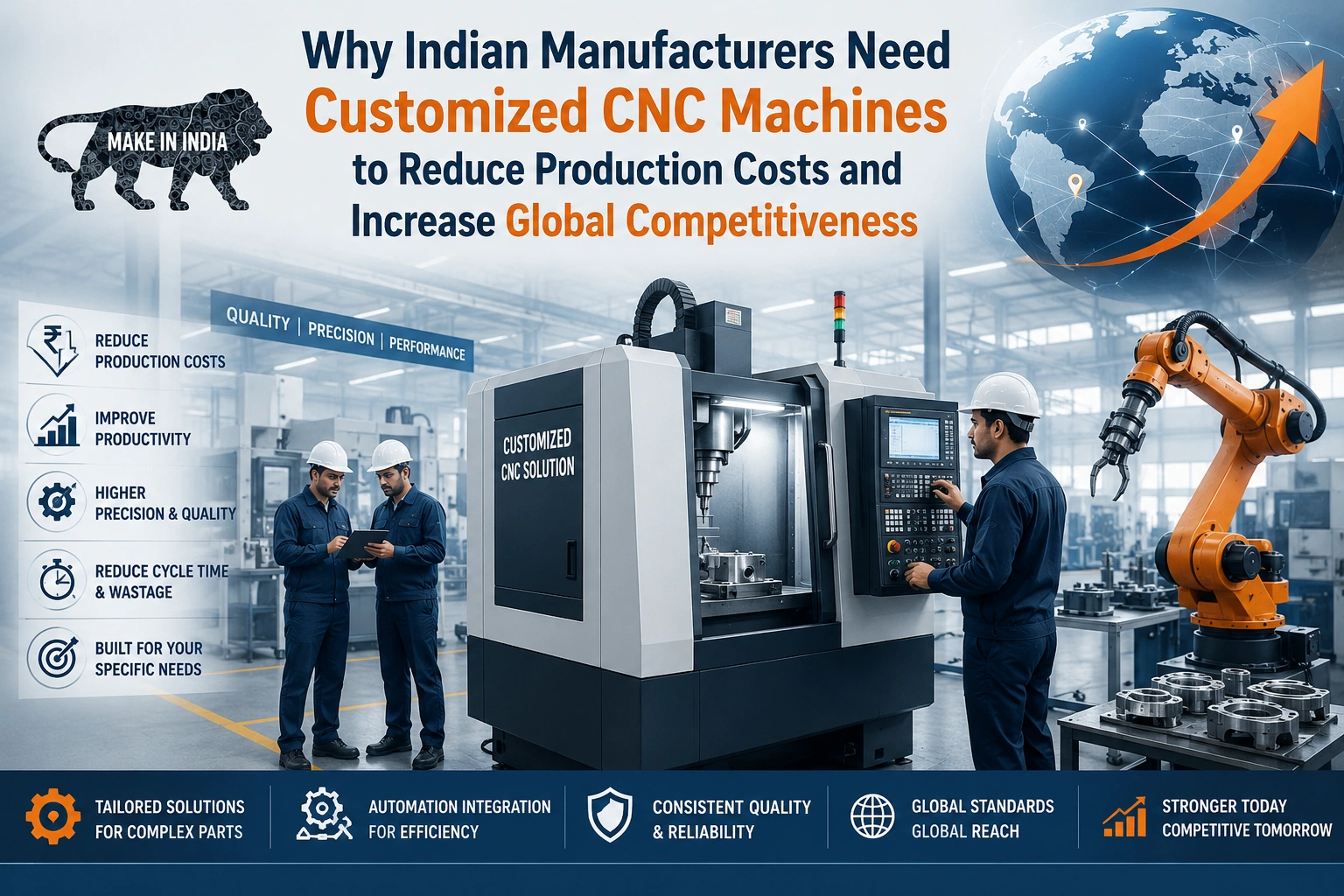
Why Indian Manufacturers Need Customized CNC Machines to Reduce Production Costs and Increase Global Competitiveness
Manufacturing in India is undergoing one of its most significant transformations in decades. As global supply chains evolve and customers demand higher precision, shorter lead times, and lower production costs, manufacturers can no longer rely solely on conventional production methods. Whether producing automotive components, aerospace parts, medical implants, industrial valves, bearings, hydraulic fittings, or heavy engineering products, companies face relentless pressure to deliver superior quality at competitive prices.
The challenge is no longer just about producing more parts—it is about producing the right parts faster, with fewer resources, lower operating costs, and near-zero defects. This is where Customized CNC Machines are becoming a strategic investment rather than merely a capital expense.
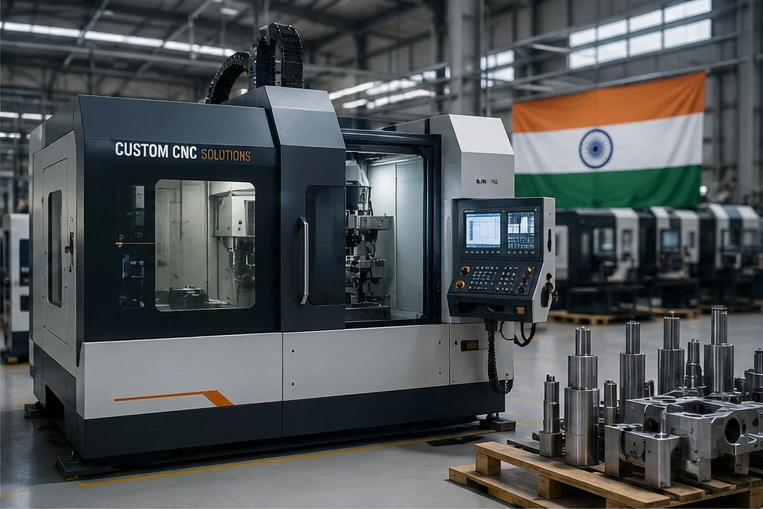
Unlike standard CNC machines designed for general-purpose machining, customized CNC manufacturing machines are engineered around a specific product, process, production volume, and quality requirement. They combine optimized machine architecture, dedicated tooling, intelligent automation, and advanced control systems to maximize productivity while minimizing manufacturing costs.
For Indian manufacturers aiming to compete with global OEMs, investing in a Customized CNC Machine Manufacturer India is increasingly becoming a competitive necessity.
The New Manufacturing Reality in India
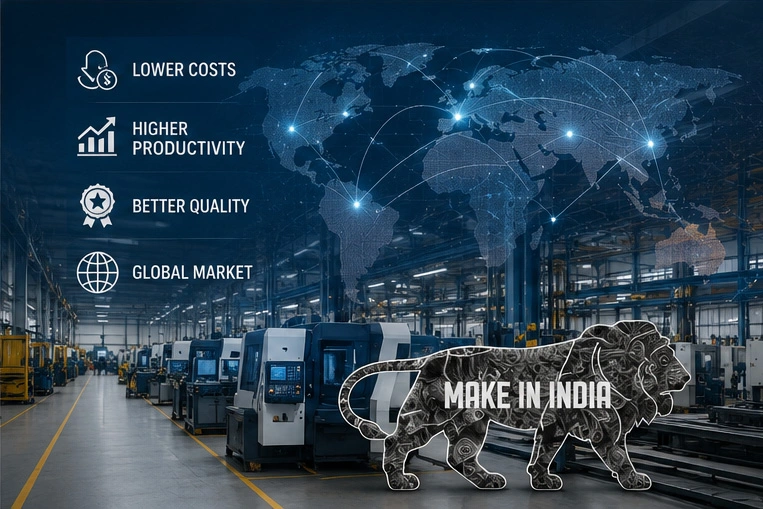
India has emerged as one of the world’s fastest-growing manufacturing destinations. Government initiatives such as Make in India, Production Linked Incentive (PLI) schemes, and increasing investments in sectors like electric vehicles, aerospace, defence, electronics, and precision engineering have created significant opportunities for domestic manufacturers.
However, these opportunities also bring new challenges:
- Rising labour costs and increasing skill shortages.
- Higher expectations for dimensional accuracy and repeatability.
- Increasing raw material prices.
- Pressure to reduce cycle time without compromising quality.
- Growing demand for traceability and Industry 4.0 readiness.
- Intense competition from manufacturers in China, Vietnam, South Korea, Germany, and Japan.
In this environment, every second of machining time matters. Every unnecessary setup, manual handling step, or inspection delay directly impacts profitability.
Traditional production methods that were acceptable ten years ago often struggle to meet today’s expectations for efficiency, consistency, and scalability.
Forward-looking manufacturers are therefore shifting their focus from simply buying CNC machines to investing in complete manufacturing solutions that optimize the entire production process.
Why Production Cost Has Become the Biggest Competitive Advantage
Most factory owners assume that lowering production costs simply means purchasing cheaper machines or negotiating lower raw material prices. In reality, the largest portion of manufacturing cost often comes from inefficiencies hidden within the production process itself.
These include:
- Excessive machining time.
- Multiple machine setups.
- Frequent tool changes.
- Manual loading and unloading.
- High rejection rates.
- Machine idle time.
- Long inspection cycles.
- Work-in-progress inventory.
- Unplanned maintenance.
- Inconsistent process capability.
Even a seemingly small reduction of 10–15 seconds in cycle time can translate into thousands of additional parts produced each month. Over the life of a production line, these savings often outweigh the initial investment in a customized machine.
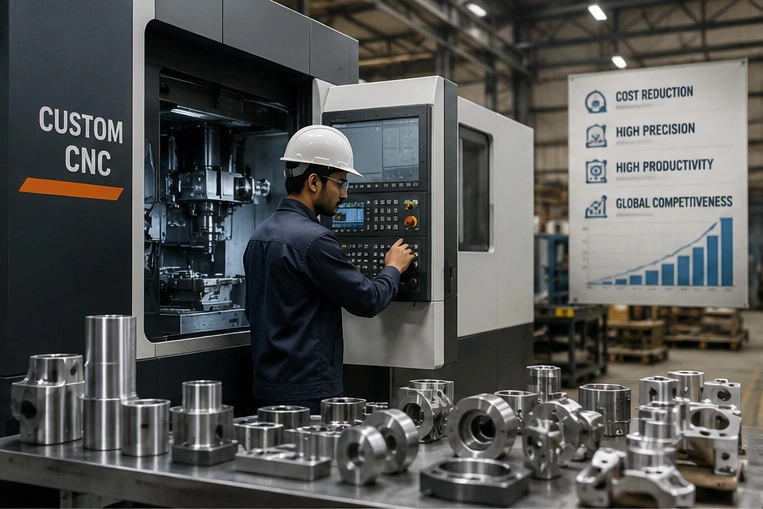
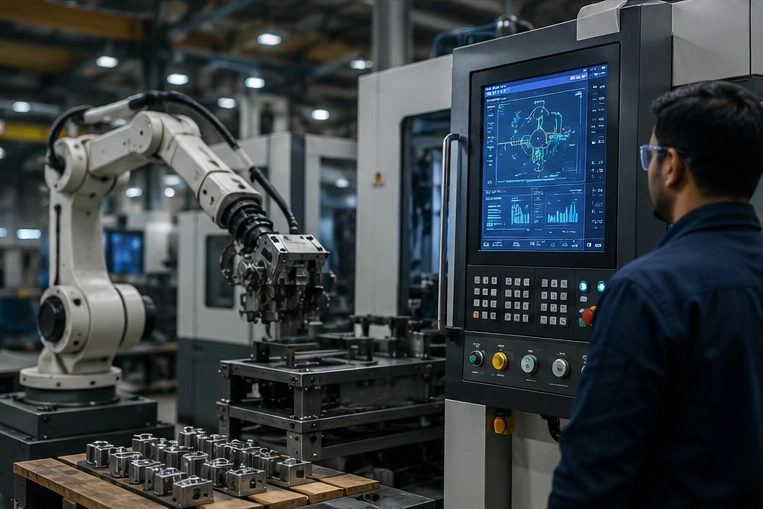
A well-designed Customized CNC Manufacturing Machine addresses these inefficiencies by integrating machining operations, automation, precision tooling, and process optimization into a single, purpose-built system.
Instead of treating machining, loading, inspection, and material handling as separate activities, customized CNC systems combine them into one streamlined workflow.
The result is lower cost per component, improved throughput, and a faster return on investment.
Why Standard CNC Machines Are No Longer Enough
Standard CNC machining centres and CNC lathes are designed to perform a wide variety of machining operations across different component types. Their versatility makes them suitable for job shops, prototype development, and low-volume production.
However, versatility often comes at the expense of efficiency in high-volume manufacturing.
A standard machine typically requires:
- Multiple fixtures for different operations.
- Several setups for a single component.
- Frequent operator intervention.
- Additional inspection stations.
- Separate loading and unloading processes.
- Manual transfer between machines.
- Longer cycle times due to generalized machine architecture.
For manufacturers producing thousands—or even millions—of identical parts each year, these inefficiencies accumulate rapidly.
Consider an automotive supplier manufacturing steering components. If each part requires three different machines, four setups, manual inspection, and multiple operators, the cumulative production cost becomes substantial. Beyond direct machining expenses, manufacturers also incur costs from handling, quality checks, work-in-progress inventory, floor space, and maintenance.
Standard CNC machines are excellent at flexibility, but they are not always optimized for maximum productivity.
This is precisely where Special Purpose CNC Machines and customized CNC systems provide a measurable advantage.
What Is a Customized CNC Manufacturing Machine?
A Customized CNC Manufacturing Machine is a purpose-built production system engineered specifically for a defined manufacturing process, component family, or production requirement.
Rather than adapting the manufacturing process to fit a generic machine, the machine itself is designed around the process.
Every major subsystem is optimized to achieve specific production goals, including:
- Required cycle time.
- Component geometry.
- Material characteristics.
- Cutting strategy.
- Tool accessibility.
- Automation requirements.
- Inspection methodology.
- Production volume.
- Future scalability.
A customized CNC machine may incorporate:
- Dedicated spindle configurations.
- Multi-spindle machining arrangements.
- Servo-controlled linear and rotary axes.
- PLC-controlled automation.
- Robotic loading and unloading systems.
- Automatic tool changing.
- Hydraulic or pneumatic clamping.
- Vision-based inspection.
- Laser measurement systems.
- Integrated chip management.
- Automatic washing and drying stations.
- Smart production monitoring.
- IoT-enabled diagnostics and predictive maintenance.
Rather than functioning as an isolated machine tool, it becomes an integrated manufacturing cell capable of delivering consistent quality with minimal operator intervention.
For example, a CNC Machine for Automotive Industry producing transmission components can be engineered to perform turning, drilling, tapping, chamfering, deburring, washing, laser inspection, and robotic unloading within a single automated production line. This eliminates multiple setups, reduces handling time, and significantly improves Overall Equipment Effectiveness (OEE).
Similarly, manufacturers in aerospace, medical devices, bearing production, valve manufacturing, and heavy engineering can benefit from machines designed specifically for their unique component geometries and quality requirements.
By aligning machine architecture with the manufacturing process, companies can achieve higher precision, shorter cycle times, improved consistency, and substantially lower production costs.
Top Reasons Customized CNC Machines Reduce Production Costs
Reducing production cost is not achieved by a single improvement. Instead, it is the combined effect of numerous engineering optimizations that work together throughout the manufacturing process.
1. Reduced Cycle Time Through Process Optimization
Cycle time is one of the most influential factors in manufacturing economics. Every second saved during machining increases the total number of parts produced without increasing labor or floor space.
A customized CNC machine is designed around the machining sequence itself. Instead of performing operations in separate machines, multiple operations can be combined into a single production cycle.
Examples include:
- Face turning and OD turning performed in one setup.
- Simultaneous drilling and tapping.
- Dual-spindle machining.
- Multi-tool machining.
- Parallel operations using synchronized axes.
A reduction of even 12–15 seconds per component can result in thousands of additional parts produced each month, improving machine utilization and lowering the cost per component.
2. Elimination of Multiple Machine Setups
Every time a component is unclamped and moved to another machine, manufacturers lose valuable production time.
Multiple setups also introduce:
- Positioning errors
- Dimensional variation
- Additional inspections
- Increased handling
- Risk of part damage
Customized CNC machines are designed to complete as many machining operations as possible in a single setup.
Benefits include:
- Better geometric accuracy
- Reduced datum errors
- Lower inspection requirements
- Faster production
- Improved repeatability
For precision industries such as aerospace, medical devices, and automotive, minimizing setups is one of the most effective ways to improve quality while reducing manufacturing costs.
3. Dedicated Tooling Improves Machining Efficiency
Standard tool holders are designed to accommodate a broad range of jobs. While flexible, they often require longer tool changes and may not provide the highest machining efficiency.
Customized CNC systems use dedicated tooling packages specifically selected for the target component.
These may include:
- Box tool arrangements
- Multi-tool holders
- Gang tooling
- Combination drilling tools
- Form tools
- Special boring bars
- Custom inserts
Dedicated tooling reduces idle movements, shortens machining cycles, and increases tool life.
It also improves process stability by maintaining consistent cutting conditions throughout production.
4. Intelligent Fixture Design Reduces Production Time
Fixtures are often underestimated despite their significant impact on machining productivity.
Poor fixture design results in:
- Long loading times
- Misalignment
- Frequent adjustments
- Higher rejection rates
- Operator fatigue
A customized fixture is engineered to:
- Locate the component precisely
- Minimize clamping time
- Improve rigidity
- Reduce vibration
- Allow automatic loading
- Maintain repeatability over long production runs
Hydraulic and pneumatic clamping systems further reduce loading time while ensuring consistent clamping force across every component.
5. Automation Eliminates Non-Value-Adding Activities
In many factories, machining occupies only a portion of the total production cycle. The remaining time is consumed by manual activities such as loading, unloading, inspection, and transportation.
These tasks do not add value to the product but increase production cost.
Customized CNC automation integrates these processes into one seamless workflow using:
- Gantry loading systems
- Industrial robots
- Servo transfer units
- Automatic conveyors
- Vision-guided pick-and-place systems
- Automatic part orientation
As a result:
- Operators supervise multiple machines instead of one.
- Human error is reduced.
- Production continues consistently across shifts.
- Workplace safety improves.
- Throughput increases.
Industry 4.0, ROI Analysis, and Future Trends in Customized CNC Manufacturing
Customized CNC Machines Are the Foundation of Smart Manufacturing
Modern manufacturing is no longer defined only by machining accuracy or spindle speed. Today’s successful factories are built around data-driven decision-making, predictive maintenance, real-time production monitoring, and intelligent automation. This shift, commonly referred to as Industry 4.0 Manufacturing, is transforming the way production facilities operate.
A customized CNC machine is no longer just a machine tool—it is a connected manufacturing asset capable of communicating with operators, supervisors, quality systems, and enterprise software. Every machining cycle generates valuable production data that can be analyzed to improve efficiency, reduce downtime, and optimize machine utilization.
Unlike conventional CNC machines that often require aftermarket modifications to become digitally connected, a purpose-built customized CNC system can be designed with Industry 4.0 capabilities from the beginning. This ensures that digital technologies work seamlessly with the mechanical design rather than being added as an afterthought.
For manufacturers investing in long-term competitiveness, integrating smart technologies into a customized CNC machine creates measurable operational advantages.
Artificial Intelligence is Transforming CNC Manufacturing
Artificial Intelligence (AI) is rapidly becoming a practical tool in advanced manufacturing—not by replacing skilled engineers, but by enhancing decision-making and process optimization.
In customized CNC systems, AI can support:
Intelligent Tool Life Prediction
Rather than replacing tools at fixed intervals, AI algorithms analyze cutting conditions, spindle load, vibration, and machining history to predict the optimal replacement time.
Benefits include:
- Reduced tooling costs
- Fewer unexpected tool failures
- Improved machining consistency
Why Hardai ARMND Engineering Solutions is Your Trusted Partner for Customized CNC Manufacturing Solutions
Selecting the right automation partner is just as important as selecting the right machine. A customized CNC machine represents a long-term investment that should continue delivering productivity, reliability, and profitability for years. Achieving that outcome requires more than machine assembly—it demands deep expertise in manufacturing processes, mechanical design, automation, control systems, and production optimization.
At Hardai ARMND Engineering Solutions, every project begins with understanding the customer’s manufacturing objectives rather than recommending a standard machine. Instead of asking, “Which CNC machine do you want?”, the engineering team asks, “What production challenge are you trying to solve?”
This engineering-first approach enables the development of manufacturing solutions that are optimized for:
- Lowest possible production cost per component
- Highest Overall Equipment Effectiveness (OEE)
- Reduced cycle time
- Improved process capability
- Lower manpower dependency
- Consistent product quality
- Faster return on investment
- Future Industry 4.0 integration
Whether the requirement is a dedicated CNC machine for a single component or a fully automated production line with robotic handling, vision inspection, and digital monitoring, each solution is engineered to meet the customer’s production goals.
Industries That Benefit from Customized CNC Machines
Industry | Typical Components | Customized CNC Benefits |
Automotive | Shafts, steering components, transmission parts, brake components | High-volume production, shorter cycle time, robotic automation |
Electric Vehicles (EV) | Motor housings, battery enclosures, drive components | Precision machining, automation, scalable production |
Aerospace | Structural components, precision housings, turbine parts | Superior accuracy, traceability, process consistency |
Defence | Precision mechanical assemblies | High reliability, secure manufacturing, repeatability |
Bearing Industry | Bearing races, rollers, cages | High-speed production, excellent dimensional control |
Valve Manufacturing | Valve bodies, stems, seats | Multi-operation machining in a single setup |
Medical Devices | Surgical instruments, implant components | High precision, contamination control, repeatable quality |
Hydraulic & Pneumatic | Cylinders, manifolds, fittings | Reduced setup time, improved surface finish |
Heavy Engineering | Large shafts, housings, fabricated assemblies | Heavy-duty machining, high rigidity, improved productivity |
General Engineering | OEM precision components | Flexible automation and reduced production costs |
Ready to Build a Smarter Manufacturing Future?
If you’re looking to reduce production costs, improve productivity, and automate your manufacturing process, partner with Hardai ARMND Engineering Solutions.
Our team specializes in designing and delivering:
- Customized CNC Machines
- Special Purpose Machines (SPMs)
- Robotic Automation Systems
- Turnkey Manufacturing Lines
- Vision Inspection Solutions
- PLC & Servo-Based Automation
- Industry 4.0-Ready Production Systems
Whether you’re planning a new production line or upgrading an existing facility, we work closely with your engineering and production teams to develop solutions tailored to your components, processes, and business goals.
Contact Hardai ARMND Engineering Solutions today to discuss your manufacturing challenges and discover how a customized CNC machine can help your business reduce production costs, improve efficiency, and compete confidently in global markets.
Recent Posts
- Custom Automation Robotic Grippers: Improving Precision and Manufacturing Efficiency
- Custom Industrial Automation Solutions & Special Purpose Machines (SPM) for Modern Manufacturing
- Custom Machines: The Complete Guide to Custom Machine Design and Manufacturing
- Dry Film Lubricants vs. Wet Greases: When to Eliminate Liquid Lubrication Completely
- Types of Automation Systems in Manufacturing A Complete Guide for Indian Manufacturers
Products
-
 MolyKul MoS2 Gear Oil additive for cars and bike| Anti-friction MoS2 Solution - 100ml
₹598.73Original price was: ₹598.73.₹399.62Current price is: ₹399.62. Including 18% GST -
MolyKul Aero-Spec 500 (MKG AS500 NG2) – MoS2 Anti-Seize Aerospace grease – 500 Deg C
₹2,088.60 – ₹9,739.72Price range: ₹2,088.60 through ₹9,739.72 Including 18% GST
-
MolyKul MoS2 Grease for industrial application| Lithium + Anti-Seize MoS2 - 650 Deg C
₹1,539.90Original price was: ₹1,539.90.₹1,169.38Current price is: ₹1,169.38. Including 18% GST -
MolyKul MoS2 engine oil additive for cars and bikes| Anti-friction MoS2 Solution - 100ml
₹195.88 – ₹531.00Price range: ₹195.88 through ₹531.00 Including 18% GST
-
MolyKul MoS2 Grease for industrial application| Lithium + Anti-Seize MoS2 - 320 Deg C
₹684.40 – ₹6,608.00Price range: ₹684.40 through ₹6,608.00 Including 18% GST


Leave A Comment