Dry Film Lubricants vs Wet Greases: When to Switch
- Home
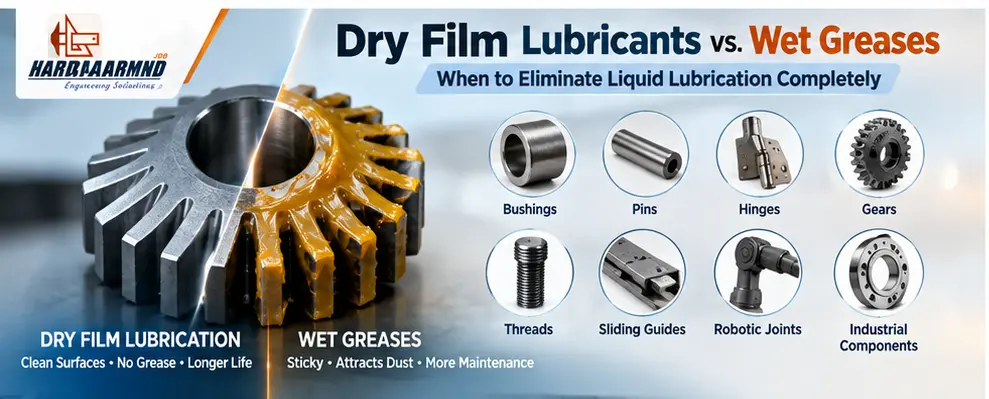
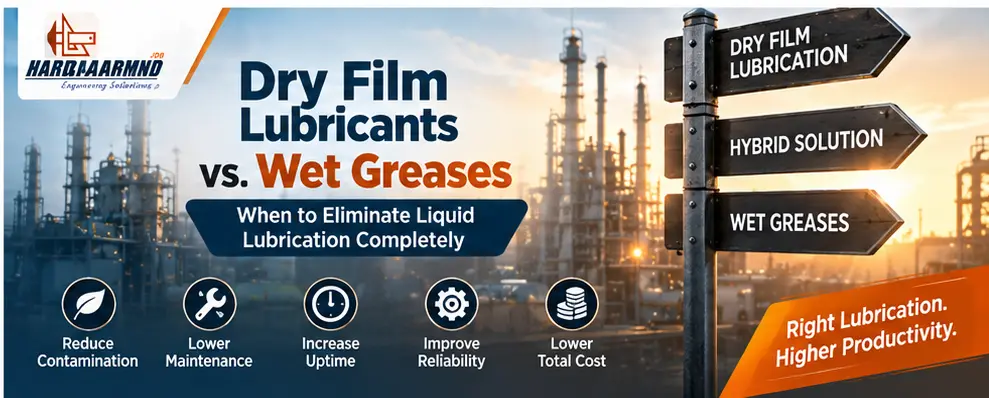
- Dry Film Lubricants vs. Wet Greases: When to Eliminate Liquid Lubrication Completely
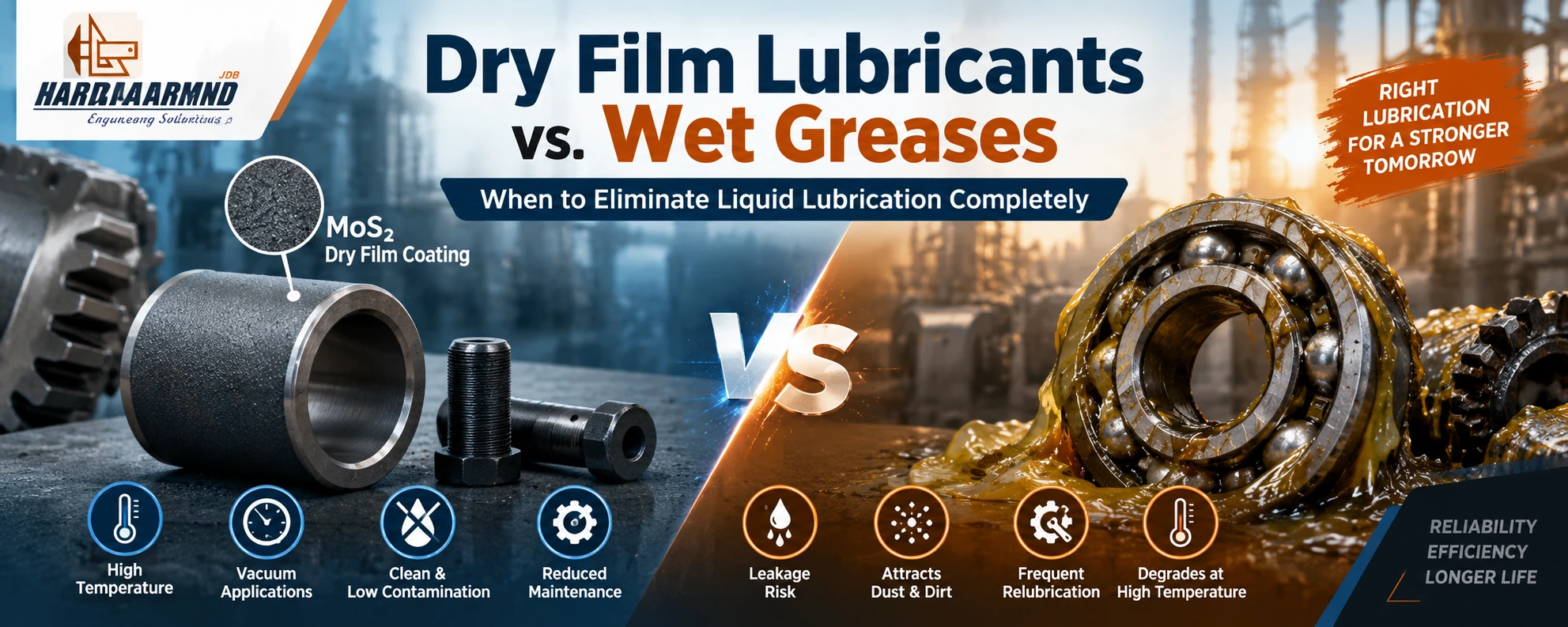
Introduction: Does Every Moving Component Really Need Grease or Oil?
For generations, industrial machinery has relied on oil and grease to control friction, reduce wear, prevent seizure and extend component life. In many machines, that remains exactly the right engineering choice.
But there is a more fundamental question that maintenance and design engineers should occasionally ask:
Does this component actually need a wet lubricant?
Oil and grease can create problems in applications involving contamination, dust, lubricant migration, difficult maintenance access, extreme temperatures, vacuum, clean manufacturing environments or intermittent motion. Grease can also accumulate particles in some environments, while oil can migrate, leak or require pumps, seals and circulation systems.
This is where dry film lubrication becomes interesting.
A dry film lubricant is a solid lubricating system designed to leave a lubricating film on a surface rather than maintaining a conventional reservoir of liquid lubricant. Solid lubricants can include materials such as molybdenum disulfide (MoS₂), graphite, PTFE and other engineered solids, often combined with binders and additives.
However, replacing grease with a dry film is not automatically an upgrade.
A high-speed rolling bearing, for example, may depend on an oil film and lubricant circulation to control friction and remove heat. Conversely, a slow-moving, heavily loaded pin or sliding interface in a difficult-to-access location may benefit substantially from a properly engineered solid-film coating.
Therefore, the real engineering question is not:
“Is dry lubrication better than grease?”
It is:
“Under the actual load, speed, temperature, environment and maintenance conditions, which lubrication mechanism provides the required reliability at the lowest total cost?”
That distinction is critical.
What Is Dry Film Lubrication?
Dry film lubrication uses a solid lubricating material to create a low-shear film between surfaces in relative motion.
Unlike conventional oil lubrication, the lubricant is not primarily supplied as a flowing liquid. Unlike grease, it does not depend on a semi-solid reservoir of base oil and thickener remaining at the contact.
A dry-film system may contain:
- A solid lubricant
- A binder or matrix
- Functional additives
- Corrosion-control additives
- Wear-resistant components
- Solvents or carriers during application
After application, the carrier is removed and, depending on the formulation, the coating may be air-dried or thermally cured.
The final coating is engineered to remain attached to the substrate while providing a lubricating interface.
ASTM D2510 specifically addresses adhesion testing of solid-film lubricant coatings because adhesion is fundamental to performance. If a coating loses adhesion, direct metal-to-metal contact can occur and wear can increase rapidly.
How is a dry film different from grease?
Grease primarily provides lubrication through its contained base oil. The thickener gives grease its semi-solid structure and helps keep the lubricant in position.
A dry film instead establishes a solid lubricating layer directly on the surface.
This distinction makes dry-film lubrication particularly attractive when lubricant migration, leakage or regular replenishment creates a significant engineering problem.
Why MoS₂ Is Important in Dry Film Lubrication
One of the most important solid lubricants used in industrial and aerospace applications is molybdenum disulfide (MoS₂).
MoS₂ has a layered crystal structure. The layers can shear relatively easily against each other, which is one of the fundamental reasons the material exhibits useful lubricating behavior.
Peer-reviewed research describes MoS₂ as a widely used solid lubricant and notes its applications in aerospace and space systems, including environments where conventional liquid lubricants can be problematic.
NASA technical literature has specifically investigated bonded and sputtered MoS₂ films under environments including ultrahigh vacuum, humid air and dry nitrogen.
The important qualification is that MoS₂ does not behave identically under every environment.
Its tribological behavior can be strongly influenced by:
- Humidity
- Oxygen
- Temperature
- Vacuum level
- Coating structure
- Film density
- Surface preparation
- Counterface material
- Load
- Sliding speed
- Contact geometry
Research reviews report that water and oxygen can degrade MoS₂’s tribological performance under some conditions, while MoS₂ can perform particularly well in vacuum and oxygen-deficient environments.
Therefore, “MoS₂ works at high temperature” is not sufficient engineering information.
The correct question is:
At what temperature, in which atmosphere, with what coating formulation, substrate, load and sliding condition?
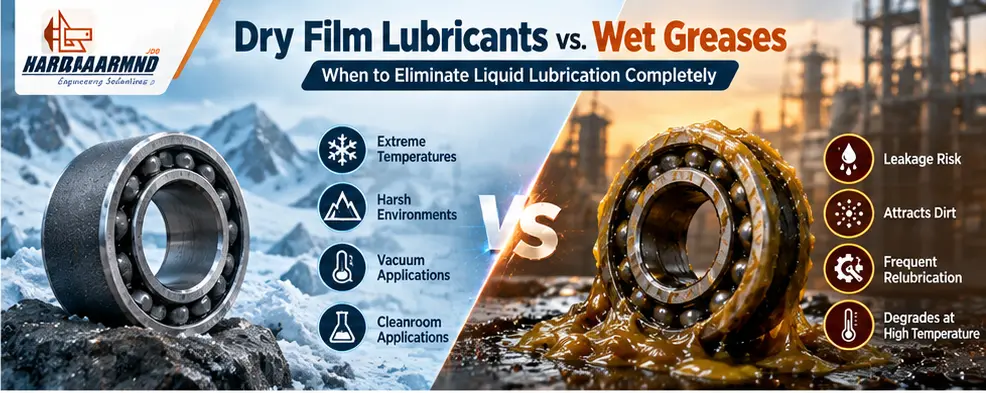
What Is Wet Grease and Liquid Lubrication?
Conventional wet lubrication includes:
- Mineral oils
- Synthetic oils
- Greases
- Gear oils
- Hydraulic fluids
- Circulating lubricants
- Specialty lubricating fluids
Grease is particularly common because it combines lubrication with good retention.
According to NSK, lubricating grease consists primarily of base oil, thickener and additives. The base oil provides the principal lubrication, while the thickener gives grease its semi-solid structure. Additives can provide properties such as oxidation resistance, anti-wear protection, extreme-pressure performance and corrosion protection.
Oil and grease can support several lubrication regimes.
Hydrodynamic lubrication
A sufficiently thick fluid film separates moving surfaces, minimizing direct asperity contact.
Elastohydrodynamic lubrication
This is particularly important in rolling contacts such as bearings and gears, where elastic deformation and pressure-dependent lubricant viscosity influence film formation.
Mixed lubrication
Some of the load is supported by the lubricant film while some surface asperity interaction remains.
Boundary lubrication
The fluid film is insufficient to completely separate the surfaces, so surface-active additives or solid films become particularly important.
This last regime is one reason dry-film lubrication can be valuable.
A dry film does not need to generate a conventional hydrodynamic film in order to provide useful boundary lubrication.
Dry Film Lubricants vs. Wet Greases: Detailed Comparison
Parameter | Dry Film Lubricant | Wet Grease / Oil |
Lubrication mechanism | Solid-film/boundary lubrication | Fluid, mixed or boundary lubrication depending on application |
Physical state | Solid coating/film | Semi-solid grease or liquid oil |
Friction control | Depends on coating chemistry and contact conditions | Strongly dependent on viscosity, film thickness and additives |
Wear protection | Provided by coating and tribofilm behavior | Provided by fluid film, additives and/or thickener system |
High-temperature performance | Potentially strong in selected environments; formulation-specific | Highly dependent on base oil, thickener and additives |
Low-temperature performance | Formulation/substrate dependent | Strongly dependent on lubricant viscosity and chemistry |
Leakage | Essentially no liquid leakage from the film itself | Oil can migrate; grease can also move under certain conditions |
Lubricant migration | Generally low after curing | Possible, particularly with liquid oils |
Dust attraction | Can be lower than grease in suitable applications | Grease can capture dust and abrasive particles |
Relubrication | May be unnecessary for a period, but film wear must be assessed | Periodic replenishment may be required |
Maintenance | Inspection/coating condition remain important | Lubricant condition and replenishment must be managed |
Clean environments | Can be advantageous if the coating is appropriately qualified | Potential contamination concerns |
Vacuum | Certain solid lubricants are particularly suitable | Conventional fluids may present volatility/outgassing issues |
High load | Excellent in selected boundary contacts | Excellent when lubricant film and formulation are appropriate |
High speed | Often not the default solution for rolling contacts | Oil is often preferred for high-speed bearings |
Shock loading | Application-specific | Can be advantageous due to lubricant reservoir and additives |
Cooling | Limited ability to carry away heat | Circulating oil can provide substantial cooling |
Sealing | Does not inherently seal the component | Grease can contribute to sealing/contaminant exclusion |
Initial cost | Can be higher because of coating/application | Often lower and readily available |
Long-term cost | Potentially lower where relubrication is difficult | Potentially higher where frequent servicing is required |
The table is a framework rather than a universal ranking. Actual performance depends on the coating, lubricant, substrate, contact geometry and operating envelope.
How Dry Film Lubrication Actually Works
Boundary lubrication
In boundary lubrication, the surfaces are not completely separated by a thick fluid film.
The goal becomes preventing severe adhesive interaction, galling and excessive wear.
A solid lubricant can create a low-shear interface that reduces direct metal-to-metal interaction.
This is especially relevant to:
- Pins
- Bushes
- Sliding interfaces
- Hinges
- Oscillating joints
- Threaded assemblies
- Mechanisms with intermittent movement
Transfer-film formation
Some solid lubricants can transfer to the opposing surface during operation.
This can create a tribological film that continues to influence friction and wear.
The exact mechanism depends on the material pair, contact pressure, temperature, environment and coating formulation.
The MoS₂ mechanism
The layered structure of MoS₂ is central to its lubricating behavior.
Its lamellar structure permits relatively easy shear between layers. Research has shown that environmental conditions have a major influence on this behavior. In particular, humidity and oxygen can negatively affect friction and wear performance under certain conditions.
This is why an MoS₂ coating should never be specified simply as “MoS₂.”
The engineering specification should address the complete coating system.
Coating adhesion
A dry lubricant is only useful if it remains attached to the substrate for the intended operating period.
Important variables include:
- Surface cleanliness
- Surface roughness
- Surface preparation
- Coating chemistry
- Film thickness
- Cure conditions
- Substrate material
- Contact pressure
ASTM D2510 recognizes coating adhesion as a critical characteristic of solid-film lubricants.
When Should You Consider Eliminating Wet Lubrication?
There are several situations where replacing oil or grease with dry-film lubrication deserves serious engineering evaluation.
1 High-temperature environments
Conventional lubricants can experience oxidation, evaporation, viscosity changes, thickener degradation or other forms of thermal deterioration.
That does not mean every dry film is automatically suitable for high temperatures.
For MoS₂, for example, the surrounding atmosphere matters significantly because oxidation can degrade tribological performance at elevated temperatures.
Therefore, high-temperature dry lubrication should be evaluated against the actual:
- Temperature
- Exposure duration
- Atmosphere
- Contact pressure
- Sliding speed
- Coating formulation
2 Vacuum environments
Vacuum is one of the classic areas for solid lubrication.
Certain conventional liquid lubricants can create concerns associated with volatility and outgassing. MoS₂ has historically been used in space-related applications because it can provide useful lubrication in vacuum environments. NASA documentation describes MoS₂ solid films among the solid lubricants investigated for such applications.
3 Clean manufacturing environments
If lubricant migration could contaminate a product or process, a solid film may offer an attractive alternative.
Potential examples include:
- Precision mechanisms
- Selected semiconductor equipment
- Instrumentation
- Controlled manufacturing environments
- Certain food or pharmaceutical machinery components, subject to applicable material and regulatory requirements
The coating itself must still be qualified for the environment. “Dry” does not automatically mean “cleanroom compatible.”
4 Dust-heavy environments
Grease can retain contaminants. In some dusty applications, a sticky lubricant can become a collection point for abrasive particles.
A properly engineered dry-film system may reduce this particular problem.
However, dry coating does not eliminate abrasive wear caused by external particles. If abrasive contamination is severe, the substrate, coating and sealing strategy must be evaluated together.
5 Difficult-to-access components
This can be one of the strongest reasons to consider dry-film lubrication.
If accessing a bearing, joint or mechanism requires:
- Machine shutdown
- Guard removal
- Scaffolding
- Confined-space access
- Production interruption
- Specialized maintenance personnel
then reducing relubrication requirements can have significant economic value.
ASTM specifically identifies restricted-access applications as an important use case for solid-film lubricants.
6 Oscillating and intermittent motion
Some joints do not rotate continuously.
They may move through a small angular range repeatedly.
Examples include:
- Hinges
- Pins
- Linkages
- Robotic joints
- Actuation mechanisms
- Mechanical pivots
Such contacts can spend substantial time in boundary or mixed lubrication regimes, making a solid lubricant an option worth evaluating.
7 Low-speed/high-load contacts
At low sliding speed, developing a stable hydrodynamic film can be difficult.
A properly selected solid lubricant can therefore provide useful boundary protection.
But load capacity is not simply a property of “MoS₂.” It depends on the complete coating/substrate/contact system.
When You Should NOT Eliminate Grease
This is where many dry-lubrication discussions become misleading.
There are applications where wet lubrication remains the better engineering solution.
High-speed bearings
High-speed rolling bearings often benefit from oil lubrication because oil can provide both lubrication and heat removal.
NSK states that oil lubrication is better suited to high-speed rotation and can provide cooling, while forced circulation is used where bearing cooling is required.
A dry coating on a bearing contact is therefore not automatically a substitute for the carefully engineered lubricant film required by the bearing.
Applications requiring continuous cooling
If the lubricant is part of the thermal-management system, eliminating it may be counterproductive.
Circulating oil can remove heat from:
- Bearings
- Gearboxes
- Compressors
- High-speed spindles
- Hydraulic systems
Replacing the oil with a solid film would remove this cooling mechanism.
Systems already designed around oil circulation
Some industrial systems have:
- Pumps
- Filters
- Coolers
- Reservoirs
- Condition monitoring
- Oil purification
In such systems, the oil is an integral part of the machine architecture.
Removing it requires much more than changing the lubricant.
Applications where grease provides sealing
Grease can help prevent contaminants from entering certain bearing arrangements.
NSK notes that grease allows simpler housing and sealing arrangements compared with oil lubrication.
A dry film does not inherently perform the same sealing function.
Severe abrasive environments
A dry film has finite thickness and finite wear life.
If external abrasives rapidly remove the coating, the system may require another protection strategy.
Can Dry Film Lubrication Completely Replace Grease?
Yes—but only in selected applications.
There are three practical strategies.
Strategy 1: Complete replacement
The dry film becomes the primary lubrication technology.
This makes sense when:
- The contact is suitable for solid lubrication
- Fluid lubrication is undesirable
- The coating has sufficient life
- Relubrication is difficult
- Temperature and environment are compatible
- Testing validates the design
Strategy 2: Hybrid lubrication
A dry film provides boundary protection while a limited quantity of oil or grease provides additional lubrication.
This approach can be useful when operating conditions vary or when both boundary and fluid-film lubrication are required.
Strategy 3: Conventional lubrication
Retain grease or oil when it provides the best combination of:
- Lubrication
- Cooling
- Sealing
- Reliability
- Cost
- Serviceability
The correct choice is determined by the operating envelope—not by whether a lubricant is marketed as “advanced.”
Dry Film Lubrication for Bearings, Bushes, Pins and Sliding Components
Dry-film coatings can be considered for a wide range of components, including:
- Bushes
- Pins
- Hinges
- Sliding guides
- Mechanical joints
- Threaded components
- Selected gears
- Automotive mechanisms
- Aerospace mechanisms
- Robotic mechanisms
- Special-purpose machines
- High-temperature assemblies
But each application must be evaluated separately.
Bushes and pins
These are often attractive candidates because their motion may be oscillating or slow, with substantial boundary lubrication.
Sliding guides
A solid film may be attractive where oil or grease migration is undesirable.
Robotic mechanisms
Dry films can be considered where maintenance access is difficult or where lubricant migration could interfere with nearby components.
Gears
Gears require careful analysis of speed, load, contact stress, temperature and lubrication regime. Dry-film technology can be used in selected gear applications, but it should not be assumed to replace a properly engineered gear oil system.
Bearings
This category requires particular caution.
A dry-film-coated bearing may be appropriate for a specialized application, but a coating is not automatically equivalent to the fluid film required by a conventional high-speed rolling bearing.
MoS₂ Dry Film Lubrication: Where Does It Make Sense?
MoS₂ is particularly interesting where boundary lubrication and environmental constraints are important.
Its advantages can include:
- Low-shear layered structure
- Useful solid-lubrication behavior
- Suitability for selected vacuum applications
- Ability to function without a conventional liquid reservoir
- Compatibility with specialized solid-film coating systems
NASA’s technical literature documents the use and investigation of bonded and sputtered MoS₂ films for demanding environments.
But there are important limitations.
MoS₂ performance can deteriorate in the presence of environmental contaminants, particularly water and oxygen under relevant conditions. Research reviews identify humidity and oxidation as important factors affecting friction and wear.
Consequently, an engineering specification should consider:
- MoS₂ grade and purity
- Coating architecture
- Binder system
- Substrate material
- Surface preparation
- Film thickness
- Cure process
- Contact pressure
- Sliding speed
- Temperature
- Humidity
- Oxygen exposure
- Vacuum level
- Expected wear life
There is no universal MoS₂ temperature rating that can safely be applied to every coating.
Dry Film Lubricant Application Process
A typical industrial process can be represented as:
Component inspection → Cleaning → Surface preparation → Coating → Curing → Inspection → Performance validation
Step 1: Component inspection
Check:
- Dimensional condition
- Surface defects
- Existing wear
- Material
- Geometry
- Contact surfaces
Step 2: Cleaning
Remove:
- Oil
- Grease
- Dirt
- Oxides
- Processing residues
Step 3: Surface preparation
Depending on the coating system, preparation may involve controlled abrasive blasting or another approved surface-treatment method.
Surface roughness matters because the coating needs an appropriate mechanical and chemical interface with the substrate.
Step 4: Coating
The dry-film system is applied to the specified surface.
Application technology can include:
- Spraying
- Burnishing
- Specialized deposition
- Other manufacturer-qualified processes
Step 5: Curing
Some bonded coatings require controlled thermal curing.
Others may be air-dried or use different deposition mechanisms.
The coating manufacturer’s specified process should control this stage.
Step 6: Inspection
Potential inspection parameters include:
- Film thickness
- Visual defects
- Surface condition
- Adhesion
- Dimensional tolerances
- Coverage
ASTM D2510 provides a standardized method for evaluating adhesion characteristics of dry solid-film lubricants.
ASTM also maintains standards addressing corrosion characteristics of solid-film lubricants, including evaluation under high-humidity conditions.
Step 7: Performance validation
For critical components, laboratory or application-specific testing may include:
- Friction testing
- Wear testing
- Load testing
- Temperature testing
- Environmental testing
- Adhesion testing
- Endurance testing
The final qualification should reproduce the important operating conditions as closely as practical.
Dry Film vs Grease: Comparing Total Cost of Ownership
A common mistake is comparing only:
₹/kg of grease vs ₹/component of coating.
That is not a meaningful industrial comparison.
The correct calculation is Total Cost of Ownership (TCO).
Direct costs
Consider:
- Grease or coating material
- Application labor
- Surface preparation
- Curing
- Equipment
- Inspection
- Replacement parts
Indirect costs
Also consider:
- Machine downtime
- Maintenance access
- Production losses
- Cleaning
- Lubricant disposal
- Emergency maintenance
- Contamination
- Spare-parts consumption
Hypothetical example
Suppose a difficult-to-access mechanical joint requires frequent shutdowns for greasing.
A dry-film coating costs more initially because the component must be removed, prepared and coated.
However, suppose the coated component significantly extends the interval between interventions.
The economic calculation then becomes:
Coating cost + application cost + inspection
versus
Grease cost + maintenance labor + access cost + downtime + replacement cost.
The coating can have a higher initial cost while producing a lower lifecycle cost.
This is only a hypothetical economic model, not a claim that dry film will always reduce costs.
Environmental and Maintenance Benefits
Where technically appropriate, dry-film lubrication can provide several operational advantages.
Potential benefits include:
- Lower lubricant consumption
- Reduced liquid leakage
- Reduced lubricant migration
- Less frequent relubrication
- Reduced cleaning requirements
- Reduced lubricant waste
- Easier maintenance planning
However, these benefits should be evaluated rather than assumed.
A dry-film component may still require inspection, replacement or recoating.
Dry lubrication is not synonymous with maintenance-free operation.
Common Myths About Dry Film Lubrication
Myth | Reality |
Dry film lubricants replace grease everywhere. | Application conditions determine suitability. |
Dry lubrication means zero wear. | Dry films wear and have finite service lives. |
MoS₂ works under every condition. | Environment, temperature, load, speed and coating formulation matter. |
Dry film means maintenance-free machinery. | Inspection and component maintenance may still be necessary. |
A thicker coating is always better. | Excessive thickness can affect dimensions and tribological behavior. |
All MoS₂ coatings are equivalent. | Coating formulation, deposition, binder and substrate preparation can significantly change performance. |
High temperature automatically means dry film. | The actual atmosphere and thermal exposure must be considered. |
Grease is obsolete technology. | Grease remains extremely effective across many industrial applications. |
Practical Industrial Examples
Case Study 1: High-Temperature Sliding Mechanism
A machine contains a slow-moving metal-to-metal sliding component operating near a temperature at which conventional grease rapidly deteriorates.
Engineering assessment
If the component operates primarily in boundary lubrication and does not require the lubricant for cooling, a high-temperature solid-film system may be evaluated.
Recommended approach
Dry film — potentially appropriate.
The coating must be qualified for the actual temperature and atmosphere.
Case Study 2: Dust-Heavy Industrial Mechanism
A mechanical linkage operates in an environment containing substantial airborne dust. Grease retains abrasive particles and requires frequent cleaning.
Engineering assessment
A properly engineered dry film could reduce the sticky lubricant reservoir that captures contaminants.
Recommended approach
Dry film — worth evaluating.
However, sealing and abrasive-wear protection remain important.
Case Study 3: Precision Mechanism Where Lubricant Migration Is Undesirable
A precision mechanism is located next to components that should not be contaminated by migrating oil.
Engineering assessment
A solid coating can potentially keep the lubricating material localized at the contact.
Recommended approach
Dry film — potentially attractive, subject to coating cleanliness, outgassing, particulate and compatibility requirements.
Case Study 4: High-Speed Bearing
A production spindle uses a high-speed rolling bearing and requires heat removal.
Engineering assessment
Oil circulation provides both lubrication and cooling. Replacing the fluid system with a dry coating would remove an important part of the thermal-management strategy.
Recommended approach
Retain oil lubrication.
NSK specifically identifies circulating oil as a solution for high-speed applications requiring bearing cooling.
Case Study 5: Difficult-to-Access Mechanical Joint
A mechanical joint is buried inside an automated machine and requires substantial downtime for every lubrication intervention.
Engineering assessment
If the joint operates at suitable speed, load and temperature, a dry-film system may significantly reduce intervention requirements.
Recommended approach
Dry film or hybrid lubrication — evaluate through endurance testing.
This is exactly the type of restricted-access application for which solid-film lubrication can be valuable.
How to Decide: Dry Film, Grease or Hybrid?
Choose Dry Film When:
- Contamination or lubricant migration must be minimized
- Relubrication access is difficult
- The contact operates predominantly under boundary lubrication
- The operating temperature is unsuitable for the existing grease
- Vacuum or specialized environmental conditions exist
- The component has suitable geometry and substrate
- The coating can be properly applied and validated
- Solid-film wear life meets the required duty cycle
Choose Grease or Oil When:
- Continuous fluid-film lubrication is required
- High-speed operation dominates
- Heat removal is important
- Grease provides valuable sealing
- The existing lubrication system is well optimized
- Continuous lubricant replenishment is practical
- The component’s operating conditions favor fluid lubrication
NSK’s bearing guidance illustrates why this distinction matters: oil generally supports higher speeds and provides a stronger cooling mechanism, while grease offers simpler systems and good lubricant retention.
Choose Hybrid Lubrication When:
- Both boundary and fluid-film lubrication are required
- Operating conditions vary significantly
- A dry film can provide backup protection
- A small quantity of wet lubricant provides additional life
- Reliability is more important than eliminating liquid lubricant completely
The Engineering Decision: When Does Eliminating Wet Lubrication Make Sense?
The strongest argument for dry-film lubrication is not that it is “better” than grease.
It is that it can solve problems that grease and oil cannot solve efficiently in certain operating environments.
Consider replacing wet lubrication when several of the following conditions occur simultaneously:
Difficult access + low/oscillating speed + boundary lubrication + contamination concerns + high maintenance cost
That combination creates a strong engineering case for evaluating dry film.
By contrast:
High speed + significant heat generation + continuous cooling requirement + established oil circulation
creates a strong case for retaining wet lubrication.
And where the machine experiences changing regimes, a hybrid system may provide the best balance.
The Engineering Decision: When Does Eliminating Wet Lubrication Make Sense?
The strongest argument for dry-film lubrication is not that it is “better” than grease.
It is that it can solve problems that grease and oil cannot solve efficiently in certain operating environments.
Consider replacing wet lubrication when several of the following conditions occur simultaneously:
Difficult access + low/oscillating speed + boundary lubrication + contamination concerns + high maintenance cost
That combination creates a strong engineering case for evaluating dry film.
By contrast:
High speed + significant heat generation + continuous cooling requirement + established oil circulation
creates a strong case for retaining wet lubrication.
And where the machine experiences changing regimes, a hybrid system may provide the best balance.
Conclusion: Select the Lubrication Technology, Not the Marketing Claim
The goal of lubrication engineering is not to select the most sophisticated lubricant.
It is to select the right lubrication technology for the actual operating conditions.
Dry-film lubrication can be an excellent solution for selected applications involving difficult access, high loads at low speed, oscillating motion, contamination sensitivity, vacuum or challenging thermal environments.
MoS₂ is particularly important because its layered structure provides useful solid-lubrication behavior and has a long history of use in demanding applications. But its performance is strongly dependent on environment, temperature, coating architecture and operating conditions.
Grease and oil remain indispensable technologies.
High-speed bearings, circulating lubrication systems, applications requiring heat removal, and components where sealing and lubricant retention are important may be better served by conventional wet lubrication.
The most useful way to think about dry film lubricants vs wet greases is therefore:
Do not ask which lubricant is universally better. Ask which lubrication mechanism best matches the contact.
For some components, the answer will be dry film.
For others, it will be grease.
And for many sophisticated machines, the optimum answer will be both.
The real opportunity for manufacturers is to stop treating lubrication as a routine maintenance consumable and start treating it as an engineering design variable.
When load, speed, temperature, environment, material pair, maintenance access and total cost of ownership are evaluated together, it becomes possible to determine whether wet lubrication should be retained, reduced, supplemented—or eliminated completely.
Frequently Asked Questions
1. What is the difference between dry film lubricant and grease?
A dry film lubricant forms a solid lubricating layer on a component’s surface, while grease is a semi-solid lubricant containing base oil, thickener and additives. Dry films are particularly useful for selected boundary-lubrication applications, while grease remains highly effective for many bearings and mechanical systems.
2. Can dry film lubricant replace grease completely?
Yes, in selected applications. Complete replacement requires suitable load, speed, temperature, environment, substrate and coating life. It should be validated through appropriate testing rather than assumed.
3. Is MoS₂ better than grease?
Neither is universally better. MoS₂ can provide valuable solid lubrication under appropriate conditions, particularly in certain boundary, vacuum and specialized applications. Grease can be superior where lubricant retention, sealing, fluid-film lubrication or cooling is important.
4. When should dry film lubrication be used?
Dry film lubrication should be considered where conventional oil or grease creates problems such as difficult relubrication, contamination, migration, unsuitable environmental conditions or excessive maintenance requirements.
5. What industries use dry film lubricants?
Dry-film lubricants are used in selected aerospace, automotive, industrial machinery, precision engineering and specialized mechanical applications. SAE maintains requirements for solid-film lubricants used in aerospace applications.
6. Are dry film lubricants suitable for high temperatures?
Some dry-film systems can operate at temperatures where conventional lubricants become unsuitable, but performance is formulation- and environment-dependent. MoS₂, for example, can be affected by oxidation and environmental conditions at elevated temperatures.
7. Can dry film lubrication be used on bearings?
It can be used in selected specialized bearing applications, but it should not be assumed to replace conventional bearing lubrication. High-speed rolling bearings frequently depend on properly designed oil or grease lubrication, and circulating oil may also provide cooling.
8. How long does a dry film lubricant coating last?
There is no universal service-life figure. Wear life depends on coating formulation, thickness, substrate, contact pressure, speed, temperature, environment, motion and duty cycle. Application-specific endurance testing is the most reliable way to establish service life.
9. Does dry film lubrication eliminate maintenance?
No. It can reduce relubrication requirements in suitable applications, but components still require inspection and maintenance. Coating condition, substrate wear and overall machine condition must be monitored.
10. What factors determine whether grease can be eliminated?
The most important factors include load, speed, motion type, temperature, environment, contact geometry, substrate, required service life, cooling requirements, sealing requirements, maintenance access and total cost of ownership.
Recent Posts
- Custom Automation Robotic Grippers: Improving Precision and Manufacturing Efficiency
- Custom Industrial Automation Solutions & Special Purpose Machines (SPM) for Modern Manufacturing
- Custom Machines: The Complete Guide to Custom Machine Design and Manufacturing
- Dry Film Lubricants vs. Wet Greases: When to Eliminate Liquid Lubrication Completely
- Types of Automation Systems in Manufacturing A Complete Guide for Indian Manufacturers
Products
-
 MolyKul MoS2 Gear Oil additive for cars and bike| Anti-friction MoS2 Solution - 100ml
₹598.73Original price was: ₹598.73.₹399.62Current price is: ₹399.62. Including 18% GST -
MolyKul Aero-Spec 500 (MKG AS500 NG2) – MoS2 Anti-Seize Aerospace grease – 500 Deg C
₹2,088.60 – ₹9,739.72Price range: ₹2,088.60 through ₹9,739.72 Including 18% GST
-
MolyKul MoS2 Grease for industrial application| Lithium + Anti-Seize MoS2 - 650 Deg C
₹1,539.90Original price was: ₹1,539.90.₹1,169.38Current price is: ₹1,169.38. Including 18% GST -
MolyKul MoS2 engine oil additive for cars and bikes| Anti-friction MoS2 Solution - 100ml
₹195.88 – ₹531.00Price range: ₹195.88 through ₹531.00 Including 18% GST
-
MolyKul MoS2 Grease for industrial application| Lithium + Anti-Seize MoS2 - 320 Deg C
₹684.40 – ₹6,608.00Price range: ₹684.40 through ₹6,608.00 Including 18% GST

Leave A Comment