Custom Automation Robotic Grippers for Industry
- Home
- Custom Automation Robotic Grippers: Improving Precision and Manufacturing Efficiency
Introduction
In modern manufacturing, even a small material-handling problem can affect the entire production process. A component that slips during transfer, a part that requires precise positioning, or a product with a delicate surface can create difficulties for automated production lines. When these challenges occur repeatedly, manufacturers may need a gripping solution designed specifically for their application.
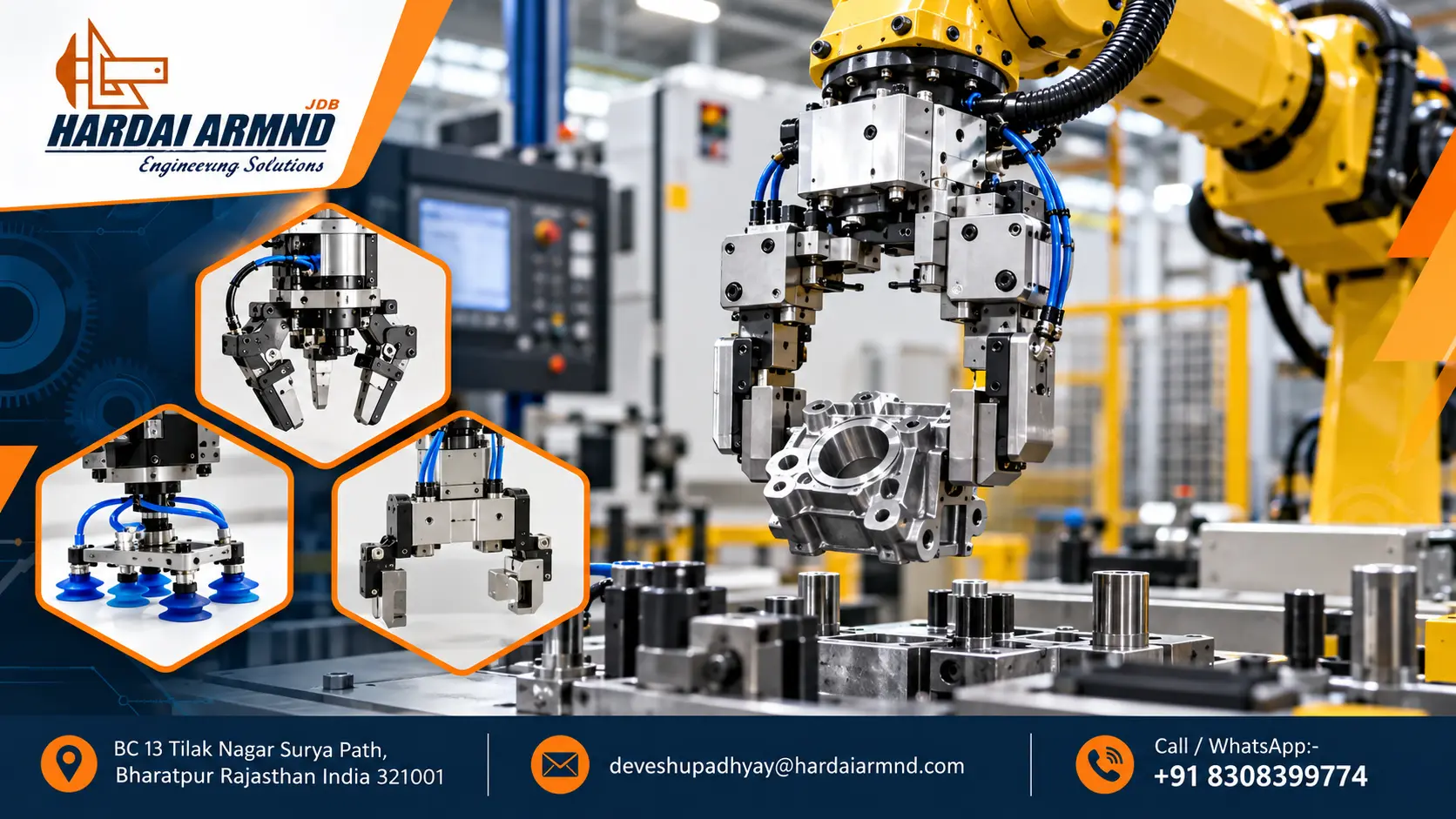
A Custom Automation Robotic Gripper helps address these requirements by enabling a robotic arm to pick up, hold, move, and release components according to the needs of a particular manufacturing operation. Unlike a standard gripper designed for general applications, a custom robotic gripper can be developed around component geometry, weight, surface characteristics, production speed, and machine integration requirements.
For manufacturers looking to automate repetitive handling tasks, the right gripper can contribute to more consistent operations, reduced manual handling, and better integration between machines and robotic systems.
Hardai ARMND Engineering Solutions focuses on custom engineering, robotic grippers, End of Arm Tooling (EOAT), Special Purpose Machines (SPM), and industrial automation solutions. Understanding how these technologies work can help manufacturers identify suitable opportunities for automation.
What Is a Custom Automation Robotic Gripper?
A custom automation robotic gripper is a specially designed gripping mechanism attached to the end of a robotic arm or another automated handling system. It acts as the robot’s working tool, allowing it to interact with physical objects during manufacturing.
A conventional robotic arm provides movement, but it cannot handle a component effectively without an appropriate end effector. The gripper supplies the contact points, gripping force, and holding mechanism needed to move the component safely and accurately.
Custom grippers are developed around the specific requirements of the application. For example, a gripper designed to handle a heavy metal component may require a different mechanism from one used to pick up a lightweight plastic part or a delicate electronic component.
The design may account for:
- Component shape, dimensions, and weight.
- Surface finish, material, and fragility.
- Required gripping force and contact points.
- Robot payload and movement requirements.
- Available space around the component.
- Production cycle time and handling frequency.
- Environmental conditions and maintenance requirements.
A properly engineered gripper helps the robot perform its assigned task with the consistency required by the production process.
How Do Robotic Grippers Work?
Robotic grippers operate through a coordinated sequence of gripping, movement, positioning, and release.
Although the mechanism varies by application, a typical automated handling cycle follows these steps:
- Component detection: Sensors or the automation system identify the component and confirm that the robot can begin the operation.
- Approach: The robotic arm moves the gripper toward the required pickup position.
- Gripping: The gripper closes its jaws, activates a vacuum circuit, applies magnetic force, or uses another suitable mechanism to secure the component.
- Holding and transfer: The robot moves the component along a programmed path while the gripper maintains its hold.
- Positioning: The robot places the component at a designated location, such as a fixture, machine, conveyor, or assembly station.
- Release and confirmation: The gripper releases the component, and sensors or control logic may verify successful placement before the next cycle begins.
Actuators provide the force or movement required to operate the gripping mechanism. Pneumatic systems commonly use compressed air, while electric grippers use electrically driven mechanisms. Vacuum systems use pressure differences to hold suitable surfaces, and magnetic grippers attract compatible materials.
Controllers coordinate the gripper with the robot and other equipment. Depending on the application, sensors may detect part presence, jaw position, gripping pressure, or successful pickup.
The complete system must be designed so that the gripper, robot, fixtures, sensors, and machine controls work together reliably.
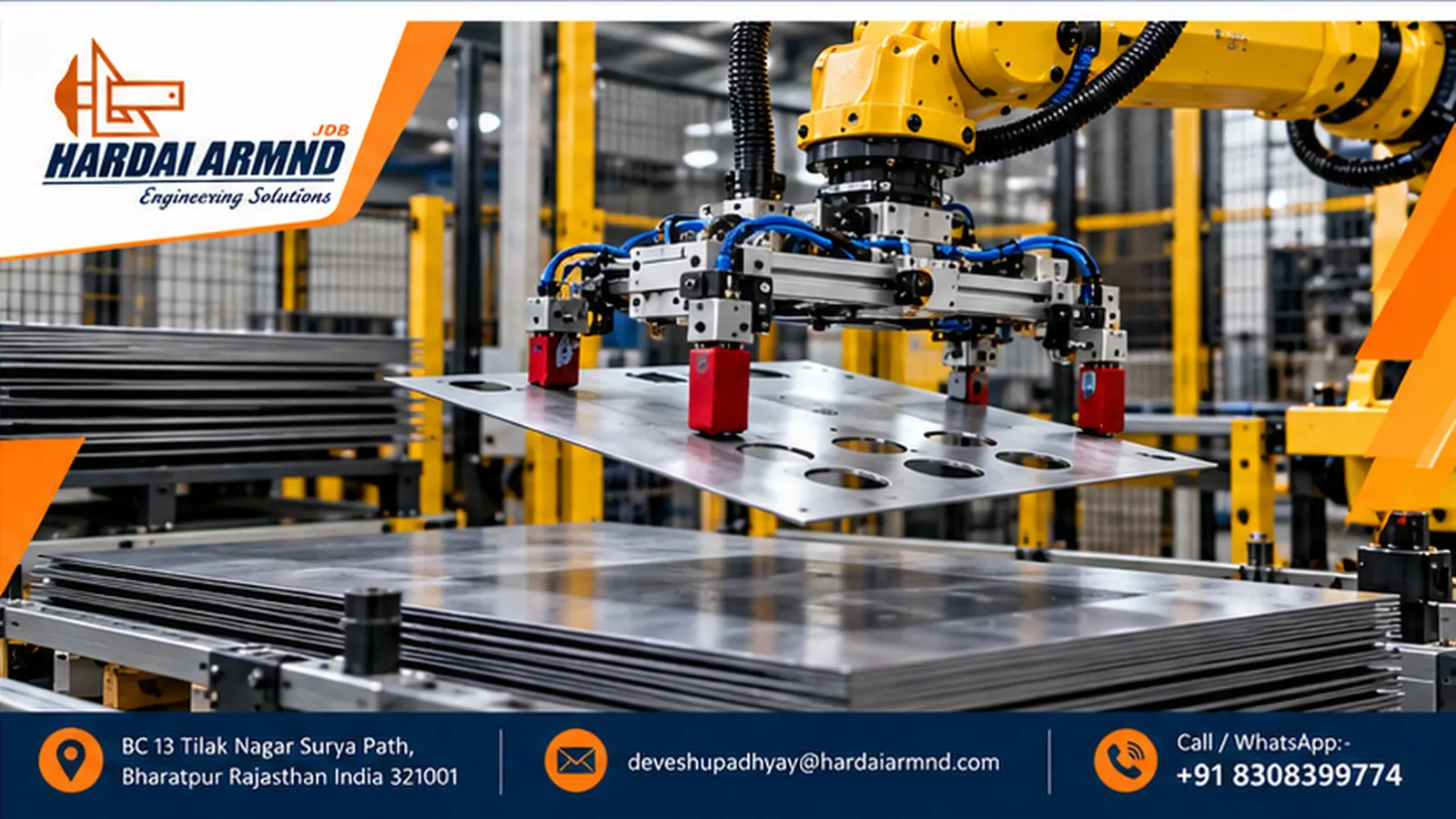
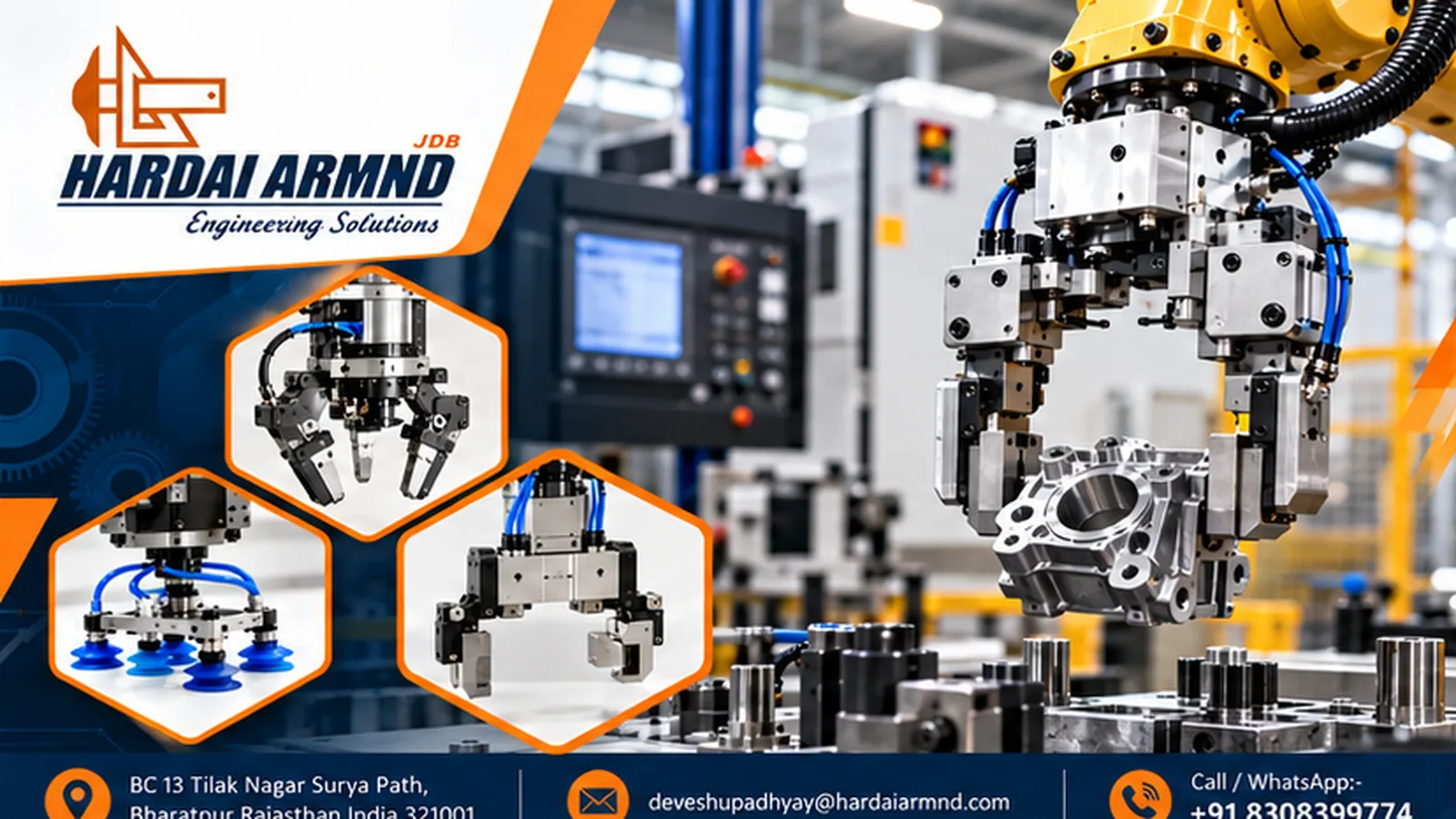
Types of Industrial Robotic Grippers
Different industrial applications require different gripping principles. Selecting the appropriate type depends on the component, operating environment, required precision, and production process.
1. Mechanical and Parallel-Jaw Grippers
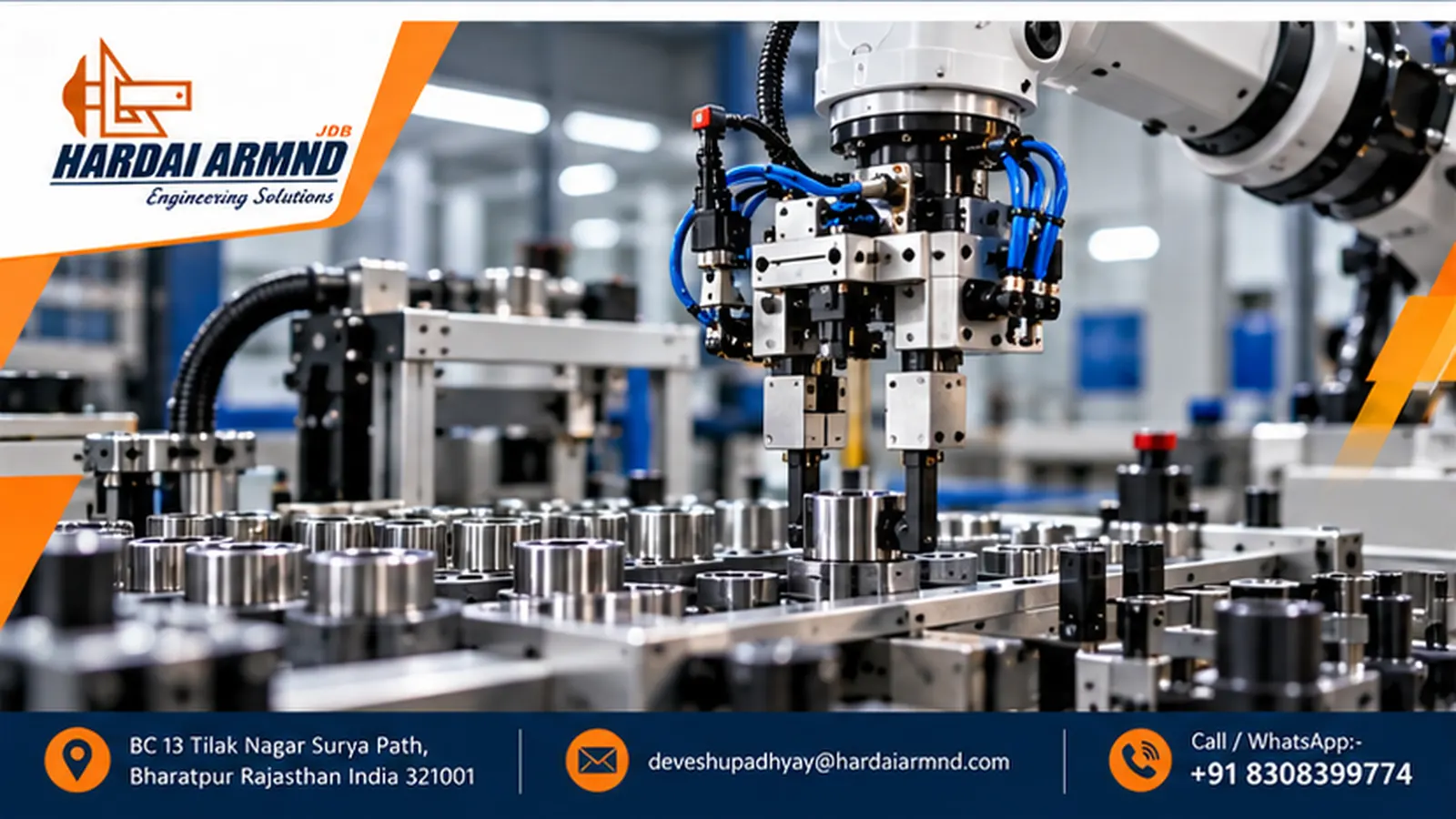
Mechanical grippers use physical contact to hold a component between gripping surfaces. Parallel-jaw grippers move their jaws toward or away from each other while maintaining approximately parallel movement.
They are commonly used for handling machined components, automotive parts, metal pieces, and manufactured assemblies.
Their gripping surfaces can be adapted to the component’s geometry. However, jaw travel, available space, surface protection, and gripping force must be considered during selection.
2. Angular Grippers
Angular grippers operate by opening and closing their jaws along an angular path. They can be useful where the available space or approach direction makes parallel jaw movement less suitable.
Applications may include component transfer, assembly, and handling in compact machine layouts.
The jaw movement and clearance requirements must be checked to prevent interference with nearby fixtures or equipment.
3. Vacuum Grippers
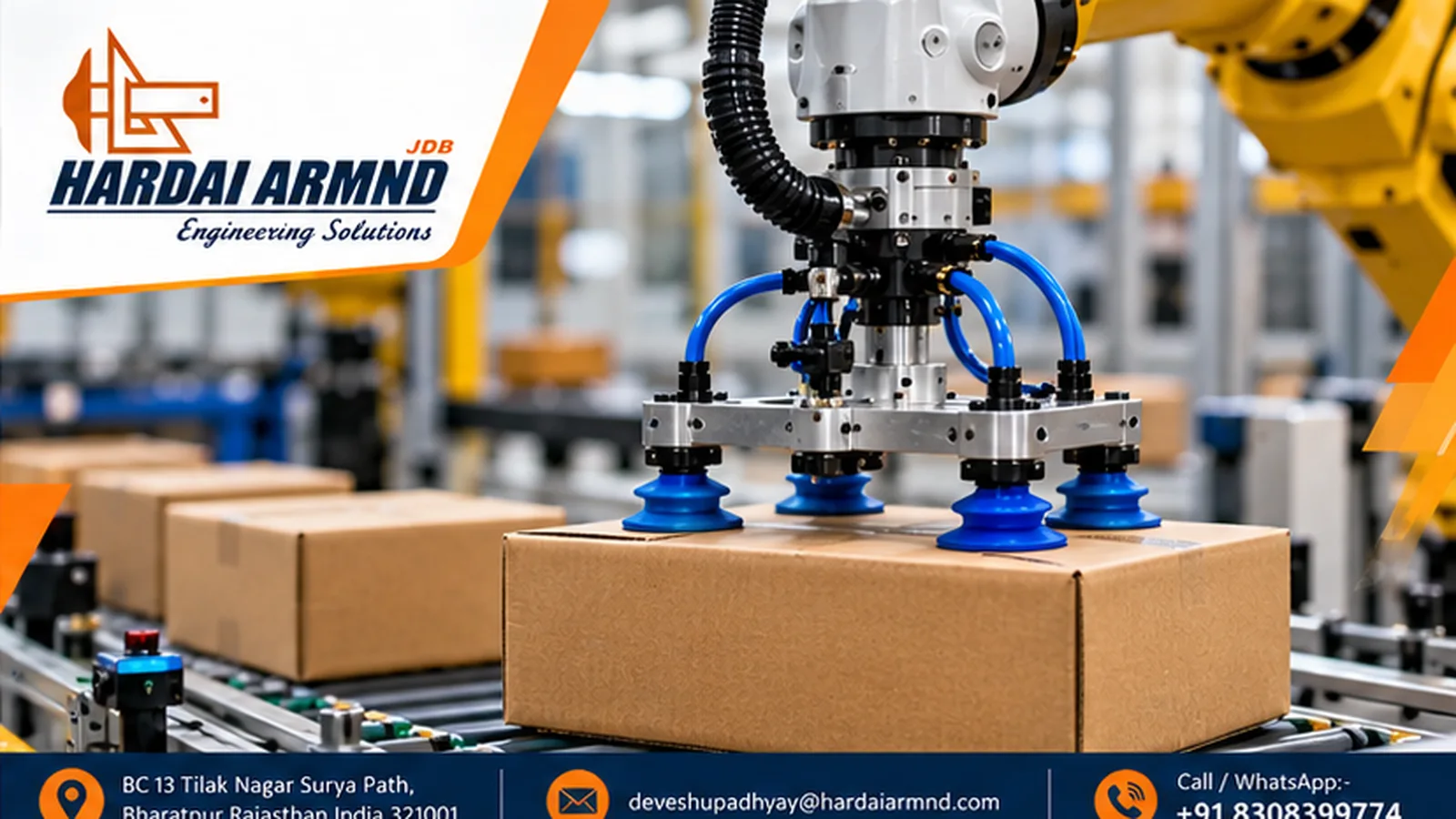
Vacuum grippers use suction cups or vacuum pads to hold suitable components. They are often used for sheet materials, cartons, panels, plastic products, and packaging operations.
Vacuum gripping can provide relatively gentle contact and can be useful for handling flat or smooth surfaces. Performance depends on surface porosity, leakage, component weight, acceleration, and vacuum availability.
Irregular, porous, oily, or highly textured surfaces may require a different cup arrangement or an alternative gripping method.
4. Magnetic Grippers
Magnetic grippers use magnetic force to handle compatible ferromagnetic materials. They may be suitable for steel sheets, metal components, and selected fabrication operations.
They can reduce the need for mechanical clamping in certain applications. However, material compatibility, component thickness, air gaps, residual magnetism, and release behaviour must be evaluated.
Magnetic gripping is not suitable for every metal, particularly non-ferromagnetic materials such as aluminium.
5. Soft and Adaptive Grippers
Soft or adaptive grippers are designed to accommodate variations in component shape or provide compliant contact. They may be useful for irregular objects, delicate products, and applications where rigid gripping surfaces could create damage.
Their suitability depends on the required holding force, precision, environmental conditions, and component characteristics. They are not automatically the right choice for heavy industrial loads or applications requiring high rigidity.
6. Pneumatic and Electric Grippers
Pneumatic and electric grippers describe how the gripping mechanism is actuated rather than a single jaw geometry.
Pneumatic grippers use compressed air and are commonly considered for repetitive industrial handling. They require suitable air supply, control components, and appropriate force management.
Electric grippers use electric motors or other electrically driven mechanisms. Depending on the model, they may provide programmable jaw positions, adjustable gripping force, and feedback on the gripping operation.
Neither type is universally better. The choice depends on control requirements, cycle time, available utilities, environmental conditions, maintenance, and integration needs.
Why Choose a Custom Robotic Gripper Instead of a Standard Gripper?
Standard grippers can be effective when a component has conventional dimensions and the required gripping motion falls within the gripper’s available specifications.
However, some manufacturing processes present challenges that standard products cannot accommodate without modification.
Consider a factory handling a machined component with an irregular outer profile. A standard gripper may contact the part at unsuitable locations or interfere with nearby fixtures. A custom design can use application-specific gripping fingers, contact surfaces, or a different mechanism to accommodate the component.
Custom robotic gripper design may be worth considering when:
- Components have unusual shapes, dimensions, or gripping points.
- Parts must be handled without scratching or deforming their surfaces.
- The robot operates in a restricted space.
- Multiple components need to be picked up in one cycle.
- The gripper must access an existing machine fixture.
- Different components require a coordinated gripping arrangement.
- The gripper must integrate with existing robots, sensors, or production equipment.
- Standard tooling does not meet the application’s force, positioning, or cycle requirements.
Customization should be based on a clear engineering need. If a standard gripper already satisfies the technical requirements, it may be the more straightforward and economical choice.
Key Benefits of Custom Automation Robotic Grippers
A well-designed gripper can support several manufacturing objectives. The actual benefits depend on the application, the quality of integration, and the operating conditions.
Consistent Component Handling
Manual handling can vary between operators and production cycles. An appropriately configured robotic gripper can repeat the same gripping sequence, helping establish more consistent material movement.
Improved Positioning and Repeatability
Components often need to be positioned accurately before machining, inspection, assembly, or packaging. Suitable gripping geometry and secure holding can help the robot place components more consistently.
Final positioning accuracy also depends on robot performance, calibration, fixtures, component tolerances, and control strategy.
Reduced Manual Handling
Automating repetitive transfers can reduce the need for operators to repeatedly lift, reposition, or move components between stations. This can support better ergonomics when the system is appropriately designed and safeguarded.
Better Integration With Production Equipment
Custom End of Arm Tooling can be developed around the interfaces and access requirements of existing machines. This can help connect robotic handling with CNC machines, conveyors, fixtures, assembly equipment, and inspection stations.
Handling Complex Components
Irregular shapes, limited gripping surfaces, and unusual orientations may require application-specific gripping fingers or mechanisms. Custom tooling can address these challenges more directly than a general-purpose solution.
Reduced Risk of Product Damage
The right contact material, gripping force, and holding geometry can help reduce slipping, marking, crushing, or deformation. These outcomes must be validated using representative components under actual operating conditions.
Opportunities to Improve Cycle Time
Gripper opening distance, actuator response, approach clearance, and pickup reliability can influence cycle time. A design that addresses these factors may help improve the overall handling sequence, although results depend on the complete automation system.
Industrial Applications of Custom Robotic Grippers
Custom grippers are relevant to many manufacturing environments where components must be moved repeatedly between defined locations.
Industry or application | Handling challenge | Potential gripper solution |
Automotive manufacturing | Different component geometries and precise positioning | Custom mechanical jaws or dedicated fixtures |
CNC machine loading and unloading | Accessing machine fixtures and handling machined parts | Compact grippers designed around the machine layout |
Assembly operations | Holding components in the correct orientation | Application-specific gripping fingers or multi-part tooling |
Packaging and palletizing | Handling cartons, packages, or products of varying sizes | Vacuum tooling or multi-point gripping arrangements |
Metal fabrication | Handling steel sheets, blanks, or fabricated components | Magnetic, mechanical, or vacuum-based systems, depending on material and geometry |
Electronics manufacturing | Handling small or delicate components | Precision gripping with controlled force or suitable vacuum tooling |
Injection moulding | Removing and transferring moulded plastic parts | Custom fingers or vacuum grippers suited to the part geometry |
Inspection and sorting | Presenting parts consistently for measurement or classification | Grippers designed for repeatable positioning and clear sensor access |
CNC Machine Loading and Unloading
In CNC operations, robotic grippers can transfer raw material into a machine and remove finished components after machining.
The gripper must accommodate the part geometry, machine-door clearance, fixture position, and required holding force. Chips, coolant, and oil can also affect gripping surfaces and sensor performance.
Assembly and Automotive Component Handling
Assembly processes often require parts to be presented in a particular orientation. Custom gripping fingers can be designed to engage specific component features while maintaining access for assembly tools.
In automotive manufacturing, the design must account for the dimensions and mass of each part, as well as the robot’s payload and acceleration.
Packaging and Palletizing
Packaging systems may handle cartons, containers, bags, or products that vary in size and surface characteristics.
Vacuum cups, mechanical clamps, or combined gripping arrangements may be suitable depending on package construction and the number of items handled in each cycle.
Metal Fabrication and Electronics
Metal fabrication may require magnetic or mechanical handling, while electronics applications can demand careful control of contact pressure and electrostatic considerations where relevant.
The important principle is to select the gripping method around the actual material and process rather than choosing a mechanism based on industry alone.
Important Factors in Robotic Gripper Design
Reliable robotic gripper design requires more than selecting a mechanism that can close around a component.
1. Component Dimensions and Weight
The component’s shape, mass, centre of gravity, and dimensional variation influence gripping geometry and the required holding force.
2. Material and Surface Finish
Steel, aluminium, plastic, rubber, glass, and finished metal surfaces behave differently under gripping contact. Contact materials should be selected to provide adequate grip without causing unacceptable damage.
3. Gripping Force and Contact Points
The gripping force must be calculated for the actual load, robot acceleration, friction, contact geometry, and operating conditions. Excessive force may damage the part, while insufficient force can allow it to slip.
4. Robot Payload and Wrist Compatibility
The robot must support the gripper’s mass together with the component being carried. Tool weight, centre of gravity, wrist loads, and inertial effects must remain within the robot manufacturer’s limits.
5. Cycle Time and Operating Frequency
High-frequency production requires attention to actuator response, jaw movement, component detection, and wear. The complete gripping cycle should be evaluated rather than considering the gripper’s closing speed alone.
6. Actuation and Available Utilities
Pneumatic, electric, vacuum, and magnetic systems have different requirements. Available compressed air, electrical connections, vacuum generation, and control interfaces can influence the final design.
7. Sensors and Part Detection
Sensors can help confirm part presence, jaw position, or successful gripping. Their placement should account for visibility, contamination, wiring, and integration with the robot controller.
8. Working Environment
Dust, oil, coolant, heat, moisture, and other contaminants may affect mechanisms, sensors, seals, and gripping surfaces. Environmental conditions should be considered early in the design.
9. Maintenance and Wear Parts
Gripping fingers, pads, seals, and other wear components should be accessible for inspection and replacement. A design that is difficult to maintain can create unnecessary production interruptions.
10. Safety and Fail-Safe Behaviour
The design should consider what happens during a loss of air pressure, electrical power, vacuum, or control communication. Where a dropped component could cause harm, suitable retention measures, monitoring, and risk controls are essential.
Custom Robotic Gripper Design and Manufacturing Process
A typical custom engineering project follows a structured process to translate a manufacturing requirement into a workable gripping solution.
- Requirement gathering: Define the component, handling sequence, production objectives, and operating constraints.
- Component and process analysis: Review drawings, sample parts, dimensions, tolerances, surface conditions, and pickup locations.
- Concept development: Evaluate gripping principles, contact points, actuation, and potential interference with nearby equipment.
- 3D CAD modelling: Develop the gripper geometry and assess mounting arrangements, clearances, and component access.
- Engineering checks: Review loads, gripping force, robot compatibility, and mechanical constraints. Simulation may be used where appropriate.
- Prototype development: Build a prototype when necessary to evaluate the proposed mechanism before final implementation.
- Testing and validation: Test representative components under relevant operating conditions, including pickup, transfer, release, and repeatability.
- System integration: Connect the gripper with the robotic arm, sensors, fixtures, and control system.
- Commissioning and maintenance planning: Confirm operating sequences, document relevant settings, and establish inspection and maintenance requirements.
The exact workflow varies with the complexity of the application. Not every project requires a prototype or simulation, and the availability of each service should be confirmed with the engineering provider.
Common Challenges in Robotic Gripper Automation
Even a carefully selected gripper can experience difficulties when the application is not fully evaluated.
- Component slipping: Review contact materials, gripping force, friction, and robot acceleration.
- Inconsistent gripping: Check component variation, jaw alignment, actuator performance, and sensor feedback.
- Restricted access: Evaluate approach angles, tool dimensions, fixture geometry, and collision clearance.
- Excessive gripping force: Adjust the mechanism or control settings to protect the component while maintaining a secure hold.
- Excessive tool weight: Reassess the gripper structure, materials, and mounting arrangement against robot payload limits.
- Sensor failures: Review sensor placement, contamination, wiring, and detection logic.
- Integration problems: Check communication interfaces, timing sequences, machine interlocks, and fault-handling behaviour.
Testing the complete handling cycle with representative parts can reveal problems that may not be obvious from a drawing alone.
How to Select the Right Custom Robotic Gripper Solution
Before approaching a robotic gripper manufacturer in India or another automation engineering provider, prepare the information needed to evaluate the application.
Use this checklist:
- Component drawings or 3D CAD models.
- Representative physical samples, where available.
- Component dimensions, weight, and material.
- Surface finish, fragility, and allowable contact areas.
- Required pickup and placement positions.
- Target cycle time and expected production volume.
- Existing robot make, model, and payload specifications.
- Machine layout, fixture details, and available clearances.
- Working conditions, including dust, oil, coolant, and heat.
- Available utilities, such as compressed air and electrical connections.
- Required sensors, communication interfaces, and safety provisions.
- Maintenance expectations and acceptable component variation.
This information helps engineers assess whether a standard gripper, a modified commercial unit, or a fully custom EOAT solution is appropriate.
Custom Robotic Gripper Solutions by Hardai ARMND Engineering Solutions
Hardai ARMND Engineering Solutions works in industrial engineering, custom robotic gripper design, End of Arm Tooling (EOAT), Special Purpose Machines, 3D CAD modelling, and related mechanical engineering services.
For manufacturers considering robotic automation, application-specific engineering begins with understanding the component, the handling process, and the constraints of the existing production environment.
A gripping solution should be evaluated in relation to the complete operation. The robot, tooling, fixtures, sensors, machine interfaces, and safety requirements all influence whether an automated handling process will operate reliably.
Hardai ARMND can be approached to discuss custom gripper and automation requirements, assess the nature of the handling challenge, and explore a suitable engineering approach.
Whether the application involves CNC machine tending, component transfer, assembly, packaging, or specialised material handling, defining the requirements clearly is an important first step toward developing a practical solution.
Frequently Asked Questions
1. What is a custom robotic gripper?
A custom robotic gripper is a gripping tool designed or modified for a specific component and handling operation. Its geometry, contact surfaces, gripping force, and actuation are selected according to the application’s requirements.
2. What is the difference between a robotic gripper and EOAT?
A robotic gripper is one type of End of Arm Tooling (EOAT). EOAT is the broader category of equipment attached to a robot’s working end, including grippers, suction tools, welding tools, and other application-specific devices.
3. Which type of robotic gripper is suitable for industrial automation?
Mechanical, vacuum, magnetic, pneumatic, electric, and adaptive grippers can all be suitable for particular applications. The choice depends on component material, shape, weight, surface, operating conditions, and required handling performance.
4. When should a manufacturer choose a custom gripper?
A custom gripper is worth considering when standard tooling cannot adequately accommodate component geometry, restricted access, delicate surfaces, multiple-part handling, or specific integration requirements.
5. Can custom robotic grippers be integrated with existing robotic arms?
Yes, provided the gripper is compatible with the robot’s mounting interface, payload, wrist-load limits, utilities, control interfaces, and application requirements. Integration should be checked against the robot manufacturer’s specifications.
6. What information is required to design a custom robotic gripper?
Useful information includes component drawings, dimensions, weight, material, sample parts, gripping locations, required cycle time, robot model, machine layout, available utilities, and working environment.
7. How does a robotic gripper improve manufacturing efficiency?
A suitable gripper can support repeatable handling, reduce repetitive manual work, improve integration with production equipment, and create opportunities to optimise cycle time. The actual outcome depends on the entire automation system.
8. What industries use custom robotic grippers?
Custom robotic grippers are used in applications across automotive manufacturing, metal fabrication, CNC machining, electronics, packaging, injection moulding, assembly, inspection, and other industries involving repetitive component handling.
Conclusion
A successful robotic automation system depends on more than the robot itself. The gripper must securely handle the component, work within the available space, support the required production sequence, and integrate with the surrounding equipment.
A Custom Automation Robotic Gripper can help manufacturers address specialised handling requirements that standard tooling may not accommodate. With careful consideration of component geometry, gripping force, robot compatibility, sensor integration, maintenance, and safety, businesses can develop solutions suited to their actual production needs.
For manufacturers evaluating robotic material handling, custom EOAT, or specialised automation equipment, Hardai ARMND Engineering Solutions offers an engineering-focused starting point for discussing application requirements.
Planning a robotic handling project? Contact Hardai ARMND Engineering Solutions to discuss your component-handling challenge and explore a suitable custom robotic gripper or automation approach.
Recent Posts
- Designing Modular SPMs for High-Mix, Low-Volume (HMLV) Manufacturing: The Scalable Automation Playbook
- Custom Automation Robotic Grippers: Improving Precision and Manufacturing Efficiency
- Custom Industrial Automation Solutions & Special Purpose Machines (SPM) for Modern Manufacturing
- Custom Machines: The Complete Guide to Custom Machine Design and Manufacturing
- Dry Film Lubricants vs. Wet Greases: When to Eliminate Liquid Lubrication Completely
Products
-
 MolyKul MoS2 Gear Oil additive for cars and bike| Anti-friction MoS2 Solution - 100ml
₹598.73Original price was: ₹598.73.₹399.62Current price is: ₹399.62. Including 18% GST -
MolyKul Aero-Spec 500 (MKG AS500 NG2) – MoS2 Anti-Seize Aerospace grease – 500 Deg C
₹2,088.60 – ₹9,739.72Price range: ₹2,088.60 through ₹9,739.72 Including 18% GST
-
MolyKul MoS2 Grease for industrial application| Lithium + Anti-Seize MoS2 - 650 Deg C
₹1,539.90Original price was: ₹1,539.90.₹1,169.38Current price is: ₹1,169.38. Including 18% GST -
MolyKul MoS2 engine oil additive for cars and bikes| Anti-friction MoS2 Solution - 100ml
₹195.88 – ₹531.00Price range: ₹195.88 through ₹531.00 Including 18% GST
-
MolyKul MoS2 Grease for industrial application| Lithium + Anti-Seize MoS2 - 320 Deg C
₹684.40 – ₹6,608.00Price range: ₹684.40 through ₹6,608.00 Including 18% GST


Leave A Comment