Custom Industrial Automation Solutions & SPM Machine Manufacturer India
- Home
- Custom Industrial Automation Solutions & Special Purpose Machines (SPM) for Modern Manufacturing
Introduction
Modern manufacturing is becoming increasingly demanding. Manufacturers are expected to produce more components in less time, maintain tighter quality standards, reduce rejection and rework, improve traceability, control production costs and respond quickly to changing production requirements.
The difficulty is that every manufacturing process is different.
A standard CNC machine, press, assembly station or handling system may perform its intended operation efficiently, but it may not solve the complete manufacturing problem. A component may require unusual fixturing. Manual loading may consume too much cycle time. Several machines may require an operator to transfer components between them. Inspection may become a bottleneck. Production quality may depend heavily on operator skill, or an existing production line may simply be unable to achieve the required output.
These are exactly the situations where custom industrial automation solutions and Special Purpose Machines (SPMs) can become valuable.
At Hardai ARMND Engineering Solutions, we approach automation from an engineering perspective. Instead of starting with a predefined machine, we study the component, manufacturing process, existing cycle time, required operation, quality parameters, inspection requirements, production volume, available floor space and target cycle time.
The objective is to develop a machine around the manufacturing requirement.
Your Process. Your Component. Your Production Target. Engineered into Automation.
Hardai ARMND Engineering Solutions develops custom industrial automation systems, Special Purpose Machines, CNC automation, robotic automation, assembly machines, servo-controlled systems, automated inspection equipment, material-handling automation, industrial test rigs and customized production machinery for manufacturing applications.
What Is Custom Industrial Automation?
Custom industrial automation is the engineering of machinery, control systems and automated processes around a particular production requirement.
The word custom is important.
Standard industrial machinery is normally developed to accommodate a broad range of components and applications. This makes standard equipment highly useful where the production process fits comfortably within its capabilities.
Manufacturing processes, however, are not always standard.
Consider an automotive component that needs machining on multiple faces, followed by dimensional inspection and cleaning. The machining operation itself may take only a few seconds, but the complete production cycle can include loading, orientation, clamping, machining, unclamping, transfer, inspection, cleaning and final unloading.
If these activities are performed independently, significant time can be lost even when the individual machines are efficient.
A custom manufacturing automation system considers the entire process. Depending on technical and commercial feasibility, multiple activities can potentially be integrated into one machine or coordinated production cell.
This is why selecting an industrial automation company in India should involve more than asking which PLC, robot or machine brand will be used. The more important question is whether the automation architecture has been designed around the actual manufacturing process.
What Is a Special Purpose Machine (SPM)?
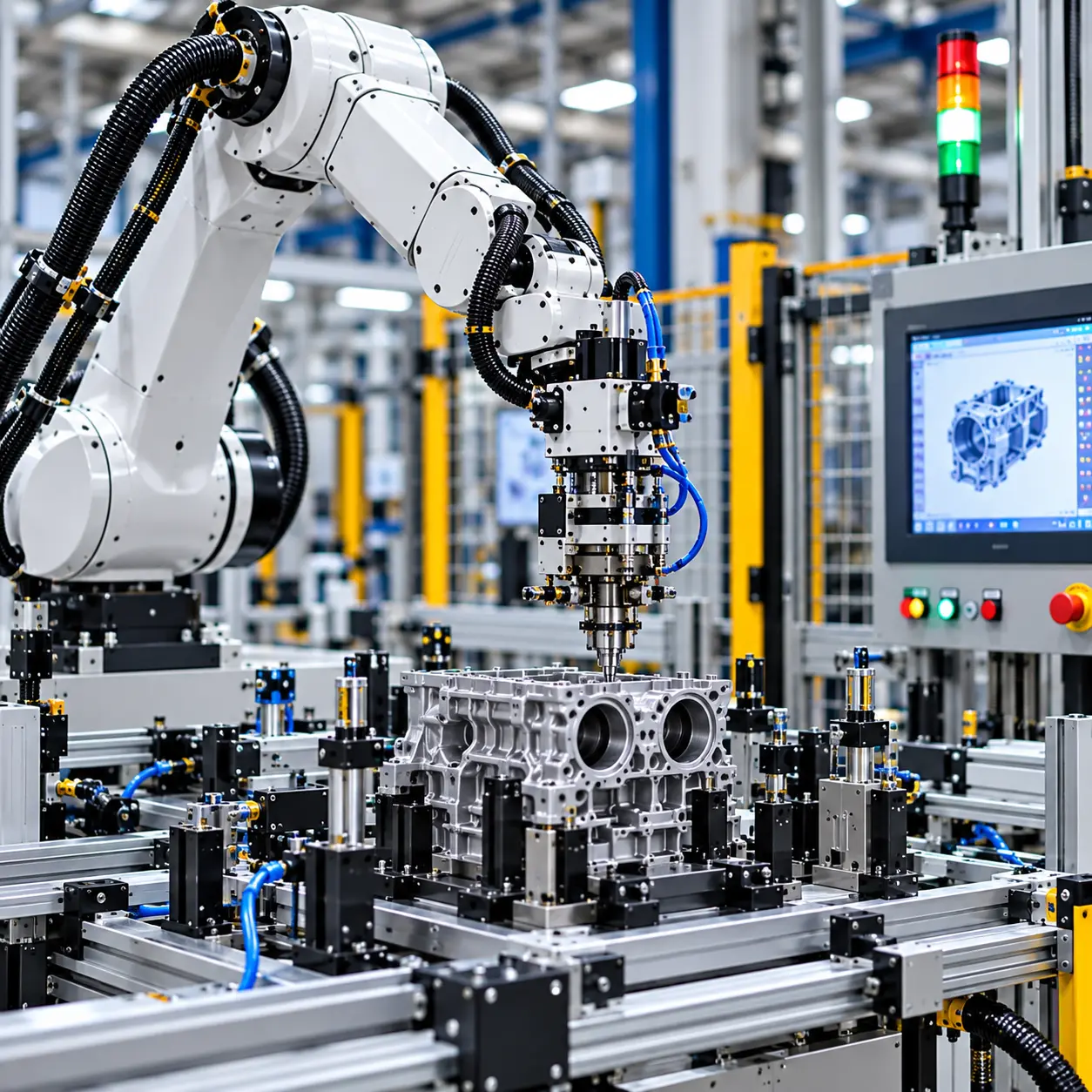
A Special Purpose Machine, commonly known as an SPM, is a machine developed for a specific manufacturing operation, component or family of components.
Unlike general-purpose equipment, an SPM does not need to perform every possible manufacturing operation. Its architecture can instead be optimized for a clearly defined production objective.
For example, suppose a component requires loading, drilling, machining, inspection and unloading. A conventional manufacturing setup may use separate equipment for these operations and require manual transfer between them.
A properly engineered SPM may be able to combine several of these operations within a controlled sequence.
The component enters the machine, is correctly located and clamped, undergoes the required manufacturing operation, is inspected according to defined parameters and is then unloaded or transferred to the next stage.
The exact configuration depends on component geometry, tolerances, production volume, cycle-time requirement and process feasibility.
This application-specific approach is one of the main reasons manufacturers search for a Special Purpose Machine manufacturer in India when conventional machinery cannot meet a particular production requirement.
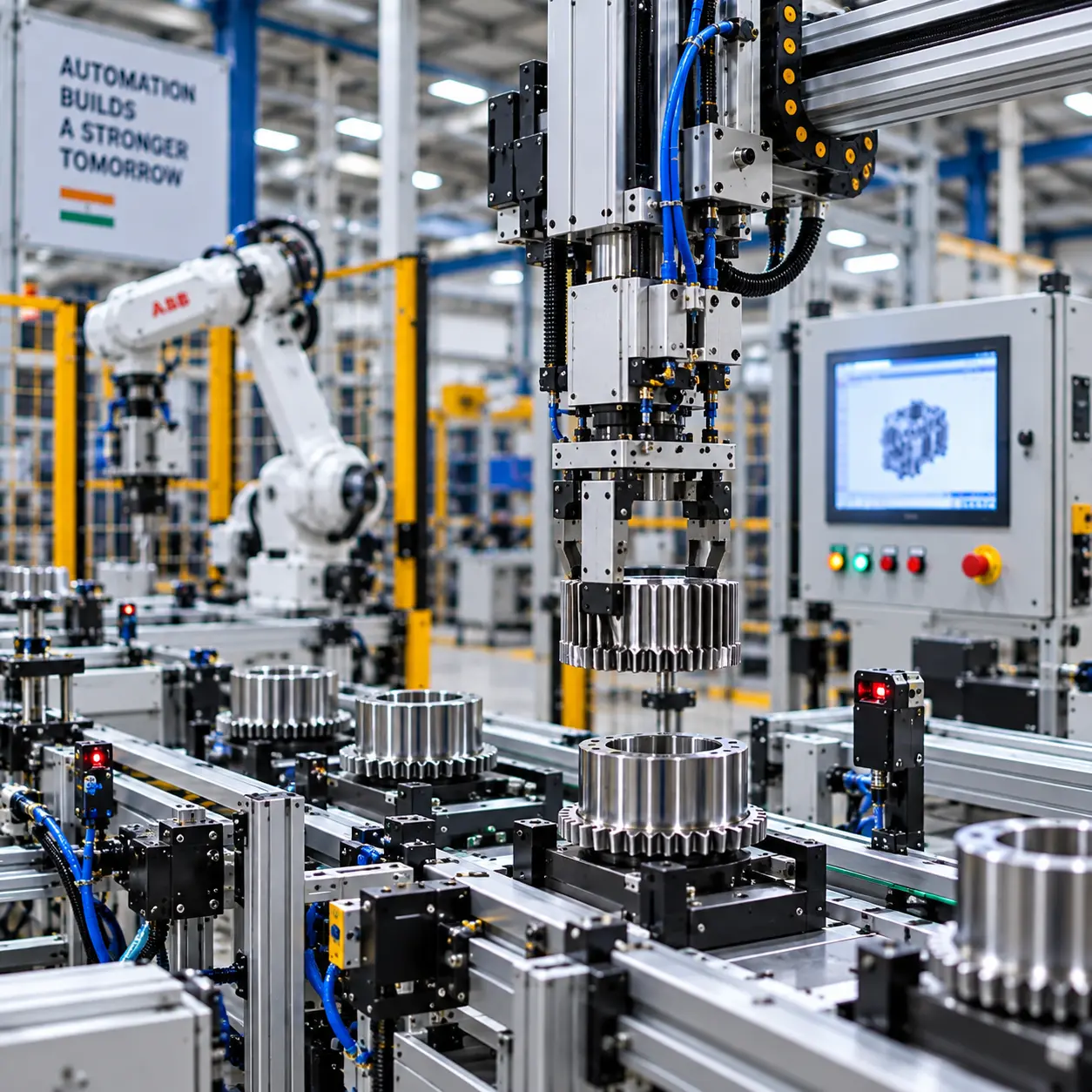
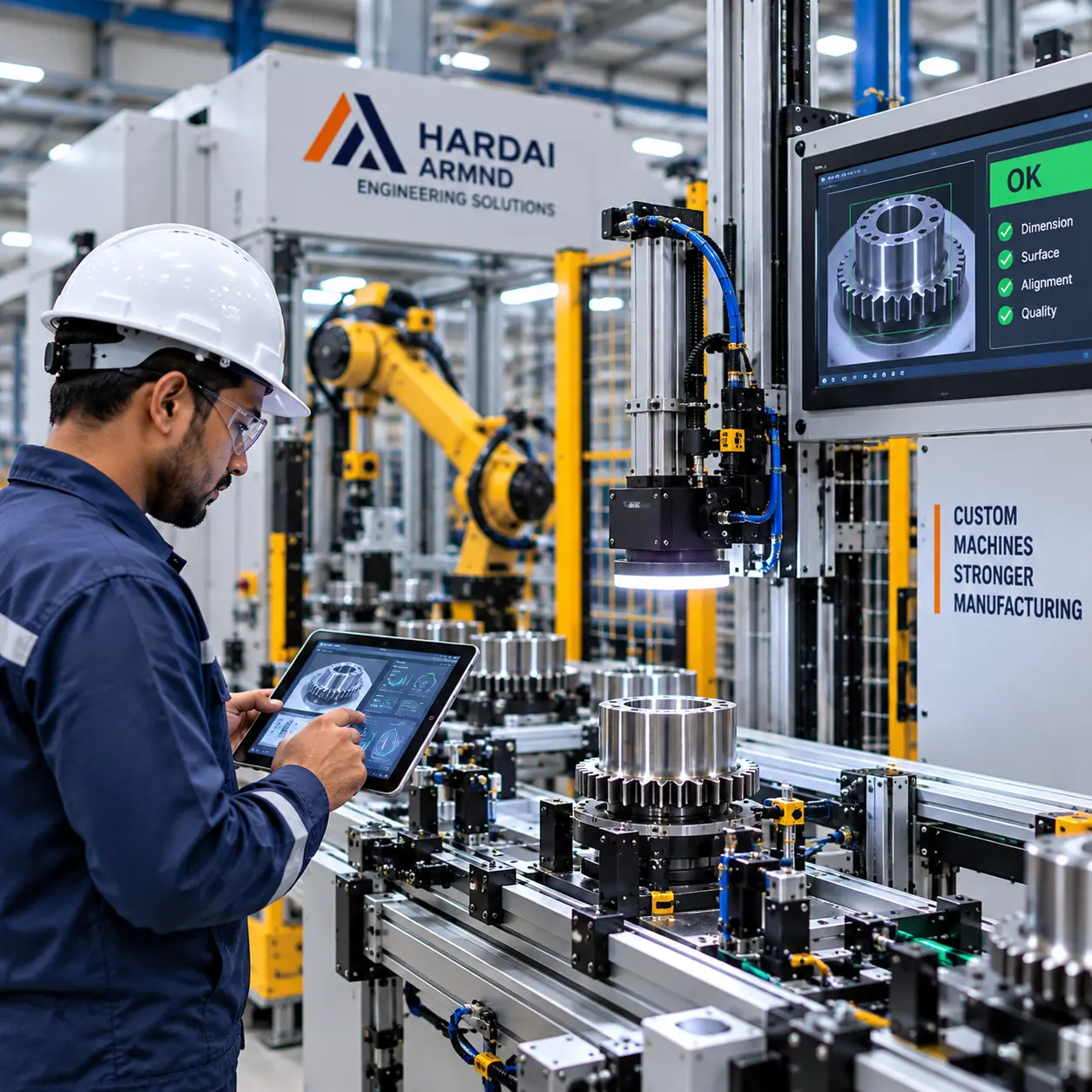
Standard Machines vs Customized SPM Machines
There is no universal rule that a customized machine is better than a standard machine.
If a standard machine can achieve the required operation, production rate, quality and flexibility economically, it may be the appropriate solution.
The need for a custom SPM machine generally appears when the manufacturing requirement begins exceeding what standard equipment can conveniently provide.
For example, a manufacturer may need a dedicated fixture for an irregular casting. Another application may require two operations to occur simultaneously to achieve the target cycle time. A third application may require automatic loading, machining, inspection and OK/NG segregation within a single production cell.
In such situations, the machine needs to be engineered around the process rather than the process being forced around a generic machine.
When Should a Manufacturer Consider Custom Automation?
The decision to automate should begin with the production problem.
One of the most common warning signs is excessive operator dependency. If production rate, component quality or inspection results change significantly between operators or shifts, the process may benefit from greater control.
Cycle time is another important consideration.
Imagine that machining requires 20 seconds, but manual loading, clamping, unloading and transfer require another 25 seconds. Buying a faster cutting tool may reduce machining time slightly, but it does not address the larger production loss.
The engineering opportunity may instead be in component handling and transfer.
Manufacturers may also consider automation when rejection or rework is increasing, repetitive operations are creating ergonomic concerns, production quantities are rising, inspection is slowing production or traceability has become important.
Therefore, the purpose of factory automation solutions should not simply be to remove operators.
The objective should be to transform a variable manufacturing activity into a repeatable, measurable and controllable production process.
Hardai ARMND Engineering Approach to Industrial Automation
At Hardai ARMND Engineering Solutions, the development of a custom machine starts with the process.
Requirement and Manufacturing Process Study
The first step is understanding what the customer actually needs the machine to accomplish.
This includes studying the existing production sequence, operator involvement, component movement, manufacturing operation, current bottlenecks, inspection process and desired output.
Instead of immediately deciding that the solution requires a robot, CNC axis or indexing machine, the manufacturing problem is first defined.
Component Drawing and 3D Model Analysis
The component is one of the most important inputs in SPM machine design.
Component geometry determines possible locating surfaces, clamping points, tool accessibility, loading direction, orientation and handling strategy.
A heavy irregular casting, for example, requires a completely different automation architecture from a lightweight precision-machined component, even if both components require a similar manufacturing operation.
Material tolerance, incoming component condition and available datums also influence fixture and tooling design.
Existing and Target Cycle-Time Analysis
Cycle time should not be treated as a single number.
A complete manufacturing cycle may contain loading time, positioning, clamping, tool approach, processing, tool return, inspection, unclamping, unloading and component transfer.
By breaking the cycle into individual activities, engineers can identify which operations dominate the production time.
Where technically feasible, some operations may then be performed simultaneously.
This is often where a properly designed custom automation system can provide substantial production advantages over simply making one machine movement faster.
Production Target Definition
The required production quantity directly influences automation architecture.
A process producing a small number of components may only justify a semi-automatic fixture or dedicated machine. A high-volume automotive component may justify a multi-station system with automatic transfer and integrated inspection.
Therefore, production requirements per hour, shift, day or month should be understood before finalizing the concept.
Concept Development and Feasibility Engineering
Once the manufacturing requirement is understood, the automation concept can be developed.
Depending on the application, Hardai ARMND may consider architectures such as a rotary indexing machine, linear transfer system, robotic automation cell, gantry loading system, dedicated machining SPM, servo-controlled mechanism or multi-axis CNC system.
The concept is then evaluated from multiple engineering perspectives.
Can the component be loaded reliably? Can the required surfaces be accessed? Is there sufficient tool clearance? Can the target cycle time realistically be achieved? How will the finished component be inspected? How will maintenance personnel access critical machine components?
Answering these questions before detailed manufacturing begins is an important part of developing reliable custom machinery.
Mechanical Design, Fixture Design and Tooling
After concept approval, the machine can progress into detailed mechanical design.
The structure must provide appropriate rigidity while remaining practical to manufacture and assemble. Servo axes, guides, bearings, actuators, tooling and mechanisms must be positioned according to the required motion and process loads.
Fixture design deserves particular attention.
Even an extremely accurate machine cannot consistently manufacture a component if the workpiece is located differently during every cycle.
Fixture engineering therefore considers datum strategy, repeatability, clamping force, component deformation, tool clearance, loading accessibility and changeover requirements.
For high-production machinery, tool replacement and maintenance access should also be considered during the design stage rather than after the machine has already been manufactured.
PLC, HMI, Servo and Robotic Integration
Mechanical automation must work together with the control system.
Depending on machine complexity, a customized automation solution can incorporate PLC control, HMI interfaces, servo motors, servo drives, industrial sensors, CNC motion, industrial robots, pneumatic systems, hydraulic systems, load cells, vision systems and data acquisition.
The PLC can control machine sequences and interlocks, while the HMI provides the operator with access to operating modes, machine parameters, alarms and diagnostics.
Servo systems are useful where programmable position, velocity or motion profiles are required.
Industrial robots provide flexible motion for component loading, unloading, machine tending and transfer.
The important point is that these technologies should not be treated as isolated products.
They need to function as one integrated manufacturing system.
Custom CNC and Machining Automation
Machining automation is an important area for improving production efficiency.
A conventional machining process may involve substantial non-cutting time. Operators load components, align them, activate fixtures, wait for machining, unload finished parts and move them to inspection or the next machine.
A custom CNC automation solution can be designed to address these additional operations.
For suitable applications, dedicated fixtures, automatic loading, servo positioning, machine-to-machine component transfer, in-process measurement, post-process inspection and automated cleaning can be integrated into the manufacturing cycle.
For high-volume production, a dedicated machining SPM can also be designed around a specific component rather than providing the broad flexibility of a conventional machining centre.
The engineering decision depends on production volume, required flexibility, cycle time, machining operations and investment requirements.
Robotic Automation and Machine Tending
Industrial robots have become an important part of modern factory automation because they provide programmable and repeatable movement.
A robotic machine tending system can load raw components into a CNC machine, remove finished parts and transfer them to another station.
However, successful robotic automation involves much more than robot selection.
Suppose a robot has sufficient payload but cannot reach the loading point at the required orientation. The robot itself may meet the specification, but the cell will not.
Similarly, a poorly designed gripper may create inconsistent component positioning even when robot repeatability is excellent.
Robot reach, payload, gripper design, component orientation, fixtures, cycle time, machine communication, safety and maintenance access therefore need to be engineered together.
Assembly Automation Systems
Manual assembly can become increasingly difficult to control when several components, orientations and quality checks are involved.
A custom assembly automation machine can introduce controlled sequencing into the process.
For example, sensors can confirm whether the correct component has been loaded. Poka-yoke arrangements can prevent incorrect orientation. Force and displacement monitoring can verify appropriate assembly conditions. The machine logic can prevent the cycle from continuing when a required component or operation is missing.
The purpose is not simply to perform assembly faster.
It is to make the assembly operation more controlled, traceable and verifiable.
Servo Press Machine Solutions
Conventional pressing systems can be highly effective for many industrial applications. However, some assembly and pressing operations require greater control over motion and process parameters.
A servo press system provides programmable control over parameters such as position, speed and motion profile. When combined with suitable measurement equipment, force and displacement can also be monitored according to the application.
This makes servo-controlled pressing useful for manufacturing processes where the press operation itself contains valuable quality information.
A customized servo press can integrate mechanical tooling, load measurement, displacement feedback, HMI controls, process monitoring and machine safety systems according to the required operation.
Automated Inspection and Quality Control
Quality inspection can become a major production bottleneck when components must leave the machine and move to a separate inspection station.
For suitable applications, inspection can instead become part of the production cycle.
An automated inspection system can use technologies such as industrial sensors, machine vision, laser measurement, linear measurement or other application-specific measuring methods.
The machine can compare measured values with predefined acceptance criteria and classify the component accordingly.
An automated production system may therefore follow a sequence such as:
Manufacture → Measure → Verify → OK/NG Decision → Segregate → Record
This establishes a much closer relationship between manufacturing and quality control.
Material Handling and Machine-to-Machine Automation
Production efficiency is often lost between machines.
Even if individual processes are fast, manual transportation, orientation and loading can add considerable non-value-added time.
A material handling automation system can use conveyors, gantries, robots, indexing mechanisms, servo transfer units or component feeders to move parts between operations.
The appropriate mechanism depends on component geometry, weight, orientation, cycle time and factory layout.
For example, a heavy component may require a gantry or robot, while a small repetitive component may be more suitable for a feeder and pick-and-place mechanism.
Automated Deburring and Finishing Systems
Deburring and finishing operations are often repetitive and difficult to control manually.
The amount of material removed can vary between operators, particularly on complex components with multiple edges or changing contours.
A customized CNC or robotic deburring system can use controlled motion to follow a predefined component path.
Depending on the component, the system may perform edge deburring, contour processing, cleaning or repetitive finishing operations.
Automation can therefore improve process consistency while reducing repetitive manual activity.
Custom Industrial Test Rigs and Testing Machines
Not every industrial test requirement can be satisfied with standard laboratory equipment.
Product-development and manufacturing teams may require a test machine that applies a particular load, speed, motion, pressure or operating sequence while measuring defined performance parameters.
Hardai ARMND can develop custom industrial testing machines and test rigs around these application-specific requirements.
The engineering process begins by defining what must be applied, what must be measured, the operating range, required accuracy, test duration, safety requirements and data that must be recorded.
The resulting architecture may integrate mechanical loading systems, servo motion, sensors, load cells, instrumentation, PLC control, HMI interfaces and data acquisition according to the testing requirement.
Production Line Automation and Integration
Sometimes the biggest manufacturing improvement cannot be achieved by optimizing a single machine.
The complete line needs to be considered.
A production line may contain machining, assembly, inspection, cleaning, identification and transfer operations. If each station operates independently, intermediate handling can create bottlenecks.
Production line automation connects these operations into a coordinated system.
For suitable applications, robots, conveyors, gantries, indexing mechanisms and automated inspection stations can be synchronized through a common control architecture.
This creates better visibility of the complete production process and reduces unnecessary intermediate handling.
From Manual Process to Controlled Automated Production
The difference between manual and automated production is not simply the absence of an operator.
The more important difference is process control.
A manual process may have variable loading time, different handling between operators and inspection results that depend on individual judgement.
A properly designed automation system defines how the component is loaded, where it is positioned, when the operation begins, what parameters are monitored, how inspection is performed and what happens if the component fails the defined criteria.
That means the process becomes increasingly repeatable and measurable.
The objective of industrial automation should therefore be:
Convert manufacturing knowledge into a controlled production sequence that can be repeatedly executed and measured.
Industries Where Custom Automation Can Be Applied
Hardai ARMND’s custom machine engineering approach can be relevant across a broad range of manufacturing sectors.
In the automotive and auto-component industry, applications can include machining automation, component assembly, pressing, deburring, inspection, testing and material transfer.
For electric vehicle and mobility manufacturing, automation can support component handling, assembly, testing, inspection and production traceability.
Aerospace and defence manufacturing may require controlled processing, precision handling, automated inspection and customized testing systems.
Within general engineering and precision manufacturing, manufacturers can use custom machinery for machining, repetitive assembly, component handling, deburring, finishing, inspection and production testing.
Electrical, electronics, industrial machinery, metal processing and consumer-product manufacturers can similarly apply automation wherever repetitive processes require greater productivity, repeatability or control.
Why Choose Hardai ARMND Engineering Solutions?
Hardai ARMND approaches industrial automation as a combination of mechanical engineering, machine design, manufacturing engineering and automation integration.
Instead of limiting a project to a predefined machine configuration, the engineering process begins with the component and manufacturing objective.
The machine architecture is then developed around factors such as process sequence, cycle time, loading, tooling, inspection, production volume, ergonomics, maintenance and available floor space.
Mechanical systems, fixtures, controls, sensors, servo systems and robotic automation are considered as interconnected elements rather than independent products.
This engineering-first approach allows Hardai ARMND to work on requirements ranging from an individual custom machine to an integrated manufacturing system.
What Should You Send Us for a Custom Automation Requirement?
If you are planning a custom SPM, robotic automation system, testing machine, assembly system or production automation project, the engineering discussion can begin with a relatively small amount of information.
The most useful starting information is your component drawing or 3D model, photographs or video of the existing manufacturing process, required operation, current cycle time, target cycle time, production quantity, tolerance and quality requirements, available machine space and required automation level.
If available, information about component variants, inspection requirements, upstream and downstream equipment, expected project timeline and budget range can further improve the initial feasibility discussion.
Not every parameter needs to be finalized before contacting Hardai ARMND.
A component drawing together with a video of the existing process and the required production target can provide a practical starting point.
Recent Posts
- Custom Automation Robotic Grippers: Improving Precision and Manufacturing Efficiency
- Custom Industrial Automation Solutions & Special Purpose Machines (SPM) for Modern Manufacturing
- Custom Machines: The Complete Guide to Custom Machine Design and Manufacturing
- Dry Film Lubricants vs. Wet Greases: When to Eliminate Liquid Lubrication Completely
- Types of Automation Systems in Manufacturing A Complete Guide for Indian Manufacturers
Products
-
 MolyKul MoS2 Gear Oil additive for cars and bike| Anti-friction MoS2 Solution - 100ml
₹598.73Original price was: ₹598.73.₹399.62Current price is: ₹399.62. Including 18% GST -
MolyKul Aero-Spec 500 (MKG AS500 NG2) – MoS2 Anti-Seize Aerospace grease – 500 Deg C
₹2,088.60 – ₹9,739.72Price range: ₹2,088.60 through ₹9,739.72 Including 18% GST
-
MolyKul MoS2 Grease for industrial application| Lithium + Anti-Seize MoS2 - 650 Deg C
₹1,539.90Original price was: ₹1,539.90.₹1,169.38Current price is: ₹1,169.38. Including 18% GST -
MolyKul MoS2 engine oil additive for cars and bikes| Anti-friction MoS2 Solution - 100ml
₹195.88 – ₹531.00Price range: ₹195.88 through ₹531.00 Including 18% GST
-
MolyKul MoS2 Grease for industrial application| Lithium + Anti-Seize MoS2 - 320 Deg C
₹684.40 – ₹6,608.00Price range: ₹684.40 through ₹6,608.00 Including 18% GST

Leave A Comment