Types of Automation Systems in Manufacturing | Complete Guide
- Home
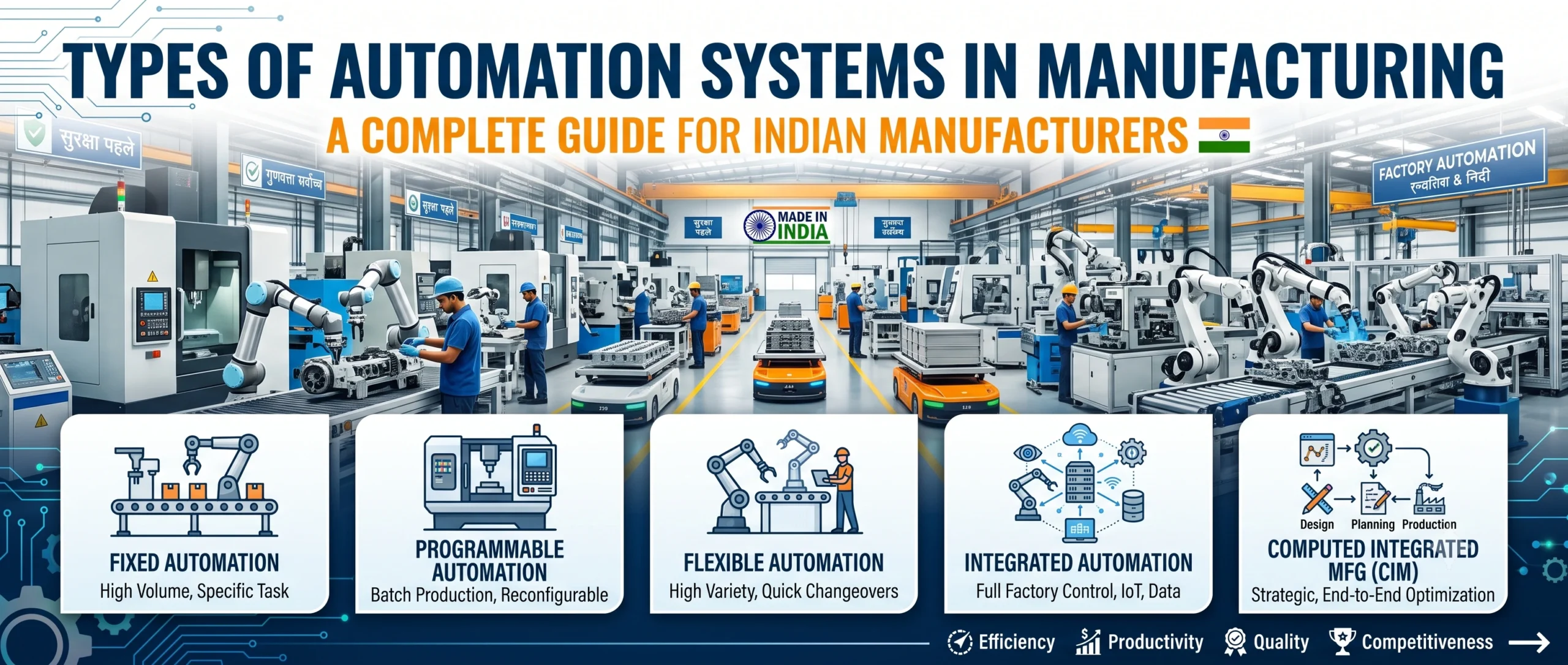
- Types of Automation Systems in Manufacturing A Complete Guide for Indian Manufacturers
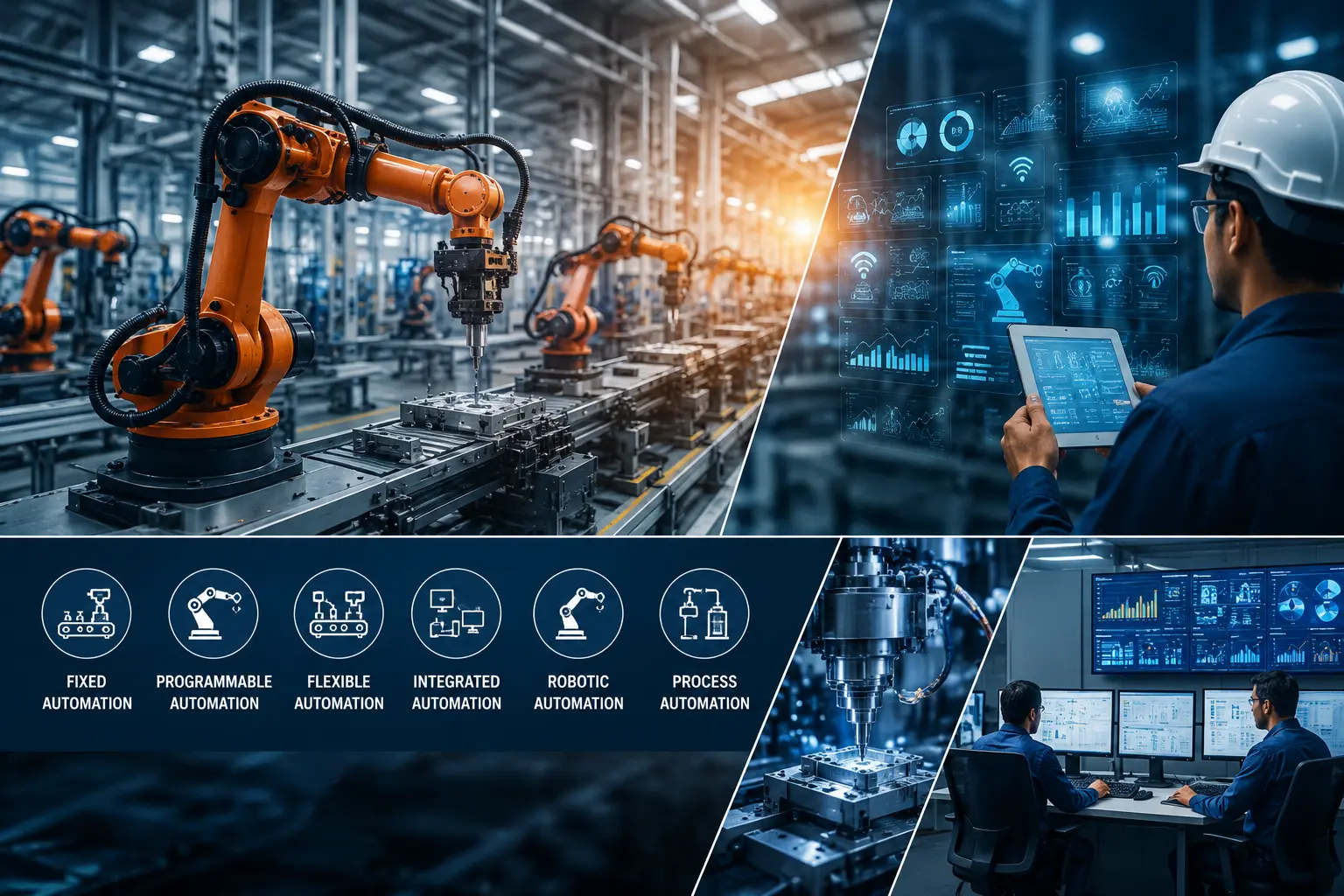
Manufacturing in India is changing rapidly. Customers expect better quality, shorter delivery times and competitive prices, while manufacturers are simultaneously dealing with rising production costs, shortage of skilled operators, inconsistent quality, machine downtime and increasing pressure to produce more from the same factory floor.
For many factories, simply adding more workers or purchasing another standard machine is no longer enough. The real opportunity lies in improving how machines, operators, material movement, inspection and production information work together. This is where industrial automation becomes important.
Automation in manufacturing does not necessarily mean replacing every operator with a robot. A well-designed automation system may be a simple automatic fixture, a PLC-controlled Special Purpose Machine (SPM), an automated CNC loading system, a gantry loader, a robotic production cell, an automated inspection station or a completely integrated manufacturing line.
The correct solution depends on the production problem.
Understanding the different types of automation systems in manufacturing helps manufacturers decide where automation can genuinely increase production capacity, reduce manufacturing cost, improve quality and reduce unnecessary dependency on manual operations.
This guide explains the major types of industrial automation, their applications, advantages and limitations, while also discussing how Indian manufacturers can move gradually from manual manufacturing toward connected and smart production systems.
What Is Industrial Automation in Manufacturing?
Industrial automation is the use of machines, control systems, sensors, software and material-handling equipment to perform manufacturing operations with reduced manual intervention and greater process consistency.
A manufacturing automation system can include technologies such as Special Purpose Machines, CNC machines, industrial robots, PLCs, servo motors, sensors, pneumatic and hydraulic systems, conveyors, gantry systems, automated inspection equipment and production-monitoring software.
The important point is that these technologies do not operate independently. Good factory automation connects them around the actual manufacturing process. Consider a simple component that currently requires an operator to load it into a machine, clamp it, start the machining cycle, remove it, inspect it and place it into the next bin.
An automated version could work like this:
Raw Component → Automatic Loading → Clamping → Machining → Unloading → Automated Inspection → Cleaning → Production Data Recording → Output
Here, the machining operation may still be performed by a CNC machine. Automation improves everything happening before, during and after machining.
This is why manufacturing automation should be understood as process engineering, rather than simply as the purchase of robots or expensive machines.
Major Types of Automation Systems in Manufacturing
There is no single automation technology suitable for every factory. Production volume, component variety, cycle time, required accuracy, available space and investment all influence the correct choice.
The following are the major automation systems manufacturers should understand.
1. Fixed Automation
Fixed automation is designed to repeatedly perform a specific operation or sequence of operations. Once the equipment is developed, its production sequence generally remains relatively unchanged.
Examples include dedicated assembly machines, high-speed production lines, transfer machines, packaging systems and dedicated machining SPMs.
Imagine an automotive component manufacturer producing several thousand identical parts every day. If the product design and production requirement are expected to remain stable for several years, a dedicated machine can be engineered specifically around that component. Fixtures, cutting tools, loading mechanisms and control sequences can all be optimized for the same operation.
The biggest advantage is high productivity. Because the equipment does not need to accommodate a large variety of products, unnecessary movements and changeover operations can be minimized. This can produce very short cycle times and excellent repeatability.
However, fixed automation has relatively low flexibility. If the component changes significantly, fixtures, tooling or even major machine assemblies may need modification.
Therefore, fixed automation generally makes the most sense when production volume is sufficiently high and the manufacturing process is stable.
2. Programmable Automation
Programmable automation allows the operating sequence to be modified through software or control programs.
Common examples include CNC machines, PLC-controlled SPMs, industrial robots and automated batch-production equipment.
Consider a CNC machining centre producing five different components. Each component can have a different machining program, tool sequence and fixture arrangement. Instead of purchasing five dedicated machines, the manufacturer can change programs and tooling according to the production schedule.
Programmable automation therefore provides a balance between productivity and flexibility. It is particularly useful in batch manufacturing, where one product is manufactured for a certain period before the machine is changed over to another product.
The main consideration is changeover time. Changing fixtures, programs, tooling and process parameters takes time, so manufacturers must consider whether the flexibility gained justifies the additional setup requirements.
3. Flexible Automation
Flexible automation takes programmable automation further by reducing the effort required when changing between products.
A flexible manufacturing system may combine CNC machines, industrial robots, servo-controlled fixtures, automatic tool changers, programmable inspection equipment and intelligent material handling.
Suppose a manufacturer produces multiple component variants that share similar manufacturing processes. Instead of stopping production for lengthy manual changeovers, the automation system can recognize the component and adjust the required program, fixture position, robot movement or inspection parameters.
This is increasingly important because manufacturers are being asked to produce greater product variety while maintaining shorter delivery schedules. Flexible automation can require a higher initial engineering investment, but it can be highly valuable where production volumes are moderate and product variants are frequent.
4. Integrated Automation
Integrated automation connects multiple manufacturing operations into a coordinated production system.
For example:
Input Conveyor → Robot → CNC Machine → Robot → Washing Station → Automated Inspection → Output Conveyor
Each machine may perform a different operation, but PLC communication, sensors and control architecture allow them to function as one production cell.
If the CNC machine is busy, the robot should know not to load another component. If inspection detects a rejected component, the system should divert it. If a safety door opens, the appropriate equipment should stop safely.
Integration can also extend to production information. Cycle counts, machine alarms, inspection results and downtime information can be recorded and displayed through HMI or production-monitoring systems.
The objective is therefore not simply to automate individual machines. It is to create a smoother production flow.
5. Robotic Automation
Industrial robots are among the most visible forms of factory automation, but they should be selected based on engineering requirements rather than simply because a company wants a robotic factory.
Robotic automation is particularly useful for operations requiring flexible movement.
Typical applications include robotic machine tending, CNC loading and unloading, pick-and-place automation, material handling, palletizing, component transfer, assembly and inspection.
For CNC machine tending, for example, a robot can pick an unfinished component, orient it correctly, load it into the machine fixture, wait for machining to finish, unload the completed component and transfer it to the next operation.
However, robots are not automatically the best solution for every repetitive process.
If a component only needs to move along a simple fixed path, a pneumatic mechanism, servo slide, conveyor or gantry system may provide a simpler and more economical solution.
Robot selection must consider payload, reach, accuracy, cycle time, component geometry, safety requirements, gripper design and the layout surrounding the robot.
Why EOAT and Robotic Gripper Design Matters
The robot is only one part of a robotic automation system.
End-of-Arm Tooling (EOAT) is the equipment attached to the robot that physically interacts with the component. Poor EOAT design can make an otherwise excellent robotic system unreliable.
Depending on the application, automation may require pneumatic grippers, servo/electric grippers, dual grippers, component-specific fingers, machine-tending grippers or palletizing EOAT.
A dual gripper, for example, may allow a robot to remove a finished component and immediately load a new component without returning to the input station between the two operations. In the correct application, this can reduce machine idle time.
Good robotic integration therefore requires the robot, EOAT, fixture, machine interface and complete process to be engineered together.
6. Special Purpose Machine Automation
A Special Purpose Machine (SPM) is a customized machine developed around a specific manufacturing operation or component.
This is particularly relevant to Indian manufacturers because many production problems do not require a general-purpose robot or an expensive imported production line.
Sometimes a carefully engineered custom SPM machine is the better solution.
An SPM can integrate fixtures, cutting tools, servo axes, pneumatics, hydraulics, sensors, PLC controls, automatic feeding, inspection and material handling into one purpose-designed production machine.
SPMs can be developed for operations such as machining, drilling, tapping, turning, pressing, assembly, deburring, testing, inspection, component transfer and machine tending.
Consider a component that currently passes through three standard machines and requires manual loading between each operation. Instead of purchasing another general-purpose machine to increase capacity, it may be possible to develop an SPM that combines several operations into one controlled production cycle.
This can reduce handling, WIP, operator dependency and total cycle time.
The engineering decision should always depend on production volume, component life, process complexity and expected ROI.
7. CNC Automation
CNC machines are highly capable, but their productivity can still be limited by what happens outside the machining cycle.
A machine may complete machining in 60 seconds and then remain idle for another 30 seconds while the operator removes the finished part, cleans the fixture, loads another component and starts the next cycle.
That idle time becomes significant over thousands of components.
CNC machine automation addresses this through technologies such as gantry loaders, robotic machine tending, automatic fixtures, dual grippers, component-orientation systems, automatic machine doors and integrated inspection.
A typical automated CNC production sequence can be:
Component Loading → Automatic Clamping → Machining → Unclamping → Unloading → Inspection
For high-volume applications, a customized CNC machine or production SPM can sometimes combine several operations that would otherwise require multiple machines.
This is why manufacturers should evaluate the complete cycle rather than only comparing machining specifications.
8. Process Automation
Process automation is commonly used where manufacturing requires continuous or precisely controlled process parameters.
Important parameters can include temperature, pressure, flow, level, speed and timing.
Sensors continuously measure these conditions, while PLCs or controllers make decisions and actuators adjust the process.
For example, an automated industrial process may need to heat a material to a defined temperature, maintain that temperature for a certain time, regulate pressure, operate pumps in a specific sequence and record whether the required process conditions were achieved.
Process automation improves consistency because critical parameters are controlled according to defined logic instead of depending completely on manual judgement.
From Manual Manufacturing to Smart Manufacturing
Factories do not have to move from manual manufacturing to Industry 4.0 overnight. Automation can be implemented progressively.
Level 1 – Manual Operation
Operators perform most activities, including loading, unloading, inspection and material transfer.
Level 2 – Mechanized Operation
Machines assist operators, but human involvement remains essential for most production decisions and handling.
Level 3 – Semi-Automatic Manufacturing
The machine performs the manufacturing operation automatically, while an operator handles activities such as loading and unloading.
Level 4 – Fully Automated Production
Loading, processing, unloading, inspection and component transfer are performed automatically with limited operator intervention.
Level 5 – Connected Smart Manufacturing
Machines additionally communicate production information, inspection results, downtime, alarms and maintenance information.
The correct level depends on the factory. Full automation is not automatically better than semi-automation if the additional investment does not solve a meaningful production problem.
Comparison of Different Manufacturing Automation Systems
Automation Type | Production Volume | Product Variety | Investment | Flexibility | Typical Application |
Fixed Automation | Very High | Low | High | Low | Dedicated production lines |
Programmable Automation | Medium–High | Medium | Medium–High | Medium | CNC and PLC-controlled machines |
Flexible Automation | Medium–High | High | High | High | Multi-product manufacturing |
Robotic Automation | Medium–High | Medium–High | Medium–High | High | Handling and machine tending |
SPM Automation | Medium–Very High | Low–Medium | Application-dependent | Customized | Dedicated manufacturing operations |
Integrated Automation | High | Medium | High | High | Complete automated production cells |
Process Automation | Application-dependent | Process-dependent | Application-dependent | Programmable | Controlled industrial processes |
The table should be treated as a general guide. Actual investment and suitability depend strongly on the component and manufacturing process.
How to Choose the Right Automation System
Choosing the right industrial automation system should begin with the manufacturing process, not with the equipment catalogue.
Before deciding between an SPM, robot, CNC machine or integrated production cell, manufacturers should understand their existing cycle time, production volume, component variants, quality problems, manpower requirements and material flow.
Floor space is another major consideration. A technically impressive automation system that creates congestion or makes maintenance difficult can reduce overall factory efficiency.
Existing equipment should also be evaluated. It is often unnecessary to replace every machine. A productive CNC machine, for example, may be integrated with an automatic loading system and continue operating as part of a new automated cell.
Future production requirements matter as well. If product variants are expected to change frequently, flexible automation may be more appropriate than highly dedicated fixed automation.
Most importantly:
Do not automate a poorly designed process.
If unnecessary component movement, excessive setup operations or inefficient process sequencing already exist, automating those problems may simply make an inefficient process run faster.
First optimize the process. Then automate it.
Is Industrial Automation Worth the Investment?
Automation ROI should not be calculated only by comparing machine investment with operator salaries.
Labour saving is only one part of the financial impact.
Suppose a manufacturing operation currently produces 400 acceptable components per shift. After process optimization and automation, production increases to 550 acceptable components while rejection and machine waiting time decrease.
The value of the additional 150 good components per shift may be more significant than the direct labour saving.
Manufacturers should therefore consider increased production, reduced rejection, lower rework, better machine utilization, lower WIP, improved quality, longer productive machine hours and reduced dependency on manual handling.
For example, assume an automation project costs ₹30 lakh and produces a combined measurable benefit of approximately ₹10 lakh per year through additional production, lower rejection and reduced operating costs. The simple payback period would be around three years.
This is only an illustrative example. Actual ROI must be calculated using real production and financial data from the factory.
Should You Choose an SPM, Robot or Standard CNC Machine?
These technologies solve different manufacturing problems.
Standard CNC Machine
A standard CNC is generally appropriate where machining flexibility is important. It can produce different components by changing programs, fixtures and tools.
Special Purpose Machine
An SPM is useful where productivity, cycle-time reduction and process-specific customization are more important. It can be engineered around one component family or manufacturing operation.
Industrial Robot
A robot is particularly useful when flexible movement, component handling, loading, unloading or transfer is required.
Integrated Automation Cell
An integrated automation cell becomes useful when several manufacturing processes need to operate automatically as one system.
In practice, the best automation solution may combine all of them:
Robot + Customized CNC/SPM + Automated Inspection + Conveyor + PLC Control
The objective is not to decide which technology is universally superior. It is to determine which combination solves the production problem most effectively.
Industry 4.0 and Smart Manufacturing
Industry 4.0 becomes useful when digital technology improves real manufacturing decisions.
Modern industrial automation can collect information about production quantity, cycle time, machine alarms, downtime, inspection results and process conditions.
IoT sensors and machine connectivity can provide production monitoring, while OEE tracking can help identify whether losses originate from machine availability, performance or quality.
Predictive-maintenance systems can use equipment-condition information to identify developing problems before an unexpected breakdown occurs.
Digital production records can improve traceability by linking a component or batch with manufacturing parameters and inspection results.
Remote diagnostics can also help engineering and maintenance teams understand faults faster.
The important point is that smart manufacturing should produce actionable information. Collecting thousands of data points has little value if nobody uses that information to improve production.
Why Indian Manufacturers Should Consider Indigenous Automation Solutions
India’s manufacturing sector is becoming increasingly sophisticated, creating opportunities for stronger domestic machine-building and automation capabilities.
Indigenous automation does not mean avoiding international technology. Industrial robots, controllers, servo systems, sensors and other globally developed technologies can still form important parts of a machine.
The advantage lies in local engineering and customization.
An Indian engineering company can develop the complete machine architecture around the customer’s component, cycle time, existing equipment, factory layout and production practices.
Local engineering can also simplify design modifications, spare-part support, troubleshooting and future expansion.
For MSMEs in particular, this can be important because they may not require a large standardized production line. They may need a carefully designed machine that solves one specific production bottleneck economically.
Building stronger Made-in-India automation capability can therefore reduce import dependency while increasing the ability of Indian manufacturers to develop process-specific manufacturing technology.
Industrial Automation & Special Purpose Machine Solutions by Hardai ARMND Engineering Solutions
Hardai ARMND Engineering Solutions approaches industrial automation as an engineering problem rather than simply an equipment-selection exercise.
The starting point is understanding what the manufacturer actually wants to improve: cycle time, capacity, quality, machine utilization, material movement, inspection, operator dependency or production scalability.
Based on this understanding, an appropriate automation architecture can be developed.
Special Purpose Machine Design & Manufacturing
Hardai ARMND develops custom Special Purpose Machines according to component and production requirements.
SPM solutions can be developed around machining, drilling, tapping, turning, pressing, assembly, deburring, inspection, testing, material handling, machine tending, component transfer and other production operations.
The objective is to design the machine around the process rather than force the process into the limitations of a standard machine.
For high-volume manufacturing, this approach can allow several operations to be combined and optimized for shorter cycle times.
Customized CNC Machine Solutions
Where conventional CNC equipment does not provide the required production rate or process integration, customized CNC and production-machine concepts can be developed.
These systems may incorporate special fixtures, multiple operations, automatic loading and unloading, integrated inspection, special tooling and component-specific machining arrangements.
The objective is to improve the complete production cycle rather than simply increase cutting speed.
Robotic Automation & Integration
Hardai ARMND’s automation approach can incorporate industrial robots for machine tending, CNC loading and unloading, pick-and-place, material handling, palletizing, assembly and process-to-process component transfer.
Robot selection is based on payload, reach, required accuracy, cycle time, component geometry and the surrounding manufacturing environment.
The complete cell—including robot, gripper, safety system, machine interface and material flow—must work together reliably.
EOAT & Custom Robotic Grippers
Hardai ARMND can develop application-specific End-of-Arm Tooling and custom robotic grippers for automated handling.
Depending on the application, EOAT may include pneumatic gripping, servo/electric gripping, dual-gripper arrangements or component-specific fingers.
Correct gripping is critical because an automation cell cannot achieve reliable production if the component is not consistently picked, oriented and positioned.
Factory Automation Solutions
Factory automation should connect processes rather than create isolated islands of equipment.
A production architecture could include:
Input Conveyor → Robotic Loading → Machining → Automatic Unloading → Inspection → Cleaning → Output Conveyor
By engineering the complete production flow, manufacturers can reduce unnecessary handling, machine waiting and WIP accumulation.
Machine Design & Engineering
Successful automation begins long before machine manufacturing.
Hardai ARMND’s engineering process can include feasibility studies, concept development, engineering calculations, 3D CAD modelling, machine design, fixture design, structural engineering, simulation, manufacturing drawings and design optimization.
Good engineering at the beginning of a project can prevent expensive modifications during manufacturing and commissioning.
PLC, HMI & Control System Integration
PLCs provide the sequencing and decision-making logic behind automated machines.
Together with HMIs, servo drives, VFDs, sensors, pneumatic systems and safety interlocks, the PLC coordinates the manufacturing sequence.
A properly engineered control system also provides diagnostics. Instead of simply stopping, the machine can identify conditions such as missing components, incorrect positioning, low pressure or a safety interruption, helping maintenance teams locate problems faster.
Automated Inspection & Quality Control
Automated inspection can be incorporated directly into production using vision systems, laser inspection, dimensional checking, presence/absence sensors and other verification technologies.
If a component fails inspection, the system can automatically separate it instead of allowing it to proceed unnoticed to the next operation.
Inspection data can also contribute to production traceability.
Material Handling Automation
Material handling often consumes more production time than manufacturers realize.
Hardai ARMND automation concepts can incorporate conveyors, gantry systems, pick-and-place mechanisms, robotic handling, automatic loading/unloading, pallet handling, component transfer and buffer systems.
The objective is not simply to move components automatically. It is to reduce unnecessary movement and create smoother flow between processes.
Machine Manufacturing, Assembly, Testing & Commissioning
Automation does not end when a 3D CAD model is completed.
A complete machine-development cycle involves:
Problem Identification → Feasibility → Concept → Engineering → Detailed Design → Manufacturing → Assembly → Controls → Testing → Component Trials → Installation → Commissioning → Optimization
Testing and optimization are particularly important because actual components, tooling and production conditions can reveal issues that cannot always be predicted completely during design.
How Hardai ARMND Approaches an Automation Project
Step 1 – Understand the Production Problem
The component, current manufacturing process, production volume, cycle time, quality requirements and existing bottlenecks are studied.
Step 2 – Feasibility & Concept Development
The engineering team evaluates whether an SPM, customized CNC, robotic cell, mechanical automation or combination of technologies is appropriate.
Step 3 – Engineering & Simulation
The selected concept moves into detailed engineering, including 3D CAD modelling, engineering calculations, fixture design, structural considerations and automation architecture.
Step 4 – Machine Manufacturing
Machine structures, fixtures and custom components are manufactured while required bought-out components are sourced.
Step 5 – Automation Integration
PLC, HMI, sensors, servo systems, drives, pneumatics, robotics and safety equipment are integrated according to the machine architecture.
Step 6 – Assembly & Testing
The machine is assembled and tested through dry trials followed by component trials and process validation.
Step 7 – Installation & Commissioning
The system is installed at the customer’s manufacturing facility and optimized under actual production conditions.
This engineering-led development process is particularly important for customized machines because every application has different components, tolerances, production volumes and operating conditions.
Frequently Asked Questions About Manufacturing Automation
1. What are the main types of automation systems in manufacturing?
Major types include fixed automation, programmable automation, flexible automation, integrated automation, robotic automation, SPM automation, CNC automation and process automation. The correct type depends on production volume, product variety, cycle time and manufacturing requirements.
2. What is the difference between fixed and flexible automation?
Fixed automation is optimized for repetitive high-volume production with relatively little product variation. Flexible automation is designed to accommodate multiple product variants with shorter changeovers.
3. Which automation system is best for high-volume manufacturing?
Fixed automation and customized SPMs can be highly effective for stable, high-volume production. However, the final selection depends on the component, process and expected product life.
4. What is a Special Purpose Machine?
A Special Purpose Machine is a customized manufacturing machine designed for a particular component, operation or production requirement. It can combine mechanical systems, tooling, fixtures, PLC controls, sensors and automatic handling.
5. Can existing CNC machines be automated?
Yes. Many CNC machines can be integrated with robotic loaders, gantry systems, automatic doors, fixtures, conveyors and inspection equipment, depending on machine compatibility and process requirements.
6. When should a manufacturer use robotic automation?
Robots are particularly useful where flexible movement, repetitive handling, machine tending, palletizing or component transfer is required. Payload, reach, cycle time and safety must be evaluated before selection.
7. How does industrial automation reduce manufacturing costs?
Automation can reduce costs through higher production, lower rejection, reduced rework, better machine utilization, reduced manual handling and more consistent manufacturing.
8. What is the difference between SPM and CNC automation?
A CNC machine generally provides greater machining flexibility. An SPM is developed around a specific manufacturing requirement and may provide greater productivity for repetitive, high-volume processes.
9. How can Indian MSMEs start factory automation?
MSMEs can begin by identifying their biggest production bottleneck rather than attempting to automate the entire factory. A semi-automatic fixture, machine-tending system, inspection station or customized SPM may provide a practical first step.
10. How should I choose an industrial automation company in India?
Evaluate the company’s ability to understand the manufacturing process, perform feasibility analysis, develop mechanical and controls engineering, integrate equipment and support testing and commissioning. The right partner should recommend the solution that fits the application rather than simply proposing the most expensive technology.
Conclusion: Start With the Production Problem, Not the Robot
Understanding the types of automation systems in manufacturing is important, but manufacturers should remember that automation technology is only a tool.
A factory should not begin its automation journey by asking:
“Which robot should we buy?”
A much better engineering question is:
“What production problem are we trying to solve?”
Perhaps the problem is excessive cycle time. Perhaps CNC machines remain idle during manual loading. Perhaps quality depends too heavily on operator skill. Perhaps WIP is accumulating between operations, inspection has become a bottleneck or production cannot increase without adding more operators.
Once the real constraint is identified, engineers can determine the correct combination of SPM + CNC + Robotics + PLC + Sensors + Inspection + Material Handling + Engineering.
For one factory, the solution may be a simple automatic fixture. For another, it may be a customized Special Purpose Machine. A third may require robotic CNC machine tending, while a high-volume plant may benefit from a completely integrated production cell.
Hardai ARMND Engineering Solutions supports manufacturers seeking customized industrial automation, Special Purpose Machine development, customized CNC solutions, robotic integration, machine design, EOAT, control-system integration, automated inspection and material-handling solutions.
Recent Posts
- Designing Modular SPMs for High-Mix, Low-Volume (HMLV) Manufacturing: The Scalable Automation Playbook
- Custom Automation Robotic Grippers: Improving Precision and Manufacturing Efficiency
- Custom Industrial Automation Solutions & Special Purpose Machines (SPM) for Modern Manufacturing
- Custom Machines: The Complete Guide to Custom Machine Design and Manufacturing
- Dry Film Lubricants vs. Wet Greases: When to Eliminate Liquid Lubrication Completely
Products
-
 MolyKul MoS2 Gear Oil additive for cars and bike| Anti-friction MoS2 Solution - 100ml
₹598.73Original price was: ₹598.73.₹399.62Current price is: ₹399.62. Including 18% GST -
MolyKul Aero-Spec 500 (MKG AS500 NG2) – MoS2 Anti-Seize Aerospace grease – 500 Deg C
₹2,088.60 – ₹9,739.72Price range: ₹2,088.60 through ₹9,739.72 Including 18% GST
-
MolyKul MoS2 Grease for industrial application| Lithium + Anti-Seize MoS2 - 650 Deg C
₹1,539.90Original price was: ₹1,539.90.₹1,169.38Current price is: ₹1,169.38. Including 18% GST -
MolyKul MoS2 engine oil additive for cars and bikes| Anti-friction MoS2 Solution - 100ml
₹195.88 – ₹531.00Price range: ₹195.88 through ₹531.00 Including 18% GST
-
MolyKul MoS2 Grease for industrial application| Lithium + Anti-Seize MoS2 - 320 Deg C
₹684.40 – ₹6,608.00Price range: ₹684.40 through ₹6,608.00 Including 18% GST

For More Contact Us
#Tags:
- Automatic SPM Machine, Automation with Hardai ARMND, Custom SPM Machine Customized SPM Machine Industrial SPM Machine Automatic SPM Machine SPM Automation Machine, Customized SPM Machine, Industrial SPM Machine, Machine Automation, Special Purpose Machine, Special Purpose Machines, SPM Automation Machine, SPM Manufacturer, SPM With Hardai ARMND, supply chain, Supply Chain Automation

Leave A Comment