Manufacturing Supply Chain with Automation in India: A full Guide
- Home
- Future-Proofing Your Manufacturing Supply Chain with Automation: What Indian Manufacturers Should Do Now
Future-Proofing Your Manufacturing Supply Chain with Automation: What Indian Manufacturers Should Do Now
A manufacturer receives an urgent order from an important customer. Raw material is available. CNC machines are installed. Operators have been assigned. On paper, there should be no problem meeting the dispatch date.
But production does not move as planned.
One operator is absent. Components from the first machining operation are waiting for transfer to the next machine. The inspection department has developed a backlog. A machine stops unexpectedly. Hundreds of semi-finished components accumulate as work-in-progress (WIP), while the production manager struggles to identify exactly where the order is stuck.
The problem may appear to be production-related, but it is also a Manufacturing Supply Chain problem.
Supply-chain resilience is often discussed in terms of suppliers, raw-material availability, logistics and inventory. These are important, but they represent only part of the picture.
For a manufacturer, the supply chain continues inside the factory:
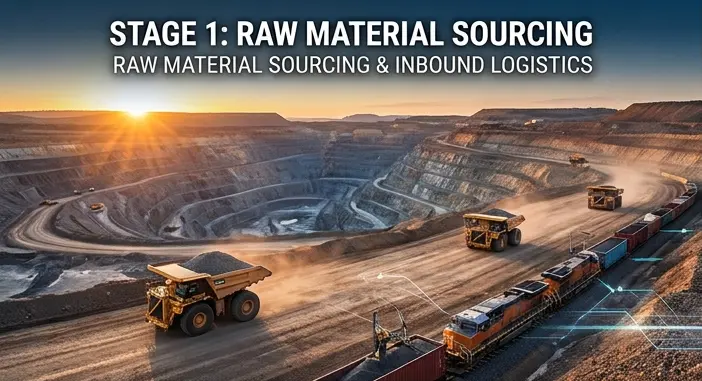
Supplier → Incoming Material → Storage → Material Handling → Machining → Production → Inspection → Assembly → WIP → Finished Goods → Dispatch
A disruption at any one of these stages can affect the final delivery date.
This is why industrial automation in India is increasingly becoming more than a productivity initiative. Strategically applied manufacturing automation can help factories create more predictable production, reduce operational dependency, improve quality consistency and respond more effectively when demand or supply conditions change.
The principle is straightforward:
A future-ready supply chain starts with a future-ready factory.
Why Manufacturing Supply Chains Are Becoming More Vulnerable
Indian manufacturers are operating under increasingly demanding production conditions. Customers want shorter lead times. Product variants are increasing. Quality requirements are becoming stricter. Skilled operators can be difficult to recruit and retain. Energy, labour and Manufacturing Supply Chain costs must be controlled while customers continue to expect competitive pricing.
At the same time, manufacturers may face uncertainty in raw-material availability, imported components, tooling, logistics and customer schedules.
This creates a difficult production environment.
Imagine that a component normally requires five manufacturing stages. Even if four stages operate efficiently, one unreliable stage can determine the output of the complete line.
- A machining operation with excessive cycle time can create upstream WIP.
- A manual inspection station can delay dispatch.
- An operator-dependent loading operation can reduce CNC utilization.
- Frequent machine breakdowns can make production schedules unreliable.
- Excessive changeover time can make smaller batch production commercially difficult.
The objective of factory automation should therefore not simply be to make machines run faster. The larger objective is to make the manufacturing system more predictable and resilient.
The Hidden Supply Chain Inside Every Factory
Consider the internal production chain of a typical engineering manufacturer:
Raw Material → Storage → Production → Inspection → Assembly → Finished Goods → Dispatch
Each stage is effectively an internal supplier to the next stage.
- If machining cannot produce components at the required rate, assembly waits.
- If inspection cannot keep pace with machining, WIP increases.
- If material handling depends on irregular manual movement, expensive machines may remain idle even though components are available elsewhere in the factory.
- If production information is recorded manually and updated late, management may not discover the bottleneck until delivery is already at risk.
This is why manufacturing process optimization requires looking beyond individual machines.
For example, purchasing a faster CNC machine may appear to increase capacity. But if the operator takes too long to load and unload components, inspection remains manual and the next operation has insufficient capacity, the faster machine may simply produce WIP more quickly.
The correct question is not:
“Which machine should we automate?”
It is:
“What is preventing material from flowing predictably from raw material to finished component?”
That change in thinking is fundamental to effective supply chain automation.
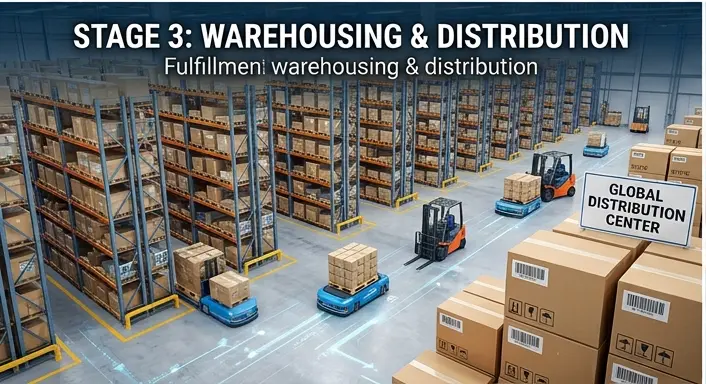

Why Automation Is Becoming a Supply-Chain Strategy
Automation is sometimes described mainly as a way to reduce manpower. That is too narrow a definition.
A well-designed automation system can improve several aspects of manufacturing simultaneously:
- predictable cycle time and production output,
- repeatability of critical operations,
- consistent material movement,
- lower dependence on individual operators,
- faster identification of quality problems,
- better machine utilization,
- improved production visibility,
- scalable manufacturing capacity.
Consider a CNC machining operation.
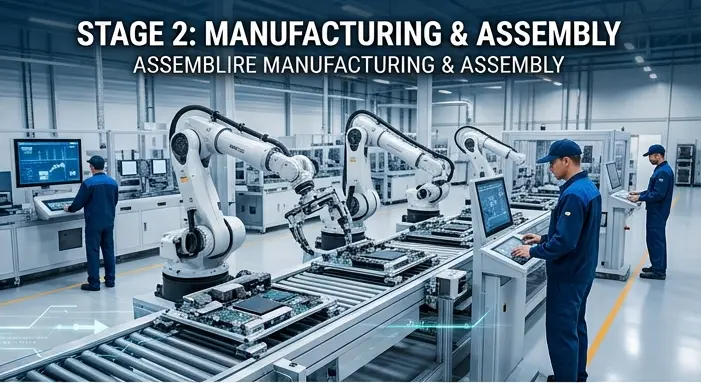
If loading, unloading, orientation and component transfer are manual, actual machine output depends partly on operator availability, fatigue, skill and consistency. With robotic machine tending, a gantry loader or another appropriate automated loading system, material flow can become more repeatable. The CNC machine can spend a greater proportion of available production time machining rather than waiting for handling activities.
This does not mean every machine requires a robot.
It means every major source of production variability should be understood and evaluated.
That is the difference between purchasing automation equipment and developing an industrial automation strategy.
Where Manufacturers Should Automate First
One of the most expensive automation mistakes is trying to automate everything at once.
A better starting point is the bottleneck.
Production teams should study where material stops, where operators spend excessive repetitive effort, where quality becomes inconsistent and where expensive equipment waits unnecessarily.
Processes that deserve early investigation commonly include repetitive operations, high-cycle-time processes, labour-intensive activities, machine loading and unloading, inspection, assembly, material transfer and operations producing excessive rejection or rework.
WIP accumulation is another useful indicator.
If hundreds of components consistently accumulate between two machines, something in that part of the production system is unbalanced.
The automation opportunity may therefore not be the machine itself. It could be material handling, inspection, fixture loading, changeover, component orientation or the next process.
A Simple Automation Priority Model
Manufacturers can evaluate potential automation projects against four practical factors:
Factor | Engineering Question |
Production Impact | Is this process limiting total factory output? |
Operational Risk | What happens if the operator, machine or process becomes unavailable? |
Quality Impact | Does this operation contribute significantly to rejection or rework? |
Automation Feasibility | Can automation improve the process economically and reliably? |
Processes that score highly across these factors should normally receive attention before low-impact activities. This helps ensure automation investment is directed toward production risk rather than automation for its own sake.
Special Purpose Machines: Automating the Process Around the Product
A Special Purpose Machine (SPM) is designed around a particular manufacturing process, component family or production requirement rather than being a completely general-purpose machine.
For suitable high-volume applications, an SPM can integrate multiple activities into one controlled manufacturing sequence.
For example:
Loading → Positioning → Machining → Drilling → Tapping → Inspection → Unloading
Instead of moving the component between multiple independent machines, fixtures and operators, selected operations can be integrated into a dedicated production system.
This can reduce component handling, intermediate storage, process variation and operator dependency.
However, SPM development requires proper engineering.
Before approaching an SPM manufacturer in India, manufacturers should clearly understand component geometry, process sequence, required cycle time, tolerance, annual production volume, tooling requirements, inspection strategy, changeover expectations and future product variants.
A well-designed SPM automation project should solve a manufacturing problem. It should not simply automate an inefficient process exactly as it exists today. This is why selecting an experienced Special Purpose Machine manufacturer in India should involve evaluating engineering and process-development capability, not only machine price.
Customized CNC Machines for Production Resilience
Standard CNC machines are extremely flexible and appropriate for a wide range of manufacturing applications. But high-volume manufacturing sometimes requires a production architecture optimized around a specific component or process.
This is where customized CNC machines can become valuable.
Depending on the component and process, customized solutions might include:
- twin-spindle CNC machines,
- dedicated turning machines,
- multi-operation CNC machines,
- CNC drilling and tapping systems,
- automated machining cells,
- integrated loading and unloading systems.
Consider a component requiring machining on two sides.
In a conventional process, the component might be machined on one CNC, unloaded, stored temporarily, transferred, reoriented, reclamped and machined again. A suitably engineered twin-spindle or integrated CNC solution may allow several of these operations to be combined.
The potential advantage is not only cycle-time reduction. It can also reduce WIP, handling, setup variation, floor-space consumption and operator dependency while shortening the production route. A customized CNC machine manufacturer in India should therefore study the complete component process rather than simply modifying an existing machine.
Robotics and Automated Material Handling
Many factories contain capable machines that operate as isolated islands.
- A CNC machine finishes a component.
- An operator removes it.
- The component is placed in a tray.
- Someone moves the tray to inspection.
After inspection, another person transfers it to the next machine. Each transition creates an opportunity for waiting, mixing, handling damage or production imbalance.
Industrial robotics and automated material handling can help connect these isolated processes.
Applications can include robotic machine tending, pick-and-place operations, component transfer, palletizing, bin handling, assembly, conveyor systems and gantry automation.
For appropriate factory layouts, AGVs or AMRs may also support movement between production areas. The goal is not necessarily to remove every human movement. The engineering goal is continuous and controlled material flow.
For example:
Input Conveyor → Robot → CNC Machine → Inspection → Robot → Next Operation → Output Conveyor
Such a cell can coordinate machining, handling and inspection rather than treating them as unrelated activities. That is where robotic automation in manufacturing can directly support supply-chain resilience.
Automated Inspection: Building Quality Into the Supply Chain
Quality problems are supply-chain problems when they affect delivery. Imagine producing 500 components before discovering that a critical dimension has gradually moved outside tolerance.
The loss is not limited to rejected components. Production time has been consumed, raw material has been processed, machine capacity has been occupied and delivery schedules may now be affected. Automated inspection systems can move quality control closer to the production process.
Depending on the application, manufacturers can consider technologies such as:
- machine vision inspection,
- laser measurement,
- dimensional inspection,
- presence/absence detection,
- surface inspection,
- in-process gauging,
- automated rejection mechanisms.
The correct technology depends on tolerance, component geometry, surface condition, production speed and measurement requirements. The fundamental advantage is earlier feedback.
If a deviation can be detected after one component instead of after hundreds, corrective action can begin sooner. This makes automated quality inspection part of production resilience rather than merely a quality-control investment.
Predictive Maintenance and Production Visibility
A machine stopping unexpectedly can disturb several downstream operations.
- The maintenance team sees the breakdown.
- Production sees missed output.
- Planning sees schedule deviation.
- Dispatch sees the delivery risk.
- The customer eventually sees the delay.
This illustrates why machine reliability affects the complete manufacturing supply chain.
Modern PLCs, sensors, CNC controllers, IIoT devices and production monitoring systems can make useful operating information available to production and maintenance teams. Depending on machine capability, manufacturers may monitor machine status, cycle time, quantity produced, downtime, alarms, tool usage, maintenance indicators and quality information.
The objective of predictive maintenance is not to claim that software can perfectly predict every breakdown.Instead, it is to use available machine and process information to identify patterns or deterioration early enough for better maintenance decisions. Even basic downtime categorization can be valuable.
If management discovers that a CNC loses significant production time not because of machining faults but because of waiting for material, loading delays or tooling problems, the required improvement becomes clearer.
Flexible Automation vs Fixed Automation
An important future-proofing principle is often overlooked:
The most automated factory is not necessarily the most future-proof factory. The most adaptable factory may be.
Fixed automation can be extremely efficient when a product remains stable and volumes are high.An automation system designed without considering these possibilities can eventually become a constraint.
This is why flexible manufacturing systems deserve serious consideration.
Flexibility can be introduced through modular fixtures, programmable CNC systems, reprogrammable robots, interchangeable tooling, recipe-based controls and modular automation cells.
For example, a robotic cell designed for one component may become more useful if the gripper and fixture architecture allow reasonable adaptation to future component variants.
Future-proofing therefore requires balancing current productivity with future flexibility.
Digital Twins, AI and the Next Generation of Manufacturing Automation
Industry 4.0 technologies are becoming increasingly practical, but manufacturers should separate useful engineering applications from exaggerated expectations. A digital twin is broadly a digital representation of a physical asset, process or manufacturing system that can be used for analysis, simulation or monitoring. Before building complex equipment, digital simulation can help engineers study robot reach, machine layout, material movement, potential interference and production sequences. Connected manufacturing systems can also collect operating data from machines and production lines.
AI-assisted systems may help identify patterns in large datasets, support machine-vision applications, analyze process variation or assist maintenance decisions. However, AI does not eliminate the need for sound machine design, correct sensors, reliable controls and proper process engineering. A poorly designed process does not automatically become efficient because an AI layer has been added.
For many manufacturers, practical Industry 4.0 begins with simpler steps:
Connect the Machine → Capture Reliable Data → Visualize Production → Identify Losses → Improve the Process
Advanced analytics should follow reliable data collection, not replace it.
A Practical Automation Roadmap for Indian Manufacturers
Automation becomes easier to manage when implemented systematically.
Stage | Manufacturer Action | Expected Outcome |
1 | Map current production | Identify bottlenecks |
2 | Measure cycle time and downtime | Establish baseline |
3 | Identify automation opportunities | Prioritize high-impact processes |
4 | Conduct technical feasibility | Select appropriate technology |
5 | Estimate ROI | Build the business case |
6 | Pilot automation | Validate the concept |
7 | Integrate with production | Improve material flow |
8 | Measure results | Identify the next opportunity |
9 | Scale progressively | Move toward a smart factory |
The first two stages are particularly important.
If actual cycle time, rejection, downtime and WIP are unknown, it becomes difficult to determine whether an automation proposal solves the correct problem.
Common Automation Mistakes Manufacturers Should Avoid
Automating a Poorly Designed Process
If unnecessary operations exist, automate only after reviewing whether those operations are required.
Buying Technology Before Identifying the Bottleneck
A robot may be impressive, but it has little value if the real constraint is inspection capacity or machine downtime.
Selecting Equipment Only by Lowest Purchase Price
Machine cost matters, but manufacturers should also evaluate reliability, maintainability, cycle time, serviceability, integration and long-term production requirements.
Ignoring Future Product Changes
Automation should consider likely product variants, fixture changes and production-volume fluctuations.
Ignoring Maintenance Accessibility
Sensors, cylinders, tooling, drives and wear components should remain accessible for maintenance.
Poor Machine Integration
Individual machines can operate efficiently while the production line remains inefficient.
Over-Automation
Not every manual operation needs automation. Automation should solve a measurable manufacturing problem.
Underestimating Training
Operators and maintenance personnel need sufficient knowledge to operate, troubleshoot and maintain the system.
Ignoring Production Data
Without measuring before and after implementation, manufacturers cannot properly evaluate the automation project.
How Hardai ARMND Engineering Solutions Supports Future-Ready Manufacturing
Hardai ARMND Engineering Solutions approaches automation from a manufacturing-process perspective.
Rather than beginning with a predetermined technology, the engineering process should begin with the component, existing production method, required output, bottleneck, tolerance, material flow and future production requirements.
The approach can be summarized as:
Understand the Process → Identify the Bottleneck → Engineer the Solution → Validate → Manufacture → Integrate → Commission → Optimize
Hardai ARMND Engineering Solutions works across areas including:
Special Purpose Machine design and manufacturing, customized CNC machines, industrial robotics, factory automation, machine tending, automated material handling, automated inspection systems, custom machine development, production-line integration, Industry 4.0 integration, engineering simulation, machine design and turnkey automation projects.
The objective of a custom automation system should not simply be to install more equipment. It should improve the manufacturing system around the actual production requirement.
For Indian manufacturers looking for an industrial automation company in India, SPM manufacturer in India, custom machine manufacturer or customized CNC machine manufacturer in India, the most important starting point is therefore not the machine specification.
Frequently Asked Questions
1. What is supply chain automation in manufacturing?
Supply chain automation uses machines, robotics, software, sensors and control systems to improve the movement of material and information from incoming material through production, inspection, storage and dispatch. Inside a factory, it can include automated material handling, machining, inspection, assembly, inventory tracking and production monitoring.
2. How does industrial automation improve supply chain resilience?
Industrial automation can make production more predictable by reducing process variability, manual dependency, material waiting time and quality inconsistencies. It can also improve machine utilization and provide production data that helps managers identify problems earlier.
3. What manufacturing processes should be automated first?
Manufacturers should normally investigate bottleneck operations, repetitive tasks, labour-intensive processes, machine loading and unloading, inspection, material handling and processes causing excessive WIP, rejection or downtime. Automation priorities should be based on production impact, technical feasibility and ROI.
4. What is an SPM in manufacturing?
A Special Purpose Machine, or SPM, is a machine engineered for a specific component, process or production requirement. SPMs are commonly used for repetitive and high-volume manufacturing where dedicated automation can combine operations and improve productivity, consistency and material flow.
5. How can customized CNC machines reduce production costs?
Customized CNC machines can combine operations, automate component handling and optimize machine architecture for a specific production requirement. This may reduce WIP, handling, setup time, floor-space usage, production lead time and operator dependency.
6. Can small manufacturers and MSMEs afford automation?
Automation does not have to begin with a complete automated factory. MSMEs can implement phased automation by starting with one bottleneck, machine, inspection process, material-handling operation or production cell and expanding after validating the results.
7. How do industrial robots improve manufacturing productivity?
Industrial robots can perform repetitive activities such as machine tending, loading, unloading, component transfer, assembly, pick-and-place and palletizing. When properly integrated, robotics can reduce waiting between processes and create more consistent material flow.
8. What is Industry 4.0 in manufacturing?
Industry 4.0 refers to connected manufacturing systems that use machine data, sensors, IIoT, automation, analytics and digital technologies to improve production visibility and decision-making. Practical implementation often begins by connecting machines and collecting reliable production data.
Recent Posts
- Custom Automation Robotic Grippers: Improving Precision and Manufacturing Efficiency
- Custom Industrial Automation Solutions & Special Purpose Machines (SPM) for Modern Manufacturing
- Custom Machines: The Complete Guide to Custom Machine Design and Manufacturing
- Dry Film Lubricants vs. Wet Greases: When to Eliminate Liquid Lubrication Completely
- Types of Automation Systems in Manufacturing A Complete Guide for Indian Manufacturers
Products
-
 MolyKul MoS2 Gear Oil additive for cars and bike| Anti-friction MoS2 Solution - 100ml
₹598.73Original price was: ₹598.73.₹399.62Current price is: ₹399.62. Including 18% GST -
MolyKul Aero-Spec 500 (MKG AS500 NG2) – MoS2 Anti-Seize Aerospace grease – 500 Deg C
₹2,088.60 – ₹9,739.72Price range: ₹2,088.60 through ₹9,739.72 Including 18% GST
-
MolyKul MoS2 Grease for industrial application| Lithium + Anti-Seize MoS2 - 650 Deg C
₹1,539.90Original price was: ₹1,539.90.₹1,169.38Current price is: ₹1,169.38. Including 18% GST -
MolyKul MoS2 engine oil additive for cars and bikes| Anti-friction MoS2 Solution - 100ml
₹195.88 – ₹531.00Price range: ₹195.88 through ₹531.00 Including 18% GST
-
MolyKul MoS2 Grease for industrial application| Lithium + Anti-Seize MoS2 - 320 Deg C
₹684.40 – ₹6,608.00Price range: ₹684.40 through ₹6,608.00 Including 18% GST



For More Contact Us
#Tags:
- Automatic SPM Machine, Automation with Hardai ARMND, Custom SPM Machine Customized SPM Machine Industrial SPM Machine Automatic SPM Machine SPM Automation Machine, Customized SPM Machine, Industrial SPM Machine, Machine Automation, Special Purpose Machine, Special Purpose Machines, SPM Automation Machine, SPM Manufacturer, SPM With Hardai ARMND, supply chain, Supply Chain Automation

Leave A Comment