Custom Automation vs Standard Machines: Complete Guide
- Home
- Custom Automation vs Standard Machines: Which Is Right for Your Manufacturing Process
Introduction
Manufacturing is evolving faster than ever before. Rising labor costs, increasing quality expectations, shorter product life cycles, and growing competition are pushing manufacturers to rethink how they produce goods. Whether you operate an automotive plant, packaging facility, metal fabrication workshop, FMCG factory, or MSME manufacturing unit, automation is no longer a luxury—it has become a strategic necessity.
However, when companies decide to automate, they often face a critical question:
Should they invest in standard machines or choose custom automation systems?
The answer can significantly impact production efficiency, operational costs, scalability, product quality, and long-term profitability.
While standard industrial machines offer affordability and quick deployment, custom automation solutions provide unmatched flexibility, productivity, and competitive advantages for specialized manufacturing processes.
In this comprehensive guide, we will explore the differences between Custom Automation vs Standard Machines, examine their advantages and limitations, compare their long-term value, and help manufacturers determine which approach aligns best with their production goals.
Understanding Standard Machines
What Are Standard Machines?
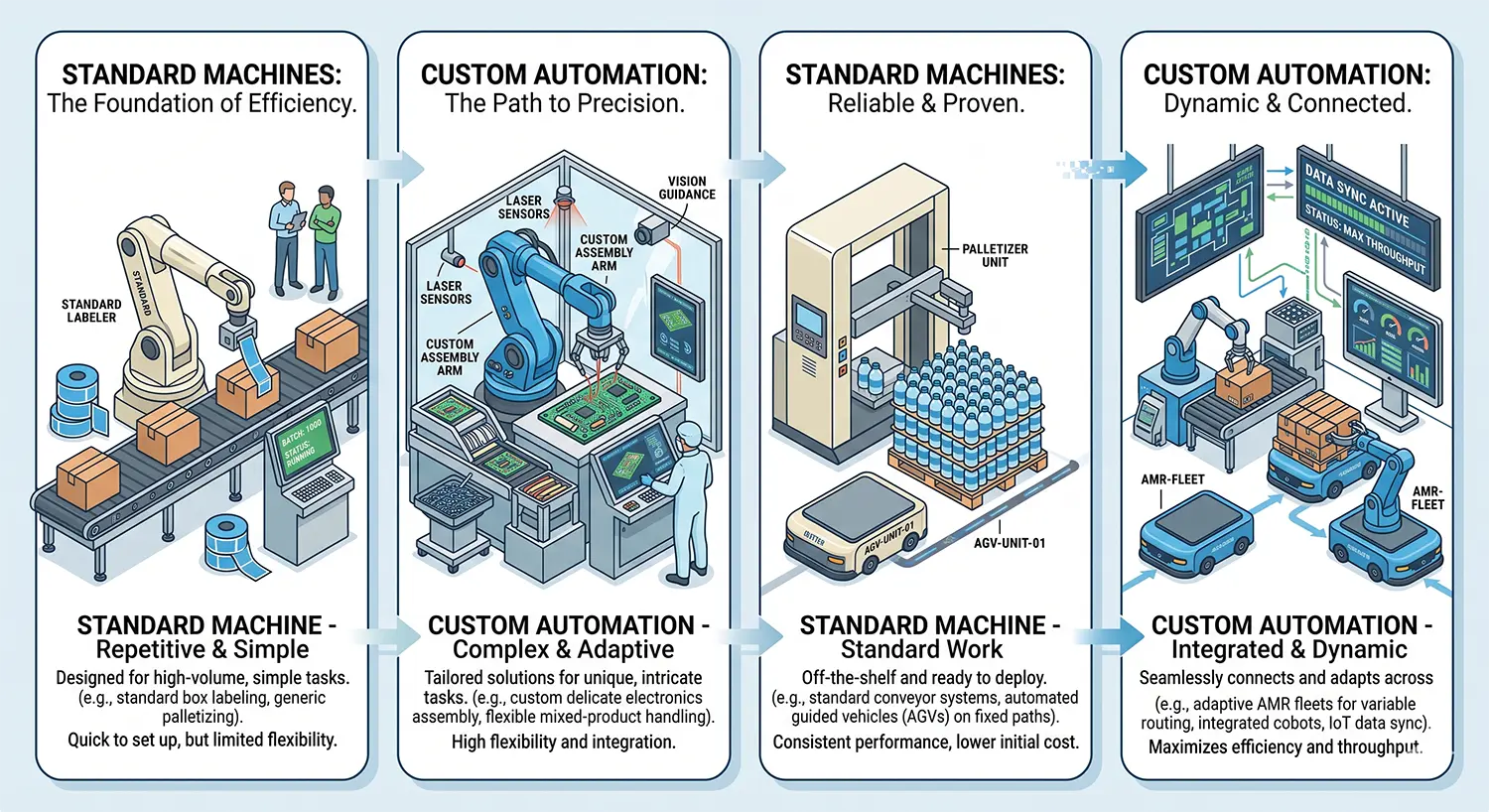
Standard machines are pre-engineered industrial equipment designed for general manufacturing applications. These machines are manufactured in large quantities and are intended to serve a broad range of industries and production requirements.
Examples include:
- CNC machines
- Injection molding machines
- Conveyor systems
- Packaging machines
- Drilling machines
- Hydraulic presses
- Standard robotic cells
These machines are available with predefined specifications and require minimal customization before deployment.
Key Features of Standard Machines
Standard industrial machines typically offer:
- Predefined functionality
- Industry-standard specifications
- Faster delivery timelines
- Lower initial investment
- Established maintenance procedures
- Widely available spare parts
Since they are designed for mass-market use, manufacturers can purchase and install them relatively quickly.
Advantages of Standard Machines
Lower Initial Investment
One of the biggest advantages is affordability. Since development costs are spread across many buyers, the purchase price is generally lower, making them an ideal choice for businesses with limited capital budgets. Additionally, because there is no need to invest heavily in upfront engineering, research, or custom software development, companies can allocate their financial resources to other critical operational needs.
Faster Deployment
Standard machines are often available off-the-shelf, reducing lead times significantly compared to custom-built solutions. This allows manufacturers to quickly ramp up production capacities or replace failing equipment with minimal disruption to their daily workflows. The streamlined purchasing process means delivery, installation, and final handoff can often occur in a matter of weeks rather than months.
Proven Technology
These machines have usually been tested extensively across multiple industries, ensuring that most technical glitches and design flaws have already been ironed out by the manufacturer. Operating a system with a long and stable track record provides peace of mind and predictable performance under standard operating conditions. This established reliability translates directly into higher uptime and fewer unexpected maintenance emergencies.
Easier Operator Training
Because they follow common operating principles, workforce training is often simpler, faster, and more standardized. Many technicians and operators are already familiar with standard user interfaces and mechanical layouts, which drastically shortens the learning curve. This familiarity reduces human error during daily operation and allows companies to easily cross-train staff or onboard temporary workers.
Spare Parts Availability
Replacement parts and service support are generally easier to source because components are mass-produced and kept in stock by global distribution networks. Manufacturers don’t have to wait for custom components to be fabricated from scratch, which keeps emergency downtime to an absolute minimum. Furthermore, a wide pool of third-party technicians is usually available to service these machines, preventing vendor lock-in.
Limitations of Standard Machines
Despite their benefits, standard machines often create operational limitations.
Limited Flexibility
Despite their benefits, standard machines often create operational limitations because they are built for generic tasks. Standard equipment may not fit unique production requirements, making it difficult to handle irregular component shapes, non-standard materials, or specialized packaging formats. When product designs change, these rigid systems often require expensive aftermarket modifications or complete replacement.
Process Compromises
Manufacturers may need to modify their processes to suit the machine rather than optimizing the machine for the process. This backward approach can lead to sub-optimal workflows, unnecessary material handling, and awkward workarounds that introduce inefficiencies into the production line. Forcing a unique, proprietary manufacturing method into a generic machine setup ultimately dilutes a company’s competitive advantage.
Lower Productivity Potential
Generic equipment may not achieve the highest possible throughput because its cycles and mechanisms are engineered for broad safety margins rather than maximum speed. Without specialized fixtures, targeted automation, or optimized multi-axis movements tailored to a specific product, the cycle times remain average. Over time, this cap on performance can prevent a high-volume facility from hitting its true peak output goals.
Integration Challenges
Integrating standard machines into existing production lines can be difficult, often requiring complex custom bridging mechanisms or custom software middleware. These machines rarely communicate natively with proprietary factory control systems or upstream and downstream equipment right out of the box. As a result, engineering teams must spend significant time and effort trying to synchronize speeds and data sharing between mismatched systems.
Future Limitations
As production requirements evolve, standard machines may struggle to adapt to new market demands, higher volume thresholds, or stricter quality standards. Their rigid architecture limits scalability, meaning a sudden shift in business strategy could render a standard machine obsolete long before its mechanical lifespan is over. This lack of future-proofing often forces companies to reinvest in entirely new systems sooner than expected.
Understanding Custom Automation
What Is Custom Automation?
Custom automation refers to automation systems specifically engineered to meet the exact requirements of a manufacturing process.
Unlike standard machines, custom automation systems are developed based on:
- Product characteristics
- Production volume
- Factory layout
- Process complexity
- Quality requirements
- Future scalability goals
These solutions often include:
- Special Purpose Machines (SPM)
- Robotic automation systems
- Automated assembly stations
- Material handling systems
- Vision inspection systems
- Custom EOAT solutions
- Integrated production lines
Custom automation is designed around the manufacturing process rather than forcing the process to fit existing equipment.
How Custom Automation Is Designed
Developing custom automation systems typically follows a structured engineering process.
Process Analysis
Engineers study existing workflows and identify inefficiencies, bottlenecks, and manual pain points within the current production line. By collecting precise cycle time data and analyzing material flow, the engineering team uncovers exact areas where automation can deliver the highest return on investment. This thorough initial assessment ensures that the final automated system is engineered to solve specific operational challenges rather than generalized problems.
Concept Development
Automation opportunities are evaluated and optimized through collaborative brainstorming, rough sketching, and initial feasibility studies. Engineers weigh various technological approaches, such as Cartesian coordinates versus articulated robotic arms, to determine the most cost-effective and reliable method. This stage defines the system architecture, estimates throughput rates, and outlines the preliminary project scope before heavy engineering begins.
Design Engineering
Mechanical, electrical, pneumatic, and software systems are developed in parallel using advanced 3D CAD modeling software. Every detail is meticulously planned, from the precise selection of sensors and actuators to the routing of complex wiring harnesses and the architecture of the PLC programming. This comprehensive digital blueprint ensures that all custom-fabricated components and commercial off-the-shelf parts interface seamlessly with one another.
Simulation and Validation
Virtual testing helps eliminate design risks by simulating the machinery’s physical movements, stress tolerances, and software logic in a digital sandbox. Using digital twin technology, engineers can detect potential mechanical collisions, optimize robotic reach paths, and validate cycle times before a single piece of metal is cut. This proactive verification process drastically reduces the likelihood of costly engineering changes during the physical build phase.
Manufacturing and Assembly
Custom equipment is fabricated and assembled by skilled technicians, machinists, and builders in a controlled manufacturing environment. Raw materials are precision-machined, structural frames are welded, and control panels are wired strictly according to the approved engineering designs. Once the physical framework is erected, the custom end-of-arm tooling and specialized mechanisms are integrated for initial power-up testing.
Integration and Commissioning
The system is integrated into production and tested under real operating conditions at the manufacturing facility to guarantee peak performance. Engineers calibrate sensors, fine-tune software parameters, and run extensive trial batches using actual production parts to ensure the equipment meets strict quality standards. This phase bridges the gap between a standalone machine and a fully synchronized, functioning asset on the factory floor.
Training and Support
Operators and maintenance teams are trained for efficient operation, safe handling, and routine upkeep of the new custom machinery. Comprehensive documentation, including customized user manuals, electrical schematics, and troubleshooting guides, is handed over to ensure self-sufficiency. Ongoing technical support and planned preventative maintenance schedules are also established to maximize long-term equipment uptime and reliability.
Industries That Benefit Most from Custom Automation
Custom automation systems are especially valuable for industries with specialized manufacturing requirements.
These include:
- Automotive manufacturing
- Metal fabrication
- Packaging industries
- FMCG manufacturing
- Pharmaceutical production
- Electronics assembly
- Aerospace manufacturing
- Heavy engineering
- Plastic processing
- Consumer goods production
Advantages of Custom Automation Systems
Optimized Productivity
Unlike generic machinery that requires you to alter your workflow, custom machines are designed specifically for your exact production process. Every mechanical movement, software algorithm, and operator interface is fine-tuned to eliminate bottlenecks and wasted motion. This seamless integration ensures that your facility operates at peak efficiency, extracting maximum utility from every second of production time.
Higher Throughput
By replacing slow manual interventions with high-speed robotics and synchronized material handling, cycle times can be dramatically reduced. Custom systems run continuously without fatigue, maintaining a blistering pace that manual lines can only achieve in short bursts. This massive acceleration in output allows manufacturers to fulfill large orders faster and rapidly scale up to meet unexpected spikes in market demand.
Better Quality Control
Implementing automation minimizes human error and significantly improves product consistency across high-volume runs. Integrated inspection tools—such as advanced machine vision and real-time force sensors—constantly monitor production quality at every stage of assembly. Any defect is instantly flagged and isolated, ensuring that only flawless products leave the line and preserving your brand’s reputation.
Improved Space Utilization
Floor space is premium real estate in any manufacturing plant, and bulky standard machinery often wastes valuable square footage. Custom systems can be cleverly engineered to fit existing factory layouts, utilizing vertical space or unique geometric configurations to minimize their footprint. This compact design frees up space for additional production lines, inventory storage, or safer pedestrian walkways.
Greater Flexibility
While older generations of automation were rigid, modern custom equipment can easily accommodate multiple product variants on a single line. Through recipes programmed into the software and quick-change modular tooling, the system can adapt to different sizes, materials, or configurations in minutes. This agility allows you to run low-volume, high-mix product lines without sacrificing profitability.
Better ROI
While the upfront price tag of a bespoke system can seem daunting, the long-term financial picture is overwhelmingly positive. Higher productivity, minimized material waste, and vastly reduced labor costs often generate much stronger long-term returns than cheaper, off-the-shelf alternatives. Over the lifespan of the equipment, these continuous compounding savings directly boost your bottom-line profitability.
Competitive Advantage
Investing in tailored technology allows manufacturers to achieve proprietary production capabilities that competitors cannot easily replicate. Whether it is a faster assembly technique, a unique packaging method, or a complex tolerance hold, custom automation sets you apart in the marketplace. This technical superiority positions your business as an industry leader capable of winning high-value contracts.
Potential Challenges and Considerations
Although highly beneficial, custom automation requires careful planning.
Higher Initial Investment
Because these systems are designed from a blank canvas, engineering and development costs are naturally greater than standard machines. You are paying for specialized research, custom CAD modeling, prototyping, and rigorous safety testing before fabrication even begins. Manufacturers must view this as a strategic capital expenditure rather than a simple equipment purchase, budgeting carefully for the initial cash outlay.
Longer Development Timeline
Unlike off-the-shelf equipment that can be delivered and plugged in within a few weeks, custom design and manufacturing require additional time. The timeline spans conceptualization, detailed engineering, component sourcing, software programming, and extensive factory acceptance testing. Companies must plan well in advance to ensure the system is ready to launch in alignment with their broader production schedules.
Specialized Engineering Expertise
Building a bespoke machine from scratch is incredibly complex, and successful implementation requires deeply experienced automation partners. Lean manufacturing teams often lack the internal bandwidth or specialized robotic and programming skills to design these systems alone. Partnering with a proven system integrator is vital to navigate the technical hurdles and ensure the project succeeds on time and within budget.
Change Management
Bringing cutting-edge technology onto the factory floor represents a massive cultural shift, making workforce adaptation and training crucial considerations. Employees may initially view automation with apprehension or struggle to operate complex digital interfaces without proper guidance. Developing a transparent communication plan and investing in robust training programs ensures your team embraces the new system safely and enthusiastically.
Despite these challenges, many manufacturers recover investments through increased productivity and operational savings.
Custom Automation vs Standard Machines: Detailed Comparison
Factor | Standard Machines | Custom Automation Systems |
Initial Investment | Lower | Higher |
Flexibility | Limited | Excellent |
Production Speed | Moderate | High |
Scalability | Limited | Highly Scalable |
Product Variety | Restricted | Supports Multiple Variants |
Space Utilization | Standard Layouts | Optimized for Facility |
Maintenance Requirements | Standard Procedures | Customized Maintenance Programs |
Return on Investment | Moderate | Higher Long-Term ROI |
Quality Control | General Quality Standards | Process-Specific Precision |
Future Expansion Capability | Limited | Designed for Growth |
Integration with Existing Systems | May Require Adjustments | Fully Integrated |
Long-Term Cost Efficiency | Moderate | Superior |
When Should You Choose Standard Machines?
Standard industrial machines can be the right choice in several situations.
Small-Scale Production
If production volumes are relatively low, investing in custom automation may not be financially justified.
Limited Budget
Companies with capital constraints may benefit from lower upfront investment.
Simple Manufacturing Processes
Basic operations often do not require extensive customization.
Examples include:
- Simple cutting operations
- Standard packaging
- Basic machining tasks
Quick Deployment Needs
When production must begin immediately, readily available machines can provide a faster solution.
Real Manufacturing Scenarios
1. Automotive Component Manufacturing
Recommended Solution: Custom Automation
Automotive suppliers often require:
- High-volume production
- Tight tolerances
- Traceability
- Zero-defect manufacturing
Custom automation systems with robotics and vision inspection deliver superior productivity and quality control.
2. Packaging Industry
Recommended Solution: Hybrid Approach
For standard packaging operations, off-the-shelf equipment may be sufficient.
However, companies handling multiple package sizes and formats often benefit from custom automation systems that improve changeover efficiency and production flexibility.
3. Metal Fabrication Industry
Recommended Solution: Custom Automation
Metal fabrication processes often involve:
- Welding
- Grinding
- Material handling
- Inspection
Custom robotic cells and Special Purpose Machines can dramatically improve throughput and operator safety.
4. Consumer Goods Manufacturing
Recommended Solution: Depends on Product Complexity
For standard products, conventional machines may be adequate.
For high-volume consumer goods with multiple SKUs, custom automation provides better flexibility and operational efficiency.
When Should You Invest in Custom Automation?
For many manufacturers, custom automation becomes the superior long-term strategy.
High-Volume Production
When production demands reach a critical mass, manual labor simply cannot keep pace with the required output. Higher throughput requirements easily justify the upfront automation investments by drastically reducing per-unit cycle times. Over time, this massive boost in production capacity allows manufacturers to meet aggressive market demands and achieve a much faster return on investment.
Complex Assembly Operations
Standard, off-the-shelf machinery often falls short when dealing with intricate designs, delicate components, or highly specific sequencing. Complex manufacturing processes benefit significantly from tailored solutions that are engineered precisely for your unique workflow. By automating these intricate steps, you eliminate human error, reduce scrap rates, and ensure that specialized assembly tasks are executed flawlessly every time.
Multiple Product Variants
Modern consumer demand requires manufacturing agility, but frequent product changeovers can cripple factory efficiency. Custom automation systems can accommodate product changes efficiently by utilizing smart sensors, programmable logic, and modular tooling. This high level of flexibility minimizes downtime during transitions, allowing a single automated line to handle a diverse mix of product variants seamlessly.
Labour Shortage Challenges
Many industries face increasing labor shortages and rising wages, making it difficult to maintain a stable, skilled workforce. Automation reduces dependency on manual labor by taking over repetitive, strenuous, or hazardous tasks that suffer from high turnover rates. By shifting human workers to higher-value roles, manufacturers can stabilize their operations and shield themselves from fluctuating labor markets.
Quality Consistency Requirements
Industries with strict quality standards, such as medical devices, aerospace, or automotive manufacturing, cannot afford the variability inherent in manual assembly. These sectors benefit immensely from automated precision, where vision systems and robotic components perform tasks with identical repeatability. This ensures 100% compliance with rigorous regulatory benchmarks and drastically reduces the risk of costly product recalls.
Long-Term Growth Plans
Investing in technology should not just solve today’s bottlenecks; it should also pave the way for tomorrow’s opportunities. Manufacturers planning expansion should consider automation systems designed specifically for scalability and future integration. A custom-built platform can be engineered with open architecture, allowing you to easily add modules or upgrade software as your business grows.
Cost vs Long-Term Value
Many manufacturers focus heavily on purchase price while overlooking long-term value creation.
A better approach is evaluating the Total Cost of Ownership (TCO).
Total Cost of Ownership (TCO)
TCO includes:
- Equipment cost
- Installation cost
- Maintenance expenses
- Downtime costs
- Labor costs
- Energy consumption
- Upgrade expenses
Custom automation often delivers lower TCO despite higher upfront costs.
Maintenance Costs
Modern automation systems are designed for predictive maintenance and improved reliability.
Benefits include:
- Reduced breakdowns
- Lower spare parts consumption
- Improved equipment lifespan
Productivity Gains
Custom systems can significantly improve:
- Throughput
- Cycle times
- Equipment utilization
Even small productivity improvements can generate substantial financial returns.
Labour Savings
Automation reduces dependence on manual labor while improving consistency and safety.
Benefits include:
- Lower labor costs
- Reduced turnover impact
- Improved workplace safety
Downtime Reduction
Integrated automation systems often achieve:
- Faster troubleshooting
- Predictive maintenance
- Improved reliability
Reduced downtime directly improves profitability.
Quality Improvements
Automation delivers:
- Repeatable performance
- Consistent product quality
- Reduced scrap rates
- Better customer satisfaction
These quality gains frequently become a major contributor to automation ROI.
Future Trends in Manufacturing Automation
The future of manufacturing will increasingly favor intelligent, connected automation systems.
AI-Powered Automation
Artificial Intelligence enables machines to:
- Optimize production schedules
- Predict failures
- Improve process control
- Reduce waste
Vision Systems
Advanced machine vision is transforming quality control through:
- Automated inspection
- Defect detection
- Measurement verification
- Product tracking
Collaborative Robots
Collaborative robots (Cobots) are becoming increasingly popular because they:
- Work alongside operators
- Improve productivity
- Require less floor space
- Offer flexible deployment
Smart Factories
Smart factories connect machines, sensors, and software into a unified ecosystem.
Benefits include:
- Real-time monitoring
- Data transparency
- Improved decision-making
- Enhanced efficiency
Industry 4.0
Industry 4.0 technologies combine:
- Automation
- IoT
- Cloud computing
- Analytics
- Artificial Intelligence
The result is highly efficient and adaptive manufacturing operations.
Data-Driven Manufacturing
Manufacturers increasingly use operational data to:
- Improve productivity
- Reduce downtime
- Optimize maintenance
- Increase profitability
Data has become one of the most valuable assets in modern manufacturing.
Why Hardai ARMND Engineering Solutions Is the Right Automation Partner
Successful automation projects require more than equipment—they require engineering expertise, process understanding, and long-term support.
At Hardai ARMND Engineering Solutions, we help manufacturers achieve operational excellence through customized engineering solutions tailored to their production goals.
Our capabilities include:
Custom SPM Design
We design and manufacture Special Purpose Machines engineered for specific manufacturing applications.
Industrial Automation Solutions
Complete factory automation systems that improve productivity, quality, and efficiency.
Robotics Integration
Industrial robotic systems for assembly, handling, welding, grinding, polishing, and packaging applications.
End-of-Arm Tooling (EOAT)
Custom EOAT and robotic tooling designed for maximum performance and reliability.
Custom Gripper Design
Specialized grippers developed for unique products and manufacturing processes.
Manufacturing Process Optimization
Engineering analysis and process improvements that enhance productivity while reducing operational costs.
Turnkey Automation Projects
From concept development and design to commissioning and support, we deliver complete automation solutions.
Internal Resources
Explore our related solutions:
- SPM Design Services
- Industrial Automation Solutions
- Robotics & EOAT Services
- Custom Gripper Design
- Manufacturing Process Optimization
Frequently Asked Questions (FAQ)
1. What is the main difference between custom automation and standard machines?
Standard machines are pre-designed for general applications, while custom automation systems are engineered specifically for a manufacturer’s process, product, and production requirements.
2. Is custom automation worth the higher investment?
In many cases, yes. Custom automation often delivers higher productivity, reduced labor costs, improved quality, and lower total cost of ownership, resulting in stronger long-term ROI.
3. Which industries benefit most from custom automation?
Industries such as automotive, packaging, FMCG, pharmaceuticals, electronics, metal fabrication, and heavy engineering often gain significant advantages from custom automation systems.
4. How long does a custom automation project typically take?
Project timelines vary based on complexity. Small systems may take a few weeks, while large turnkey automation projects can require several months for design, manufacturing, integration, and commissioning.
5. Can custom automation be integrated with existing machinery?
Yes. Modern custom automation systems are often designed specifically to integrate with existing production lines, helping manufacturers maximize previous investments while improving performance.
Conclusion
When evaluating Custom Automation vs Standard Machines, there is no universal answer that fits every manufacturing environment.
Standard machines remain an effective solution for businesses with limited budgets, straightforward processes, and immediate deployment requirements.
However, manufacturers pursuing higher productivity, improved quality, greater flexibility, labor optimization, and long-term growth often discover that custom automation systems provide substantially greater value over time.
The right decision should be based on:
- Production volume
- Process complexity
- Product variation
- Growth strategy
- Budget considerations
- Expected ROI
As manufacturing continues to move toward Industry 4.0, smart factories, industrial robotics, and intelligent automation, companies that invest strategically today will be better positioned to compete tomorrow.
Ready to Automate Your Manufacturing Process?
Whether you need a Special Purpose Machine (SPM), a fully integrated Industrial Automation Solution, a custom Robotics & EOAT System, or complete Manufacturing Process Optimization, Hardai ARMND Engineering Solutions can help.
Contact Hardai ARMND Engineering Solutions today for a professional automation consultation and discover the most profitable path toward higher productivity, lower operating costs, and sustainable manufacturing growth.
Recent Posts
- Custom Automation Robotic Grippers: Improving Precision and Manufacturing Efficiency
- Custom Industrial Automation Solutions & Special Purpose Machines (SPM) for Modern Manufacturing
- Custom Machines: The Complete Guide to Custom Machine Design and Manufacturing
- Dry Film Lubricants vs. Wet Greases: When to Eliminate Liquid Lubrication Completely
- Types of Automation Systems in Manufacturing A Complete Guide for Indian Manufacturers
Products
-
 MolyKul MoS2 Gear Oil additive for cars and bike| Anti-friction MoS2 Solution - 100ml
₹598.73Original price was: ₹598.73.₹399.62Current price is: ₹399.62. Including 18% GST -
MolyKul Aero-Spec 500 (MKG AS500 NG2) – MoS2 Anti-Seize Aerospace grease – 500 Deg C
₹2,088.60 – ₹9,739.72Price range: ₹2,088.60 through ₹9,739.72 Including 18% GST
-
MolyKul MoS2 Grease for industrial application| Lithium + Anti-Seize MoS2 - 650 Deg C
₹1,539.90Original price was: ₹1,539.90.₹1,169.38Current price is: ₹1,169.38. Including 18% GST -
MolyKul MoS2 engine oil additive for cars and bikes| Anti-friction MoS2 Solution - 100ml
₹195.88 – ₹531.00Price range: ₹195.88 through ₹531.00 Including 18% GST
-
MolyKul MoS2 Grease for industrial application| Lithium + Anti-Seize MoS2 - 320 Deg C
₹684.40 – ₹6,608.00Price range: ₹684.40 through ₹6,608.00 Including 18% GST

Leave A Comment