Gantry Robots vs. 6-Axis Arms: Which Fits Your Factory?
- Home
- Gantry Robots vs. 6-Axis Articulated Arms: Which Fits Your Factory Floor?
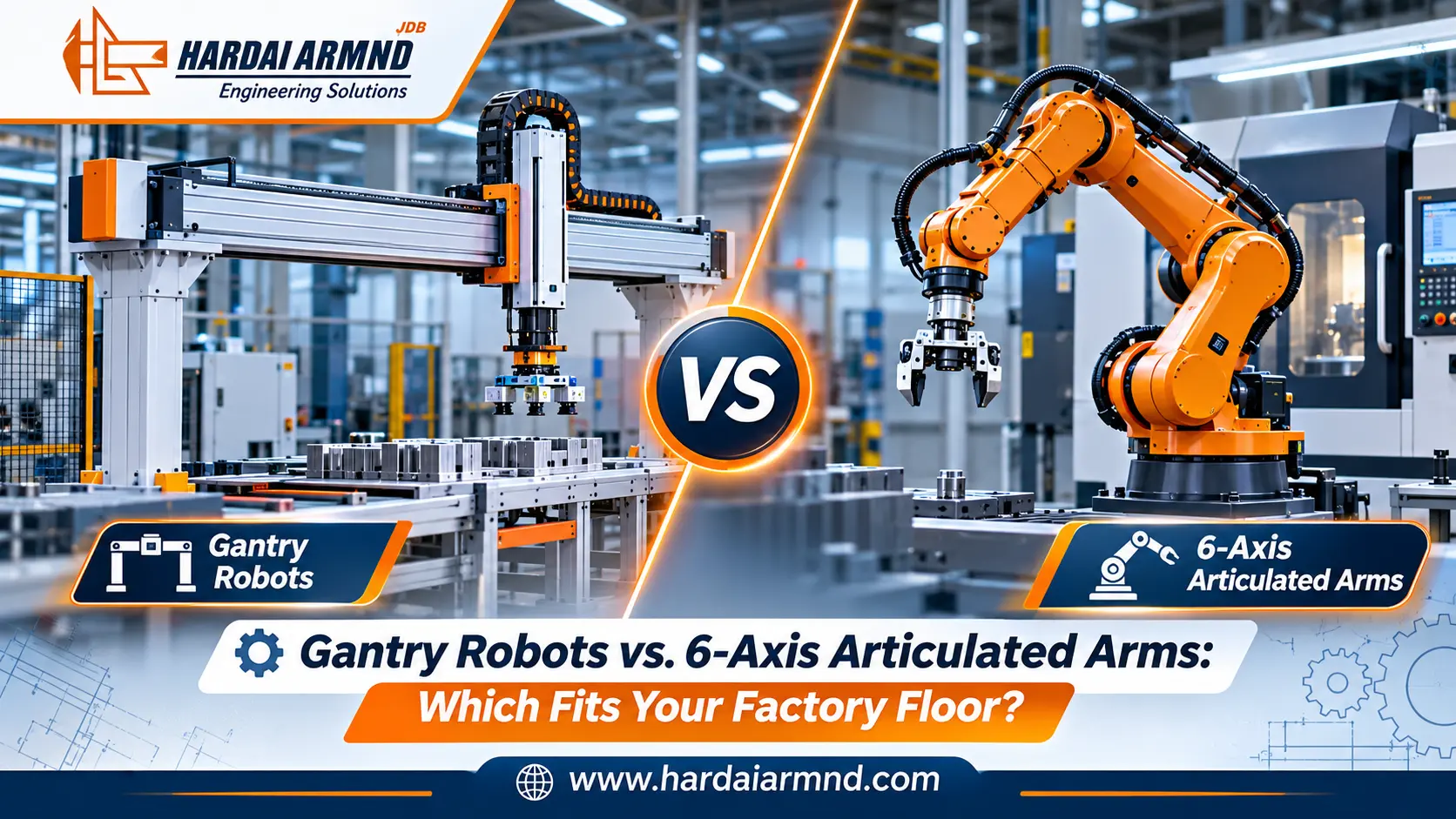
Selecting the wrong kinematic architecture for an automated cell is one of the fastest ways to erode capital expenditure (CapEx) on a manufacturing floor. Plant heads and automation engineers frequently default to 6-axis articulated arms because of their ubiquity in modern factories, or conversely, over-specify heavy overhead gantries where multi-directional dexterity is actually required. When evaluating Gantry Robots vs 6-Axis Articulated Arms, the decision comes down to four physical realities: work envelope geometry, payload deflection across span, floor space constraints, and path complexity.
At Hardai ARMND Engineering Solutions, we engineer both architectures into bespoke Special Purpose Machines (SPMs) and automated machining cells. Below is a rigorous engineering breakdown to help your procurement and manufacturing teams specify the exact robotic architecture your cycle time and shop floor demand.
Understanding the Contenders: Kinematics & Core Architecture
Cartesian / Gantry Robotic Systems
A Gantry robot (a specialized dual-column or overhead-supported Cartesian coordinate robot) operates primarily across three linear axes (X,Y,Z) positioned at right angles to one another. Supported at both ends by structural steel beams and precision-machined linear guideways, gantry systems distribute mechanical loads symmetrically across an elevated frame.
Because the load is supported from above rather than cantilevered from a single base pedestal, gantry robots eliminate the severe bending moments that limit articulated arms. Furthermore, a gantry can be fitted with an auxiliary rotary wrist (4th or 5th axis) at the base of the vertical Z-mast to allow part rotation during pick-and-place transfers without sacrificing structural stiffness.
6-Axis Articulated Robotic Arms
A 6-axis articulated robot mimics the kinematics of the human arm, offering six Degrees of Freedom (6-DOF): base rotation (Axis 1), lower-arm shoulder tilt (Axis 2), upper-arm elbow pitch (Axis 3), wrist roll (Axis 4), wrist pitch/bend (Axis 5), and tool flange rotation (Axis 6).
This serial kinematic chain allows the End-of-Arm Tooling (EOAT) to approach a workpiece from virtually any compound angle within its spherical work envelope. Unlike linear systems restricted to orthogonal movement planes, a 6-axis arm can reach around structural obstacles, enter tight CNC side-doors, invert castings mid-air, and trace complex 3D spline paths for continuous processes like deburring, polishing, or seam welding.
Head-to-Head Technical Comparison
Engineering Parameter | Cartesian / Gantry Robotic System | 6-Axis Articulated Robotic Arm |
Degrees of Freedom & Dexterity | 3 linear axes (X,Y,Z); optional 1–2 rotary wrist axes. Orthogonal pathing only. | 6 rotational axes (6-DOF). Full spatial orientation (pitch, yaw, roll) at any point. |
Payload Capacity & Deflection | High to Ultra-High (50 kg to 5,000+ kg). Dual-supported bridge minimizes cantilever deflection. | Low to High (3 kg to 1,000+ kg). Payload drops sharply at maximum horizontal reach due to torque limits. |
Work Envelope Geometry | Rectangular / Cubic prism. Virtually unlimited X-axis expansion by adding rail modules. | Spherical / Kidney-shaped. Fixed radial reach; contains a central “dead zone” near the base pedestal. |
Floor Space & Footprint | Minimal floor interference. Overhead stilt mounting clears the floor for AGVs and operators. | Pedestal-mounted footprint plus wide safety guarding perimeter (unless ceiling/wall inverted). |
Positioning Repeatability | Ultra-high (0.01mm to 0.05mm), stable across the entire span via precision ball/roller screws or rack-and-pinion drives. | High (0.02mm to 0.15mm), though cumulative joint backlash increases slightly at full arm extension. |
Programming & Integration | Straightforward PLC/CNC G-code or linear coordinate programming. Simple inverse kinematics. | Complex inverse kinematics requiring teach pendants, offline 3D path simulation, and singularity management. |
Initial CapEx & Scalability | Lower cost for long-span, multi-station lines; modular axis upgrades. Structural steel framing adds installation time. | Lower upfront hardware cost for compact single-cell setups; requires expensive linear 7th-axis floor tracks to scale horizontally. |
Mechanical Maintenance | Exposed linear guideways, ball screws, and rack drives require strict contamination shielding and specialized lubrication. | Sealed rotary gearboxes (harmonic and cycloidal drives) require periodic synthetic grease replacement and seal inspections. |
Deep-Dive: 5 Critical Factory Floor Decision Factors
1. Floor Space vs. Overhead Clearance
If your shop floor is densely packed with CNC turning centers, conveyors, and inspection gauges, carving out a 3m3m safety-fenced footprint for a pedestal-mounted 6-axis robot can disrupt material flow. Gantry robots utilize unused vertical plant volume. By mounting the X– and Y-axes on overhead structural columns, operators, forklifts, and Autonomous Mobile Robots (AMRs) can pass safely beneath the transfer bridge while parts move overhead between stations. Conversely, if your facility has low ceiling trusses, overhead bridge cranes that conflict with gantry beams, or delicate floor slabs, a compact floor-mounted 6-axis cell is far easier to deploy.
2. Payload-to-Reach Ratio and Structural Rigidity
In a 6-axis arm, every joint servo must carry the weight of all subsequent joints, links, the EOAT, and the payload itself. Pushing a 150 kg casting 2.8 meters away from the robot base generates massive cantilever torque, forcing you to purchase an oversized, high-CapEx heavy-duty arm. A gantry robot distributes that exact same 150 kg load vertically down into rigid steel columns. Whether the gantry carriage is at 0.5meters or 18meters along the X-axis, its structural deflection and repeatability remain virtually identical.
3. Workpiece Reorientation Requirements
Ask your process engineers: Does the part simply need to move from Point A to Point B, or must it be tilted, flipped, and snaked around fixtures?
- If you are extracting a machined cylinder block vertically from a top-loading VMC and placing it onto a wash conveyor, a 3-axis gantry does this with fewer motors and faster linear acceleration.
- If you are extracting a raw forging from a bin, rotating it 180 to load a horizontal lathe chuck, and then presenting its contoured edges to an automated polishing head, a 6-axis arm is mandatory.
4. Multi-Machine Line Spanning vs. High-Density Single Cells
To tend four CNC machines positioned in a straight 15-meter line using a 6-axis robot, you must mount the articulated arm onto a floor-mounted linear 7th-axis rail (a Roll-on-Rail configuration). This combines the cost of a 6-axis arm with a floor track that collects swarf and blocks operator access to the machine doors. An overhead gantry naturally spans 4 to 8 machining stations along a single continuous X-beam while keeping the front doors of every CNC completely unobstructed for tool changes and manual interventions.
5. Dynamic Path Accuracy vs. Point-to-Point Speed
Gantry robots excel at rapid point-to-point linear transfers and high-force vertical insertion tasks (such as press-fitting bearings or heavy palletizing). However, when the process requires maintaining a constant tool velocity along a complex 3D curve—such as automated deburring of cast manifolds, continuous adhesive dispensing, or multi-axis laser cladding—the coordinated 6-DOF motion of an articulated arm cannot be replicated by a standard gantry.
The Hidden Bottleneck: Why End-of-Arm Tooling (EOAT) Dictates Success
Even the highest-specification gantry or 6-axis robot will fail its cycle-time targets if paired with an off-the-shelf, poorly balanced gripper. The interface between the robot flange and your workpiece determines grip security, part swap speed, and positional accuracy inside the fixture.
At Hardai ARMND Engineering Solutions, we treat the kinematic structure and the custom robotic grippers as a single unified mechanical system:
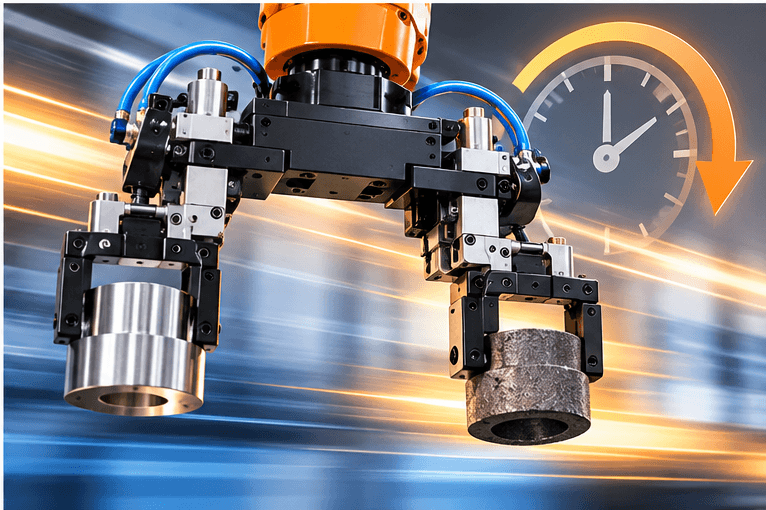
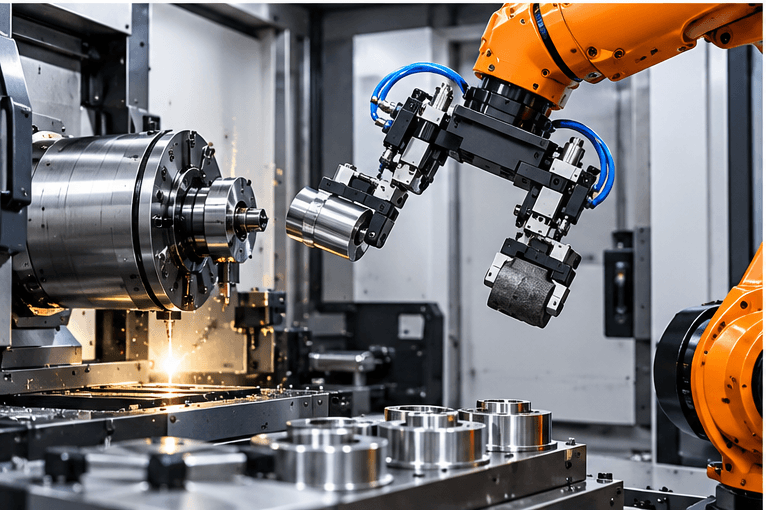
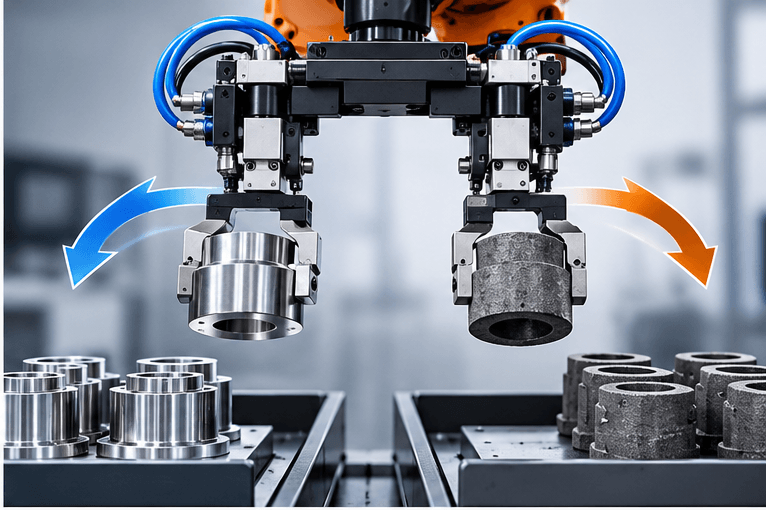
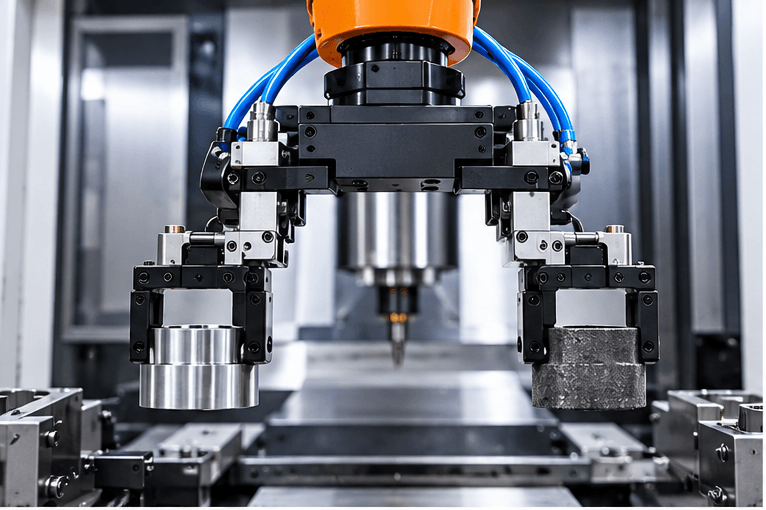
- Dual-Gripper CNC Machine Tending EOAT: Whether mounted on a gantry Z-mast or a 6-axis wrist, we engineer dual-sided pneumatic and servo-electric grippers that simultaneously unload a finished component and load a raw blank in under 4 seconds—slashing machine idle time by over 50%.
- Application-Specific Gripping: From heavy-duty hydraulic finger grippers for hot forgings and vacuum/magnetic array tooling for sheet metal gantries, to compliant force-controlled automated polishing grippers for 6-axis finishing cells.
- CAD/CAE Virtual Commissioning: Before cutting a single piece of steel for your Special Purpose Machine (SPM), our engineering team performs full 3D kinematic reach studies, collision detection, and Finite Element Analysis (FEA) on the EOAT and gantry frame. We optimize gripper mass so you can specify a smaller, more cost-effective robot model without exceeding wrist inertia limits.
Extending Uptime: Tribology & Lubrication in High-Duty Robotic Cells
A widely overlooked factor when comparing Gantry Robots vs 6-Axis Articulated Arms is how factory-floor contaminants impact long-term mechanical wear and unplanned maintenance downtime.
Gantry systems rely on long, exposed linear guideways, ball screws, roller screws, and rack-and-pinion drives. In machining, foundry, or grinding environments, airborne metallic dust, abrasive swarf, and coolant mist settle onto conventional wet greases and oil films. This creates an abrasive lapping paste that rapidly destroys linear bearing races, causes stick-slip positional jitter, and leads to premature actuator seizure. Similarly, 6-axis arms operating near heat-treatment furnaces, die-casting cells, or welding booths suffer from thermal degradation and grease bleed in their high-load rotary bearings and EOAT slides.
Hardai ARMND Engineering Solutions eliminates this vulnerability at the tribological level by integrating our proprietary MolyKul MoS2 (Molybdenum Disulfide) Dry Film Lubrication Technology:
- Zero Dust & Swarf Attraction on Gantry Rails: Applying MolyKul Mono-Coat dry film lubricant to linear guideways, ball screws, and sliding EOAT jaw mechanisms creates a dry, micron-thin lamellar surface with an ultra-low coefficient of friction (0.03to0.06). Because the coating is completely dry to the touch, machining chips, grinding dust, and foundry grit cannot adhere to the rails.
- Extreme Pressure & Thermal Stability: Our MoS2-coated linear and rotary bearings withstand extreme contact pressures (up to 2,500MPa) and operating temperatures ranging from $-180^\circ\text{C}$ to $+450^\circ\text{C}$—far outlasting standard lithium or synthetic greases in high-duty 24/7 automation cells.
- Elimination of Stick-Slip in Precision Positioning: By bonding directly to the metallic substrate of linear guides and gripper fingers, MoS2 solid lubrication prevents micro-welding and stick-slip during high-precision micron-level indexing.
Decision Checklist: 5 Questions to Ask Before Requesting an RFQ
Before finalizing your automation layout, run your production requirements through this 5-point engineering audit:
- What is our required approach angle? If parts are loaded strictly vertically or horizontally along straight planes, choose a Gantry. If the tool must enter at compound angles or reorient the part mid-cycle, choose a 6-Axis Arm.
- How many stations are we linking, and what is the linear span? For straight lines exceeding 4 meters or linking 3+ machines in sequence, an Overhead Gantry almost always delivers superior ROI and floor utilization.
- What is the total dynamic payload (Part + EOAT mass)? For payloads over 100 kg traveling across long spans, a Gantry avoids the massive CapEx jump and structural foundation requirements of ultra-heavy 6-axis robots.
- Can we afford floor-level safety fencing? If floor space around your CNC doors is required for manual setup batches or AGV transit, specify a Stilt-Mounted Overhead Gantry.
- What is the environmental contamination profile? If your cell involves abrasive dust, high heat, or chemical washdowns, ensure your integrator specifies sealed drives alongside MoS2 dry film lubricated linear bearings and EOAT components to prevent premature rail failure.
Engineer Your Next Automated Cell with Hardai ARMND
Choosing between a Gantry system and a 6-Axis Articulated Arm doesn’t have to be a guessing game—and in many complex production lines, a hybrid SPM architecture combining an overhead gantry transfer beam with a compact 6-axis arm provides the ultimate balance of reach and dexterity.
At Hardai ARMND Engineering Solutions, we bridge the gap between mechanical design, custom robotic tooling, and advanced tribology. From concept-to-commissioning Special Purpose Machines (SPMs) and custom End-of-Arm Tooling (EOAT) to life-extending MolyKul MoS2 dry film bearing coatings, we build automation systems engineered for zero-compromise uptime.
Ready to optimize your factory floor layout and reduce cycle times? Contact the engineering team at Hardai ARMND Engineering Solutions today for a comprehensive 3D kinematic simulation, custom EOAT design consultation, and turnkey automation proposal.
Recent Posts
- Gantry Robots vs. 6-Axis Articulated Arms: Which Fits Your Factory Floor?
- Why Dual-Gripper EOAT is the Secret to Cutting CNC Machine Tending Cycle Times by 50%
- Designing Modular SPMs for High-Mix, Low-Volume (HMLV) Manufacturing: The Scalable Automation Playbook
- Custom Automation Robotic Grippers: Improving Precision and Manufacturing Efficiency
- Custom Industrial Automation Solutions & Special Purpose Machines (SPM) for Modern Manufacturing
Products
-
 MolyKul MoS2 Gear Oil additive for cars and bike| Anti-friction MoS2 Solution - 100ml
₹598.73Original price was: ₹598.73.₹399.62Current price is: ₹399.62. Including 18% GST -
MolyKul Aero-Spec 500 (MKG AS500 NG2) – MoS2 Anti-Seize Aerospace grease – 500 Deg C
₹2,088.60 – ₹9,739.72Price range: ₹2,088.60 through ₹9,739.72 Including 18% GST
-
MolyKul MoS2 Grease for industrial application| Lithium + Anti-Seize MoS2 - 650 Deg C
₹1,539.90Original price was: ₹1,539.90.₹1,169.38Current price is: ₹1,169.38. Including 18% GST -
MolyKul MoS2 engine oil additive for cars and bikes| Anti-friction MoS2 Solution - 100ml
₹195.88 – ₹531.00Price range: ₹195.88 through ₹531.00 Including 18% GST
-
MolyKul MoS2 Grease for industrial application| Lithium + Anti-Seize MoS2 - 320 Deg C
₹684.40 – ₹6,608.00Price range: ₹684.40 through ₹6,608.00 Including 18% GST


Leave A Comment