Dual-Gripper EOAT: Cut CNC Machine Tending Time by 50%
- Home
- Why Dual-Gripper EOAT is the Secret to Cutting CNC Machine Tending Cycle Times by 50%
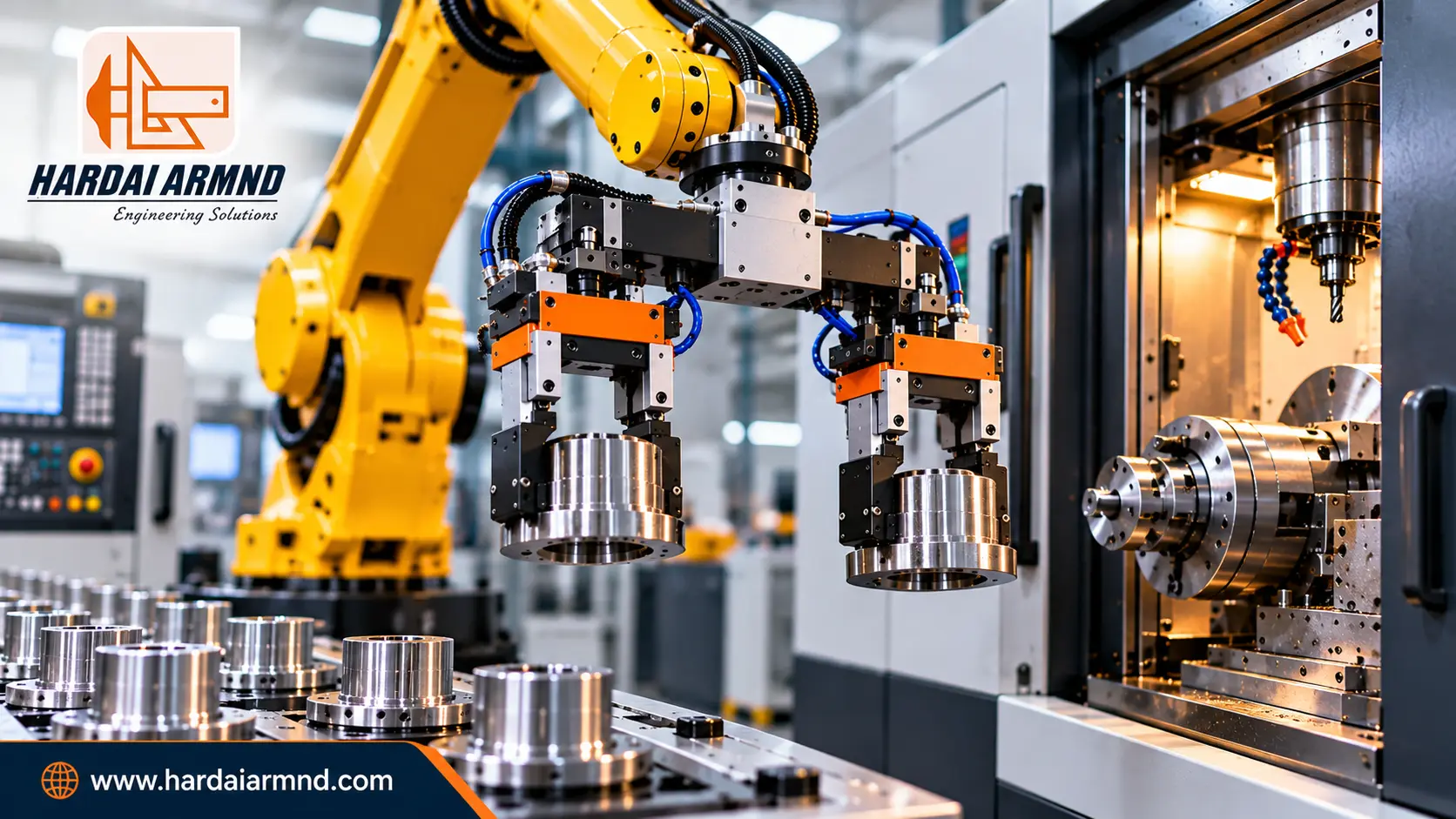
A CNC turning center or vertical machining center (VMC) only generates revenue when the spindle is actively cutting metal. Every second the machine door remains open while waiting for a finished part to be unloaded and a raw blank to be clamped is pure lost capacity.
Across Indian automotive, aerospace, defense, and heavy engineering shop floors, many manufacturers invest heavily in 6-axis industrial robots or collaborative robots (cobots) to automate CNC tending—only to discover that their overall cycle time barely improves over a fast human operator. The bottleneck rarely lies in the robot’s arm speed or the CNC controller. Instead, the culprit is almost always at the robot’s wrist: a Single-Gripper End-of-Arm Tooling (EOAT) configuration.
When a robot is equipped with a single gripper, the CNC machine sits completely idle while the robot travels back and forth between the chuck and the pallet. By upgrading to a custom-engineered Dual-Gripper EOAT for CNC machine tending, manufacturers eliminate redundant robot travel while the machine door is open—slashing non-cutting part exchange times by 50% or more and boosting spindle utilization from an average of 65% to over 90%.
Single-Gripper vs. Dual-Gripper EOAT: The Step-by-Step Motion Breakdown
To understand why a single gripper starves your CNC spindle of productive cutting time, examine what happens the moment the machining cycle finishes and the pneumatic auto-door opens.
The Single-Gripper Bottleneck (Sequential Operations)
With a single gripper mounted to the robot flange, every part exchange requires two separate robot entries into the CNC enclosure while the spindle sits idle:
- Door Opens: The robot enters the CNC workspace with an empty gripper.
- Unload Finished Part: The gripper clamps the finished component, the chuck unclamps, and the robot retracts out of the machine.
- Outbound Drop-Off (Spindle Idle): While the CNC waits with its door open, the robot swings to the outbound conveyor, cleaning station, or inspection chute and releases the finished part.
- Inbound Pick-Up (Spindle Still Idle): The robot moves to the inbound feeder tray or vision table, aligns with a raw forging or bar billet, and grips the blank.
- Load Raw Blank: The robot re-enters the CNC enclosure, seats the raw blank into the chuck or fixture, waits for clamping confirmation, and retracts so the door can close.
During steps 3 and 4, your highest-depreciation asset—the CNC machine—is doing nothing.
The Dual-Gripper Advantage (Parallel Operations)
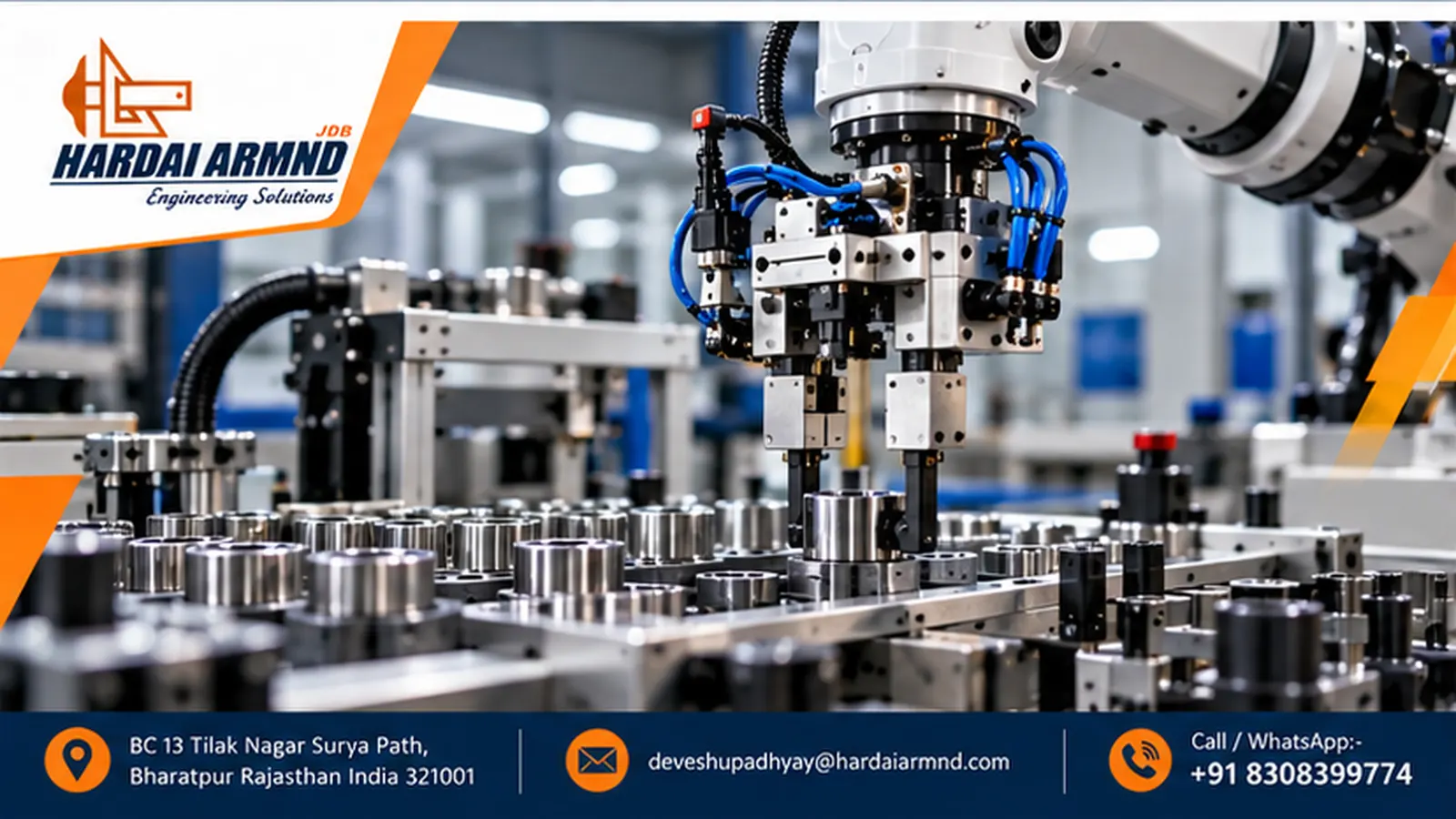
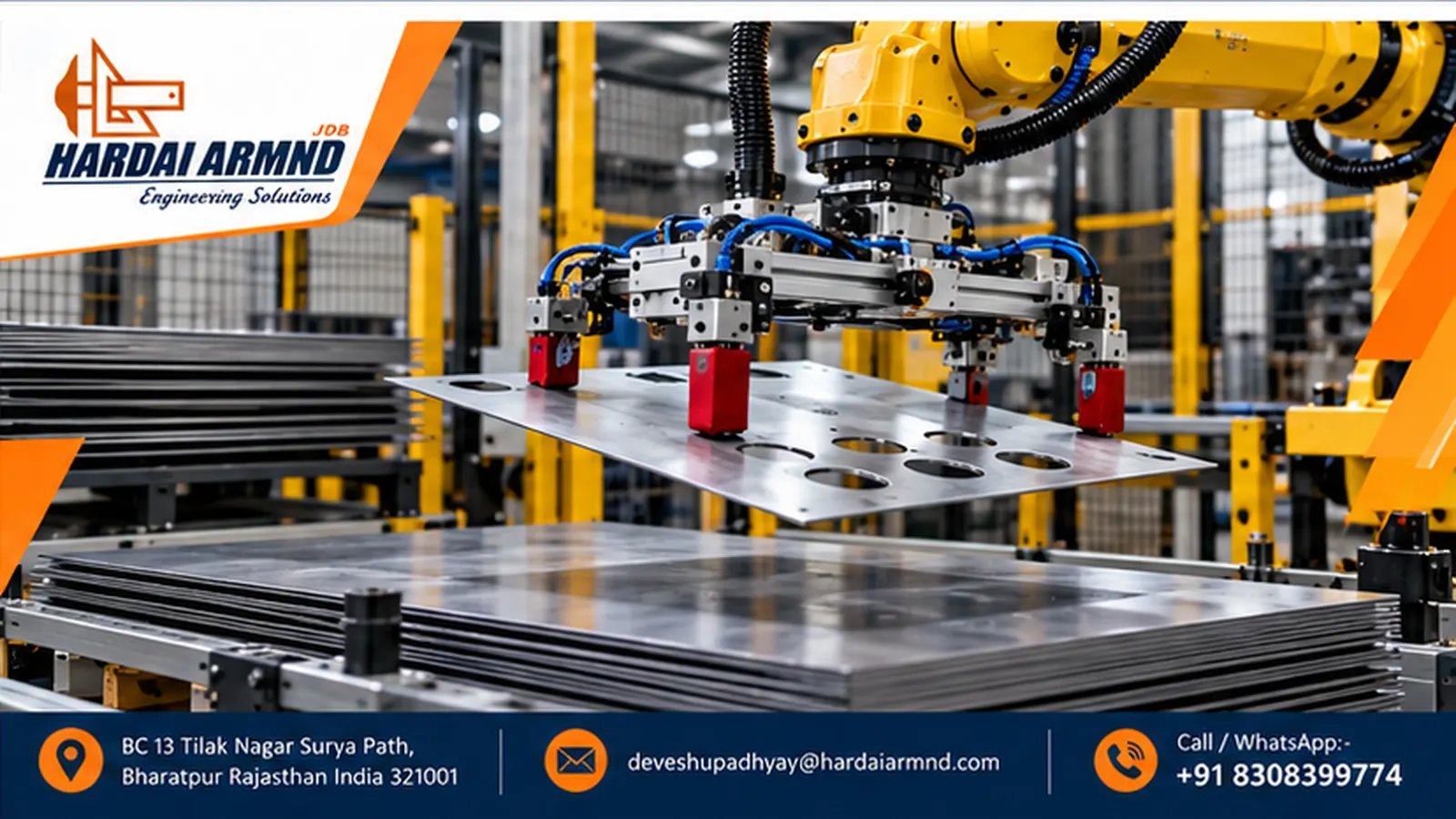
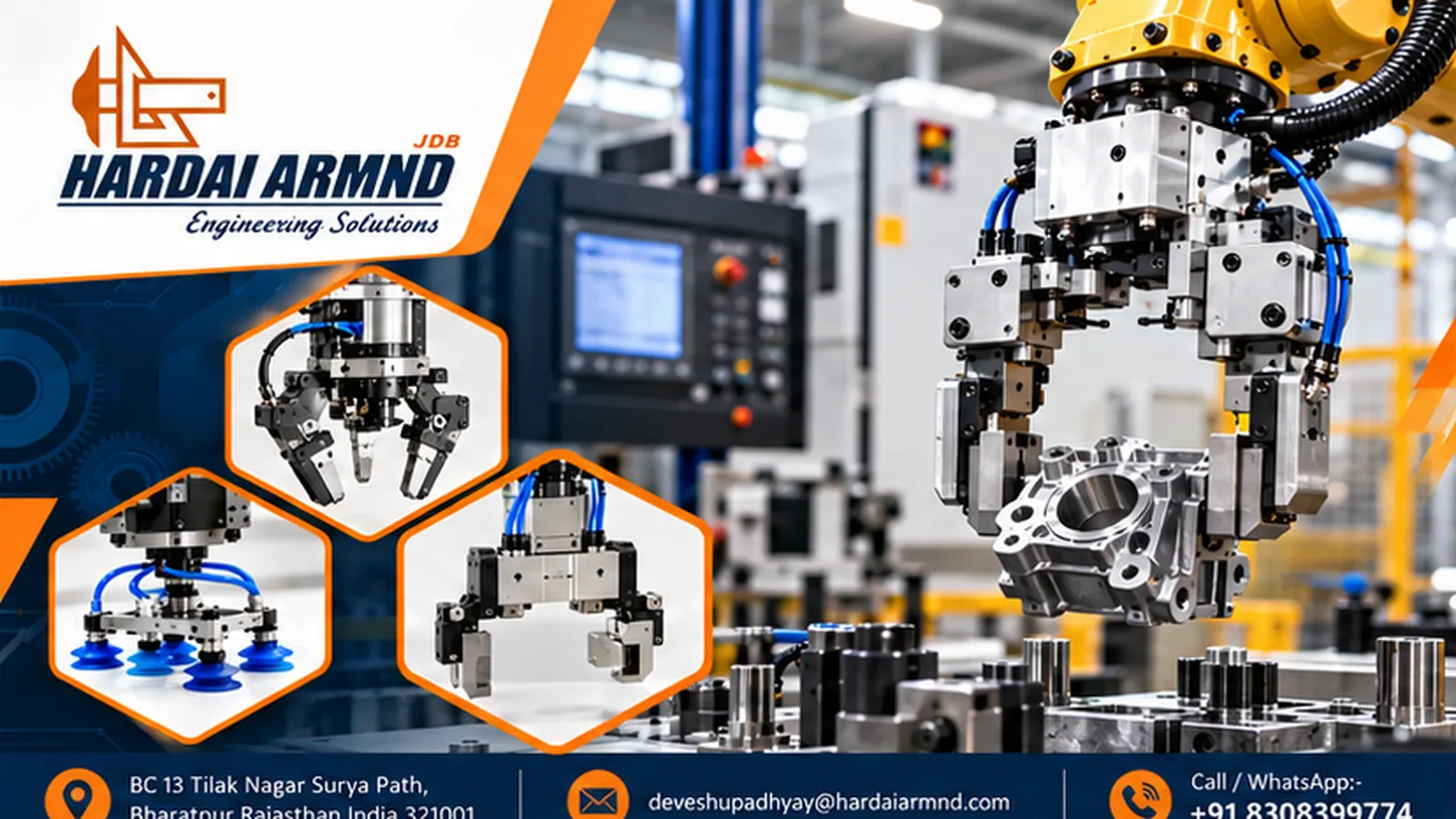
A Dual-Gripper EOAT mounts two independent gripping actuators onto a shared structural manifold—typically arranged in an angled 90° V-configuration or a 180° back-to-back configuration.
Because the robot holds two parts simultaneously, all pallet picking and placing happens in parallel while the CNC spindle is actively cutting the previous part:
- Pre-Staging (During Active Machining): While the CNC is cutting Part A, the robot picks up Raw Blank B from the infeed tray using Gripper 1 and waits directly outside the CNC door (“staged position”), leaving Gripper 2 empty.
- Single Entry Unload: The instant the CNC door opens, the robot enters once and uses empty Gripper 2 to pull Finished Part A from the chuck.
- In-Chuck Wrist Index (The 3-Second Flip): Without leaving the CNC enclosure, the robot rotates its 6th axis (wrist) by 90° or 180°, activates an integrated air blow-off nozzle to clear chips from the chuck jaws, and immediately inserts Raw Blank B using Gripper 1.
- Immediate Cycle Restart: The robot retracts, the door closes, and the spindle resumes cutting immediately. While the CNC machines Part B, the robot gauges, deburrs, and palletizes Finished Part A and picks Raw Blank C.
Performance Comparison: Single vs. Dual-Gripper EOAT
Operational Metric | Single-Gripper EOAT | Dual-Gripper EOAT | Operational Impact |
Robot Entries into CNC per Cycle | 2 Separate Entries | 1 Single Entry | Eliminates double approach/retract strokes |
Pallet Pick & Place Timing | Sequential (CNC waits idle) | Parallel (Hidden inside cut time) | 100% of tray travel removed from critical path |
Typical Door-Open Exchange Time | 24 – 30 Seconds | 10 – 14 Seconds | >50% reduction in non-cutting idle time |
Average CNC Spindle Utilization | 65% – 72% | 86% – 93% | Up to 25% more parts per shift per machine |
6th-Axis Robot Wear & Tear | High (Long-axis swings under speed) | Low (Compact wrist rotation inside envelope) | Extended robot reducer and gearbox lifespan |
The Cycle Time Math: Proving the 50% Reduction
Let’s validate the productivity gain with a concrete engineering calculation based on a typical automotive Tier-1 CNC turning operation producing flanged transmission shafts.
Baseline Shop Floor Parameters
- Machining Cut Time (Spindle Turning): 45 seconds
- Fixed Machine Overhead: 6 seconds (2s spindle deceleration + 2s auto-door open + 2s door close/chuck pressure confirmation)
- Shift Duration: 8 hours (28,800 available production seconds)
Scenario A: Robotic Cell with Single-Gripper EOAT
When the door opens, the robot performs a sequential exchange:
- Approach & unclamp finished shaft: 4 seconds
- Retract, swing to outbound rack, release finished shaft: 9 seconds
- Swing to inbound billet feeder, pick raw forging, return to CNC door: 10 seconds
- Enter CNC, blow off chuck, load raw forging, clamp & retract: 5 seconds
- Total Part Exchange Time: 28 seconds
TotalCycleTime(Single)=45s(Cut)+6s(Fixed)+28s(Exchange)=79seconds
HourlyOutput=3,600seconds79seconds=45.5parts/hour(364partsper8-hourshift)
Scenario B: Robotic Cell with Custom Dual-Gripper EOAT
Because the robot already holds the next raw forging right outside the door while the 45-second cut is happening:
- Enter CNC & unclamp finished shaft with Gripper A: 4 seconds
- Index robot wrist 90° + integrated air-blast chuck cleaning: 3 seconds
- Load raw forging with Gripper B, clamp & retract: 5 seconds
- Total Part Exchange Time: 12 seconds (a 57.1% reduction in exchange downtime)
Total Cycle Time (Dual)=45s(Cut)+6s(Fixed)+12s(Exchange)=63seconds
Hourly Output=3,600 seconds 63seconds=57.1 parts/hour (457 partsper 8-hourshift)
The Bottom-Line Production Gain: Simply switching from a single-gripper to a Dual-Gripper EOAT for CNC machine tending yields +93 additional finished parts per shift—or +279 parts per day across a 3-shift operation—from the exact same CNC machine and robot.
Critical Engineering Factors When Designing Custom Dual-Gripper EOAT
While the cycle-time math makes a dual-gripper setup an obvious choice, strapping two standard catalogue grippers onto an aluminum plate often leads to premature actuator failure, robot overload alarms, and dropped parts.
At Hardai ARMND Engineering Solutions, we approach End-of-Arm Tooling as a precision mechanical engineering discipline rather than a simple bracket assembly. Here are the four critical engineering challenges our design team solves for every custom EOAT project:
1. Payload Optimization & Wrist Moment of Inertia (FEA Validated)
When a robot transitions from a single gripper to a dual gripper, its wrist must support:
- Two pneumatic, hydraulic, or servo gripper bodies
- A dual-angle mounting manifold with integrated pneumatic valving
- Two heavy workpieces simultaneously during the brief moment between unloading the finished part and loading the raw blank
More critical than static weight is the Moment of Inertia (J) and Tool Center Point (TCP) offset. If the dual mounting bracket pushes the heavy workpieces too far outward from the ISO-9409-1 robot wrist flange, the rotational torque during the rapid 90°/180° wrist flip will trigger deceleration faults or overload the robot’s 5th and 6th harmonic drives.
The Hardai ARMND Solution: Before cutting a single gram of metal at our Jaipur facility, our engineering team runs comprehensive 3D CAD Modeling alongside Structural and Modal Finite Element Analysis (FEA). We topologically optimize the mounting manifold—removing parasitic dead weight while maintaining maximum torsional stiffness—so your robot or cobot operates safely within its payload envelope at peak acceleration.
2. Asymmetrical Part Geometry: Raw Forging vs. Precision Machined Surface
A raw cast or forged blank rarely shares the same outer diameter (OD), surface roughness, or clamping land as the finished CNC-machined part.
- The Unload Gripper must handle a precision-ground, thin-walled, or threaded finished surface without leaving witness marks or distorting concentricity.
- The Load Gripper must grip a rough, scaly, slightly out-of-round raw forging with high clamping force to withstand the mechanical push-in force required to seat the part firmly against the CNC chuck face.
The Hardai ARMND Solution: We custom-machine dedicated finger profiles for each side of the dual EOAT. The raw-loading side utilizes hardened, serrated high-bite steel jaws for maximum slip resistance, while the finished-unloading side uses contoured soft jaws, non-marring polyurethane inserts, or ID collet expansion fingers tailored to your part print.
3. Integrated High-Velocity Air Blow-Off & Part-Seating Verification
In high-volume CNC lathe tending, a single curl of swarf trapped on the chuck jaw face will cause the next raw blank to clamp at a 0.2 mm runout angle—scrapping the part and risking a catastrophic turret crash. If the robot has to put down the part and pick up a separate air gun, your dual-gripper cycle time savings disappear.
The Hardai ARMND Solution: We engineer internal pneumatic air passages directly through the EOAT manifold body. As the robot wrist pivots from the unload gripper to the load gripper, high-velocity directional air nozzles flush coolant and metal chips off the chuck jaws in less than 1.5 seconds. Furthermore, we integrate inductive proximity sensors and spring-loaded pushers onto the EOAT to verify flush part seating before the chuck closes.
4. Defeating Coolant Washout & Chip Seizing with MolyKul MoS2 Dry Film Lubrication
The interior of a CNC machine is one of the most hostile environments in manufacturing. High-pressure water-soluble coolant continuously sprays the EOAT, washing away conventional lithium or synthetic greases from the gripper’s sliding T-slots and rack-and-pinion mechanisms. Worse yet, tacky wet grease acts like a magnet for fine cast-iron dust and brass/aluminum micro-chips, turning into an abrasive grinding paste that jams gripper jaws mid-shift.
The Hardai ARMND Edge: As pioneers in advanced solid lubrication technology, Hardai ARMND treats all sliding custom gripper jaws, actuator guideways, and wear plates with our proprietary MolyKul Mono-Coat (2D Monolayer MoS2 Dry Film Lubrication).
- Zero Chip Attraction: Because MolyKul MoS2 cures as an ultra-thin, dry molecular layer bonded directly to the metal substrate, metal swarf and grinding dust cannot stick to the sliding ways.
- Impervious to CNC Coolant: Unlike wet grease, MoS2 solid film lubrication does not emulsify or wash out under high-pressure coolant jets.
- Ultra-Low Coefficient of Friction: Reduces sliding friction and wear on pneumatic and mechanical actuators, maintaining repeatable gripping centering accuracy (0.02mm) across millions of cycles without manual re-greasing.
Custom-Engineered EOAT vs. Off-the-Shelf Imports: The ROI Case for Indian Manufacturers
When setting up a robotic CNC tending cell, automation integrators and plant managers often default to ordering imported, catalogue “plug-and-play” dual gripper kits from European or East Asian suppliers. On the shop floor, these off-the-shelf kits frequently introduce three expensive problems:
- Compromised Finger Length & Jaw Stroke: Catalogue grippers force you to bolt long, heavy adapter fingers onto a tiny base actuator to clear the CNC chuck jaws—creating severe jaw deflection and reducing effective clamping force by up to 40%.
- Prohibitive CapEx & Spare Part Lead Times: Imported EOAT assemblies carry heavy import duties, high unit costs, and 6-to-10-week lead times if a proprietary seal kit or jaw slide gets damaged during a crash.
- Lack of Application Integration: Standard kits do not match the specific clearance geometry of your tailstock, steady rest, or fixture clamping clamps.
The Hardai ARMND 6-Step Engineering Workflow
At Hardai ARMND Engineering Solutions, we deliver 100% Made-in-India Custom Automation Robotic Grippers and Special Purpose Machine (SPM) tooling engineered from the ground up for your exact workpiece family and CNC work envelope:
- Application Audit & Quotation: We evaluate your 3D part models (raw and finished), robot payload curve, chuck geometry, and target cycle time to provide a transparent, fixed-cost engineering proposal.
- Concept & Architecture Planning: Choosing the optimal actuation method (pneumatic 3-jaw concentric, parallel, hydraulic, vacuum, or hybrid mechanical) and mounting angle (90, 120, or 180).
- CAD Modeling & FEA Simulation: Full 3D collision checking inside your CNC enclosure alongside structural FEA and CFD (for integrated air/coolant manifolds) to guarantee zero wrist deflection.
- Precision In-House Production: Manufactured at our state-of-the-art facility in Jagatpura, Jaipur, utilizing aerospace-grade alloys, hardened tool steels, and MolyKul MoS2 dry-film surface engineering.
- Rigorous Load & Repeatability Testing: Every Dual-Gripper EOAT undergoes clamping force verification, pneumatic leak testing, and cycle endurance trials prior to dispatch.
- Lifetime Post-Delivery Support: Rapid availability of custom replacement jaws, local field engineering assistance, and quick-change jaw modifications when you introduce new component part numbers.
Frequently Asked Questions (FAQ)
1. Can a collaborative robot (cobot) handle the weight of a Dual-Gripper EOAT?
Yes—provided the EOAT is structurally optimized. Standard cobots (such as 10 kg, 12 kg, or 16 kg payload models) have strict wrist torque limits. By using finite element analysis (FEA) to machine lightweight structural pockets into high-strength aluminum manifolds and keeping the Tool Center Point (TCP) compact, Hardai ARMND designs custom dual grippers that allow cobots to tend parts weighing up to 3–5 kg each without triggering protective torque stops.
2. How do we handle multiple part sizes on the same CNC machine without losing setup time?
For high-mix, low-volume CNC shops, we design quick-change pin-locked jaw fingers or multi-stepped V-jaws. An operator can swap jaw fingers for a new component family in under 60 seconds without tools, or a single stepped jaw profile can grip 3 to 4 different shaft diameters automatically.
3. What is the typical ROI payback period for upgrading to a custom Dual-Gripper EOAT?
In a 2-shift or 3-shift CNC production environment where spindle utilization increases by 18% to 25%, the additional output typically pays back the entire cost of a custom Hardai ARMND Dual-Gripper EOAT in 6 to 14 weeks.
4. How does MolyKul MoS2 coating improve gripper lifespan compared to standard anodized or greased slides?
Standard greased slides require weekly disassembly and cleaning in heavy cast-iron or wet-coolant CNC applications because chips pack into the grease channels. Our MolyKul Mono-Coat MoS2 dry film bonds at the micro-surface level, preventing galling, corrosion, and chip accumulation while operating dry or submerged in coolant.
Ready to Cut Your CNC Idle Time in Half?
Stop letting single-gripper robot travel rob your CNC machines of productive spindle hours. Whether you are retrofitting an existing robotic cell or commissioning a new turnkey Special Purpose Machine (SPM) automation line, Hardai ARMND Engineering Solutions builds custom, FEA-validated Dual-Gripper EOAT systems engineered to outlast and outperform off-the-shelf imports.
Schedule a Free CNC Cycle-Time & Custom EOAT Engineering Consultation Today:
- Manufacturing & Design Center: Plot No. 81 & 82 Basement, Platinum Govind Bagh, Beelwa Kalan, Jagatpura, Jaipur, Rajasthan – 302022
- Registered Head Office: Bharatpur, Rajasthan – 321001
- Direct Engineering Helpline: +91 8308399774
- Email: deveshupadhyay@hardaiarmnd.com
- Web: www.hardaiarmnd.com
Recent Posts
- Why Dual-Gripper EOAT is the Secret to Cutting CNC Machine Tending Cycle Times by 50%
- Designing Modular SPMs for High-Mix, Low-Volume (HMLV) Manufacturing: The Scalable Automation Playbook
- Custom Automation Robotic Grippers: Improving Precision and Manufacturing Efficiency
- Custom Industrial Automation Solutions & Special Purpose Machines (SPM) for Modern Manufacturing
- Custom Machines: The Complete Guide to Custom Machine Design and Manufacturing
Products
-
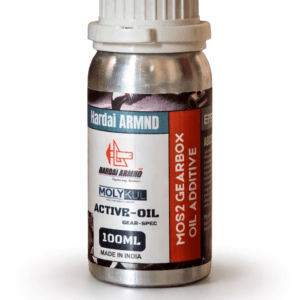
 MolyKul MoS2 Gear Oil additive for cars and bike| Anti-friction MoS2 Solution - 100ml
₹598.73Original price was: ₹598.73.₹399.62Current price is: ₹399.62. Including 18% GST -
MolyKul Aero-Spec 500 (MKG AS500 NG2) – MoS2 Anti-Seize Aerospace grease – 500 Deg C
₹2,088.60 – ₹9,739.72Price range: ₹2,088.60 through ₹9,739.72 Including 18% GST
-
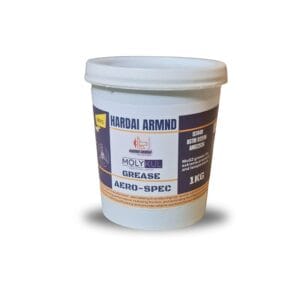
MolyKul MoS2 Grease for industrial application| Lithium + Anti-Seize MoS2 - 650 Deg C
₹1,539.90Original price was: ₹1,539.90.₹1,169.38Current price is: ₹1,169.38. Including 18% GST -
MolyKul MoS2 engine oil additive for cars and bikes| Anti-friction MoS2 Solution - 100ml
₹195.88 – ₹531.00Price range: ₹195.88 through ₹531.00 Including 18% GST
-
MolyKul MoS2 Grease for industrial application| Lithium + Anti-Seize MoS2 - 320 Deg C
₹684.40 – ₹6,608.00Price range: ₹684.40 through ₹6,608.00 Including 18% GST


Leave A Comment