Custom SPM vs Standard Machines: Which Is Better?
- Home
- Custom SPM vs Standard Machines: Which Is Better for Your Production Line?
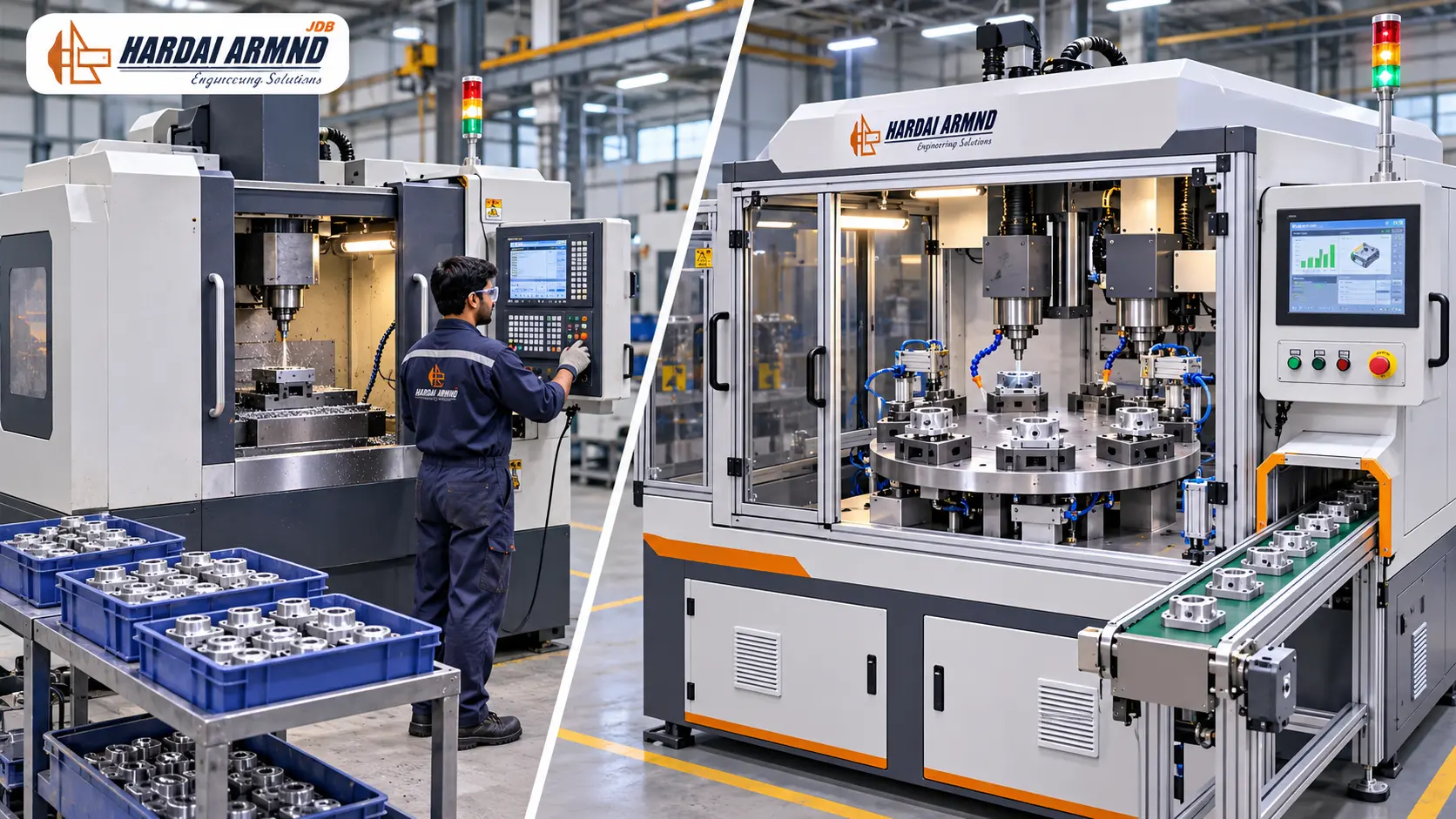
Indian manufacturing is navigating a decisive shift. Across industrial clusters—from automotive tier-1 suppliers in Pune and Chennai to precision engineering MSMEs in Faridabad, Rajkot, and Rajasthan—factory owners face mounting pressure to deliver tighter tolerances, faster turnaround times, and zero-defect batches while managing rising labor and energy costs. Achieving high industrial production efficiency requires more than simply adding floor capacity; it demands selecting the right machinery architecture for the job.
When expanding capacity or automating a bottleneck, manufacturing decision-makers typically evaluate two fundamental equipment paths: off-the-shelf standard industrial machines or purpose-built custom Special Purpose Machines (SPM).
Evaluating Custom SPM vs Standard Machines is not merely a procurement comparison—it is a strategic capital expenditure decision that directly dictates your cycle times, per-part manufacturing cost, floor space utilization, and long-term scalability. Choosing an under-specified standard machine for a high-volume repetitive task creates permanent operational drag, while commissioning a custom SPM for low-volume, frequently changing batches ties up capital unnecessarily.
What Are Standard Industrial Machines?
Standard industrial machines are mass-produced, catalog-listed equipment engineered by Original Equipment Manufacturers (OEMs) to perform generalized manufacturing tasks across a wide variety of industries. Common examples include conventional lathes, standard 3-axis CNC vertical machining centers (VMCs), off-the-shelf hydraulic presses, standard band saws, and generic belt conveyors.
How They Are Designed
OEMs design standard machines around broad industry averages. They feature universal worktables, generic control interfaces, standard spindle speeds, and wide working envelopes so that a single machine model can serve an aerospace subcontractor, a general fabrication shop, and an agricultural equipment manufacturer alike.
Advantages of Standard Industrial Machines
- Immediate Availability: Because they are built to stock or produced in regular batches, lead times are typically short, allowing rapid deployment.
- Predictable Upfront Cost: Pricing is standardized and transparent, making initial budgeting and vendor comparisons straightforward.
- Established Service & Spares Ecosystem: Replacement parts, service technicians, and operator familiarity are widely available across industrial hubs.
- High Resale Value: General-purpose utility ensures a strong secondary market if production requirements change.
Limitations in Specialized Production
- Unused Capabilities: You pay for broad functionality—such as wide axis travels or multi-speed gearboxes—that your specific part may never utilize.
- Fixture and Workholding Workarounds: Because the machine is not built around your component geometry, engineers must rely on complex manual clamping, multi-setup indexing, or secondary jigs.
- Manual Material Handling: Standard machines typically require an operator to load, orient, clamp, cycle-start, unclamp, and unload every piece, limiting throughput and introducing human variability.
What Are Custom Special Purpose Machines (SPM)?
A Special Purpose Machine (SPM) is a bespoke industrial machine designed, engineered, and manufactured from the ground up to execute a specific sequence of operations on a dedicated component or narrow family of parts. Rather than adapting your process to fit a catalog machine, SPM machine design adapts the machine architecture entirely around your component and production workflow.
Core Elements of Custom SPM Engineering
Unlike off-the-shelf equipment, Special Purpose Machine manufacturing integrates multiple engineering disciplines into a unified system:
- Dedicated Mechanical Architecture: Custom structural frames, multi-spindle heads, rotary indexing tables, or linear transfer slides sized specifically for the part envelope and cutting/forming forces.
- Purpose-Built Tooling and Fixtures: Pneumatic, hydraulic, or servo-actuated clamping fixtures engineered to locate and secure the exact component geometry in seconds with repeatable datum accuracy.
- Integrated Industrial Machine Automation: Seamless coordination of Programmable Logic Controllers (PLCs), Human-Machine Interfaces (HMIs), servo drives, pneumatic actuators, vision sensors, and automated feeding mechanisms (such as bowl feeders, pick-and-place gantries, or robotic loaders).
- Multi-Operation Consolidation: Combining drilling, tapping, reaming, pressing, gauging, or laser marking into a single automated cycle.
Applications in Indian Manufacturing
In Indian manufacturing plants, customized manufacturing machines are deployed wherever repetitive bottlenecks limit output. Typical deployments include multi-station rotary indexing machines for automotive brake components, automated leak-testing and assembly rigs for valve manufacturers, dedicated multi-spindle drilling/tapping units for electrical switchgear housings, and custom press-fit stations for bearing assemblies.
Custom SPM vs Standard Machines – Key Differences
Understanding the operational trade-offs between Custom SPM vs Standard Machines requires looking beyond the purchase invoice to examine how each behaves on the shop floor over a 5-to-10-year lifecycle.
Evaluation Parameter | Standard Industrial Machines | Custom Special Purpose Machines (SPM) |
Machine Design & Configuration | Generic, universal design built for a wide range of parts and processes. | Tailor-made architecture engineered around specific component geometry and process steps. |
Initial Investment | Lower upfront capital expenditure; standardized catalog pricing. | Higher initial CAPEX due to custom NRE (Non-Recurring Engineering), CAD design, and bespoke fabrication. |
Production Speed & Cycle Time | Moderate; constrained by single-operation processing and manual loading/unloading. | High; optimized through simultaneous multi-axis/multi-station operations and automated handling. |
Operational Efficiency | Lower floor-space and energy efficiency per part when running dedicated high-volume jobs. | High Overall Equipment Effectiveness (OEE) with minimized non-cutting/non-value-added time. |
Product Quality & Consistency | Dependent on operator skill during manual clamping, alignment, and multi-setup transfers. | High repeatability; poka-yoke fixtures and automated cycles eliminate human setup errors. |
Flexibility & Customization | High process flexibility across diverse parts, but limited hardware customization. | Dedicated to specific parts or part families; accommodates variants via quick-change tooling. |
Integration with Existing Lines | Standalone operation; requires external conveyors, robots, or manual transfer between stations. | Engineered to interface directly with upstream/downstream conveyors, MES, and plant automation. |
Maintenance Requirements | Standardized spares and familiar maintenance procedures across general technicians. | Requires preventive maintenance schedules, documented BOMs, and PLC/automation diagnostics. |
Scalability & Future Expansion | Scaled by purchasing additional standalone machines and hiring more operators. | Modular SPM architectures allow adding stations or upgrading feeders as volume grows. |
Return on Investment (ROI) | Gradual ROI; relies on steady utilization across varied job-shop orders. | Rapid ROI in high-volume production via drastically lower cost-per-part and labor savings. |
Practical Shop-Floor Takeaways
- Cycle Time Compression: On a standard VMC, drilling four holes on three different faces of a casting requires three separate setups or a costly 4th/5th-axis rotary setup. A custom multi-head SPM drills all faces simultaneously in a single clamping cycle, cutting floor-to-floor time by 60% to 75%.
- Floor Space Utilization: Replacing three standalone machines and their intermediate work-in-progress (WIP) buffer bins with a single compact rotary-index SPM frees valuable shop-floor real estate.
Advantages of Custom SPM Machines for Manufacturing
When aligned with the right production profile, custom SPM machine solutions deliver measurable competitive advantages across the plant floor.
1. Engineered for Exact Production Requirements
Every actuator, spindle motor, guideway, and structural weldment is sized strictly for the required load, stroke, and duty cycle. You avoid paying for unused axis travel while gaining rigidity precisely where cutting or pressing forces occur.
2. Dramatically Reduced Cycle Times
Custom SPMs eliminate non-productive motion. Simultaneous machining heads, rotary indexers (where station 1 loads while stations 2, 3, and 4 process), and short-stroke dedicated slides compress cycle times far beyond what sequential standard machines can achieve.
3. Superior Repeatability and Zero-Defect Consistency
Manual re-clamping between standard machines introduces cumulative tolerance stack-up. Custom SPM fixtures locate the component once against hardened datum pads, incorporating poka-yoke (mistake-proofing) sensors to verify part seating before the cycle initiates.
4. Reduced Operator Dependency and Skill Bottlenecks
Finding and retaining skilled machinists is an ongoing challenge across Indian industrial belts. By automating clamping, tool feed, and part ejection, a custom SPM allows a single semi-skilled operator to safely tend the machine—or oversee multiple automated cells—while maintaining precision.
5. Seamless Production Line Automation
Custom SPMs are designed as native nodes within production line automation. Whether receiving parts directly from an upstream die-casting chute or feeding finished assemblies onto an inspection conveyor, mechanical interfaces and PLC handshakes are built in from day one.
6. Elimination of Production Bottlenecks
In almost every factory, one slow operation dictates the pace of the entire line. Deploying a targeted SPM at that bottleneck balances line takt time and unlocks latent capacity across upstream and downstream equipment.
When Should You Choose Standard Industrial Machines?
Despite the efficiency of custom automation, standard machines remain the logical choice in several manufacturing scenarios:
- High-Mix, Low-Volume (HMLV) Job Shops: If your facility produces small batches of dozens of different components every week, setup agility matters more than per-part cycle time.
- Frequent Product Design Changes: For products still in prototyping or undergoing regular dimensional revisions, rigid dedicated tooling becomes obsolete too quickly.
- Limited Initial Capital: Startups or MSMEs operating under strict CAPEX ceilings often benefit from standard machines that can be financed easily and deployed immediately.
- Standardized, Single-Step Operations: When a basic cut-off, surface grind, or simple turning operation already meets your takt time without creating a bottleneck, customization adds unnecessary complexity.
- Urgent Delivery Deadlines: When a contract requires production to start within two to three weeks, off-the-shelf machinery is the only viable path.
When Should You Invest in Custom SPM Machines?
Manufacturers should evaluate Custom Machine Design for Manufacturing when operational data points to clear volume, quality, or cost constraints:
- High-Volume Repetitive Manufacturing: Annual volumes running into tens of thousands or millions of identical or family-grouped parts where saving even 5 seconds per cycle yields massive annual capacity gains.
- Multi-Operation Bottlenecks: Parts requiring sequential drilling, chamfering, tapping, pressing, or assembly steps that currently travel across three or four separate standard machines.
- Tight Geometric Tolerances: Components requiring strict concentricity, perpendicularity, or positional accuracy that degrade when transferred manually between setups.
- High Labor Cost or Safety Risks: Repetitive manual loading, heavy lifting, or hazardous stamping/pressing operations where automation improves both ergonomics and throughput.
- Space-Constrained Facilities: Plants looking to double output within their existing shed footprint without civil expansion.
Custom SPM vs Standard Machines – Cost and ROI Analysis
A common procurement pitfall is comparing machines solely on upfront purchase price rather than Total Cost of Ownership (TCO) and cost per produced component.
Key Financial Factors to Evaluate
- Initial Machine Investment: Includes engineering design, fabrication, controls, and factory acceptance testing (FAT).
- Installation & Commissioning: Foundation work, pneumatic/electrical hookups, and operator training.
- Direct Labor Cost: Number of operators required per shift across 1, 2, or 3 shifts.
- Scrap, Rejection, and Rework: Material and machining hours lost due to inconsistent manual setups.
- WIP Inventory & Floor Space: Capital tied up in half-finished parts waiting between standalone machines.
Hypothetical Manufacturing ROI Illustration
Note: The figures below are purely illustrative assumptions created to demonstrate ROI calculation methodology, not actual industry benchmarks.
Consider an automotive component manufacturer producing 300,000 cast aluminum housings annually across two 8-hour shifts (250 working days/year = 4,000 operating hours). The part requires 4 cross-holes drilled, chamfered, and tapped.
Financial & Operational Metric | Option A: Standard VMC Setup (2 Machines) | Option B: Custom 4-Station Rotary SPM |
Assumed Initial Capital Investment | ₹36,00,000 (₹18L × 2 standard VMCs + basic vices) | ₹48,00,000 (Turnkey custom SPM + dedicated fixtures) |
Cycle Time per Part | 45 seconds (across sequential setups) | 15 seconds (simultaneous multi-head indexing) |
Effective Hourly Output (at 85% OEE) | ~68 parts/hour (total across 2 machines) | ~204 parts/hour (single machine) |
Operators Required per Shift | 2 operators (1 per machine) | 1 operator (loading/unloading at Station 1) |
Annual Operator Cost (2 Shifts @ ₹25,000/mo) | ₹12,00,000 / year | ₹6,00,000 / year |
Assumed Scrap / Rework Rate | 3.5% (due to manual re-clamping errors) | 0.5% (poka-yoke pneumatic clamping) |
Annual Rejection Cost (@ ₹150/part) | ₹15,75,000 / year | ₹2,25,000 / year |
Combined Annual Labor + Scrap Cost | ₹27,75,000 / year | ₹8,25,000 / year |
ROI Takeaway: Although the custom SPM requires ₹12,00,000 more in initial CAPEX, it generates ₹19,50,000 in annual operational savings through labor and scrap reduction alone—recovering the incremental investment in under 8 months while tripling hourly capacity.
Real-World Industrial Applications of Custom SPM Machines
Special Purpose Machines for Manufacturing solve distinct engineering bottlenecks across core industrial sectors:
- Automotive Component Manufacturing: Multi-way drilling and tapping SPMs for engine blocks, transmission housings, brake calipers, and steering knuckles; automated bushing press-fit and staking machines.
- CNC Machining & Component Handling: Gantry-based automated loading/unloading cells, automatic bar feeders, and post-machining deburring and washing stations integrated with CNC turning centers.
- Industrial Assembly Operations: Servo-controlled press-fitting, automated screw-driving stations, ultrasonic welding fixtures, and Vision-guided assembly verification systems for electrical and appliance parts.
- Metalworking & Fabrication: Custom hydraulic straightening presses, multi-torch automated seam welding rigs, and dedicated tube-end forming or punching machines.
- Bearing & Mechanical Components: Automated raceway superfinishing units, ball/roller assembly stations, and inline dimensional gauging and sorting machines.
- Packaging & Material Handling: Pick-and-place robotic palletizers, automated shrink-wrapping/cartoning lines, and custom slat or indexing conveyors synchronized with upstream production rates.
Important Factors to Consider Before Selecting an SPM Machine
Before issuing a Request for Quotation (RFQ) to SPM machine manufacturers in India, engineering and procurement teams should define nine critical parameters:
- Production Volume and Target Takt Time: Calculate required daily/monthly output and divide available shift seconds by target volume to establish maximum allowable cycle time.
- Component Drawings & Family Variants: Provide 3D CAD models, 2D GD&T drawings, material hardness specs, and details of any part size variants the machine must accommodate via quick-change tooling.
- Accuracy and Repeatability Specs: Define critical-to-quality (CTQ) tolerances and process capability targets (Cp / Cpk).
- Available Shop-Floor Footprint & Ceiling Height: Map column locations, crane hook heights, and entry door dimensions for machine rigging.
- Utilities & Existing Line Compatibility: Verify 3-phase power availability, compressed air pressure/flow (CFM), coolant filtration needs, and communication protocols (PROFINET, EtherNet/IP, Modbus) for upstream/downstream integration.
- Operator Safety & Ergonomics: Ensure compliance with industrial safety standards—light curtains, interlocked safety guarding, two-hand cycle start controls, and ergonomic loading heights.
- Maintenance Accessibility: Check that lubrication points, pneumatic valves, sensors, and wear components are easily reachable without dismantling major sub-assemblies.
- Future Scalability: Assess whether modular stations or spare PLC I/O points should be included for future capacity upgrades.
- Budget & Payback Window: Align capital outlay with your company’s internal hurdle rate and expected payback period.
Why Choose Hardai ARMND Engineering Solutions for Custom SPM Design and Manufacturing?
Developing a reliable Special Purpose Machine requires disciplined mechanical engineering long before metal is cut on the shop floor. At Hardai ARMND Engineering Solutions, every machine project begins with an engineering-first evaluation of your component geometry, cycle-time bottleneck, and plant workflow.
Hardai ARMND Engineering Solutions supports Indian manufacturers with end-to-end capabilities across:
- Custom Special Purpose Machine (SPM) Design: Purpose-built machines engineered around your specific machining, pressing, assembly, or handling process.
- Mechanical Machine Design & Development: Robust structural frames, precision drive mechanisms, custom tooling, and pneumatic/hydraulic workholding fixtures.
- 3D CAD Modeling & Engineering Simulation: Detailed digital prototyping, kinematic motion validation, tolerance stack-up checks, and structural load analysis prior to fabrication.
- Customized Industrial Automation Solutions: Integrated PLC/HMI control panels, servo motion control, sensor-based error proofing, and automated material transfer systems.
- Production-Oriented Machine Development: Practical designs focused on operator ergonomics, straightforward shop-floor maintenance, and measurable OEE improvement.
By analyzing your process constraints first, Hardai ARMND ensures that custom automation is applied strictly where it delivers clear operational and financial returns.
Conclusion – Which Machine Is Better for Your Production Line?
There is no universal winner in the Custom SPM vs Standard Machines debate—only the right architectural fit for your production economics. Standard industrial machines remain indispensable for flexible, low-to-medium volume operations, prototyping, and general-purpose job shops where versatility and low upfront cost take priority. Conversely, custom Special Purpose Machines become a decisive strategic asset when repetitive high-volume output, tight multi-face tolerances, labor constraints, or single-station bottlenecks limit your plant’s profitability.
Evaluating cycle time, scrap rates, operator utilization, and long-term ROI before purchasing equipment ensures your capital investment drives sustainable manufacturing growth.
Planning to automate a production bottleneck or evaluate a custom machine solution for your plant?
Connect with the engineering team at Hardai ARMND Engineering Solutions to discuss your component drawings, cycle-time goals, and custom SPM design requirements.
Frequently Asked Questions (FAQs)
1. What is the difference between custom SPM and standard machines?
Standard machines are mass-produced, general-purpose equipment built to handle a wide variety of parts and basic tasks. Custom Special Purpose Machines (SPMs) are uniquely engineered and built specifically for a dedicated component or process sequence, integrating custom fixtures, multi-station tooling, and automation to maximize speed and repeatability.
2. What are the main advantages of custom Special Purpose Machines?
Custom SPMs significantly reduce cycle times through simultaneous operations, improve dimensional consistency via dedicated workholding fixtures, lower per-part labor costs through automation, reduce scrap rates, and optimize factory floor space.
3. Are custom SPM machines more expensive than standard machines?
Upfront, yes—custom SPMs have a higher initial purchase price because they include dedicated engineering design, 3D CAD modeling, custom tooling, and bespoke fabrication. However, in high-volume production, they usually deliver a significantly lower total cost per part and a faster return on investment.
4. When should a manufacturing company invest in a custom SPM machine?
A company should invest in a custom SPM when producing high volumes of repetitive components, facing persistent production bottlenecks, struggling with manual setup errors on tight-tolerance parts, or seeking to consolidate multiple sequential operations into one automated cycle.
5. Can custom SPM machines improve production efficiency?
Yes. By eliminating manual part transfers between multiple machines, automating clamping and loading, and performing multiple machining or assembly tasks simultaneously, custom SPMs dramatically increase Overall Equipment Effectiveness (OEE) and hourly output.
6. Are SPM machines suitable for small and medium-sized manufacturers?
Yes, especially for Indian MSMEs supplying tier-1 automotive, electrical, or engineering OEMs with steady monthly schedules. Even compact, semi-automated SPMs (such as dedicated multi-spindle drilling/tapping units or pneumatic assembly fixtures) can help MSMEs meet strict OEM quality audits and delivery volumes without expanding headcount.
7. How long does it take to design and manufacture a custom SPM machine?
Lead times depend on machine complexity, automation level, and component sourcing. Simple semi-automated SPMs may take 6 to 10 weeks from design approval to dispatch, while complex multi-station rotary or automated assembly lines typically require 12 to 20 weeks.
8. Can custom SPM machines be integrated with existing production lines?
Yes. Custom SPMs are engineered around your existing plant layout, conveyor heights, utility connections, and PLC communication protocols, allowing seamless mechanical and digital integration with upstream and downstream equipment.
Recent Posts
- Custom SPM vs Standard Machines: Which Is Better for Your Production Line?
- MolyKul MoS2 Bearings: Enhancing Bearing Performance with Advanced Solid Lubrication Technology
- Gantry Robots vs. 6-Axis Articulated Arms: Which Fits Your Factory Floor?
- Why Dual-Gripper EOAT is the Secret to Cutting CNC Machine Tending Cycle Times by 50%
- Designing Modular SPMs for High-Mix, Low-Volume (HMLV) Manufacturing: The Scalable Automation Playbook
Products
-
 MolyKul MoS2 Gear Oil additive for cars and bike| Anti-friction MoS2 Solution - 100ml
₹598.73Original price was: ₹598.73.₹399.62Current price is: ₹399.62. Including 18% GST -
MolyKul Aero-Spec 500 (MKG AS500 NG2) – MoS2 Anti-Seize Aerospace grease – 500 Deg C
₹2,088.60 – ₹9,739.72Price range: ₹2,088.60 through ₹9,739.72 Including 18% GST
-
MolyKul MoS2 Grease for industrial application| Lithium + Anti-Seize MoS2 - 650 Deg C
₹1,539.90Original price was: ₹1,539.90.₹1,169.38Current price is: ₹1,169.38. Including 18% GST -
MolyKul MoS2 engine oil additive for cars and bikes| Anti-friction MoS2 Solution - 100ml
₹195.88 – ₹531.00Price range: ₹195.88 through ₹531.00 Including 18% GST
-
MolyKul MoS2 Grease for industrial application| Lithium + Anti-Seize MoS2 - 320 Deg C
₹684.40 – ₹6,608.00Price range: ₹684.40 through ₹6,608.00 Including 18% GST

Leave A Comment