Automated FRP Tank Plasma Surface Smoothening Machine
Category
Special Purpose Machines / Industrial Automation
Project Type
Concept Development, Machine Design, Manufacturing & Automation
Application
FRP Tank Manufacturing
Technology
Automated Plasma Surface Treatment
Developed & Executed By
Hardai ARMND Engineering Solutions
What is an FRP Tank Plasma Surface Smoothening Machine?
The FRP Tank Plasma Surface Smoothening Machine is a specially developed automated machine designed for the surface-finishing stage of FRP tank manufacturing.
After the primary tank manufacturing/forming process, the outer surface of an FRP tank may have comparatively rough, uneven or projecting surface fibres that require controlled finishing before the tank proceeds to subsequent production stages.
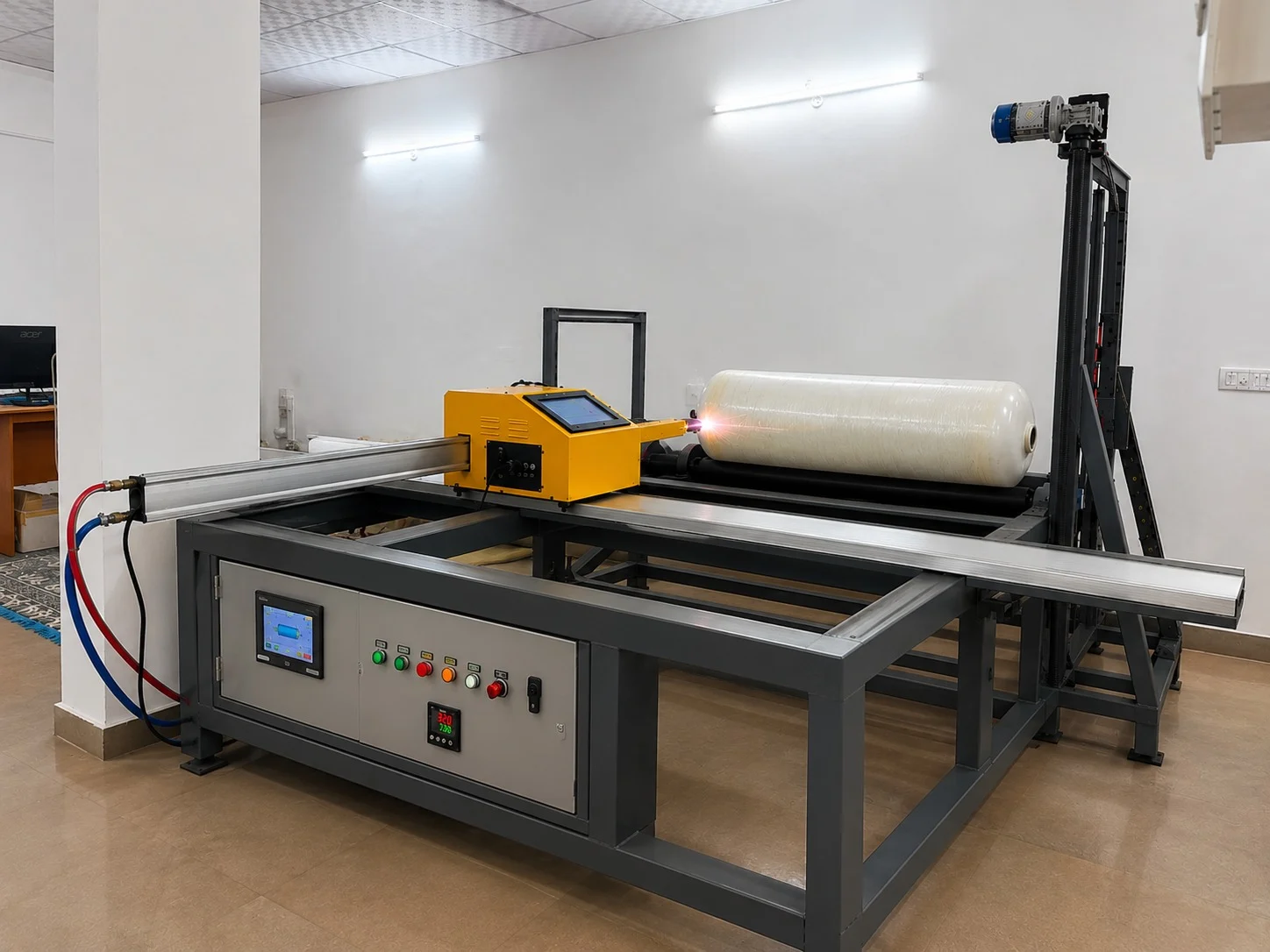
Hardai ARMND Engineering Solutions developed this Special Purpose Machine (SPM) to automate this surface-treatment operation using a controlled plasma treatment process. Instead of relying completely on manual surface finishing, the machine rotates the FRP tank while a precisely positioned plasma treatment head travels along its length. The combination of controlled tank rotation and linear movement of the treatment head provides systematic exposure of the tank's outer circumference to the plasma treatment.
The machine was conceived, mechanically designed, fabricated, assembled, automated and tested as a customized engineering solution for the FRP tank manufacturing process.
After the primary tank manufacturing/forming process, the outer surface of an FRP tank may have comparatively rough, uneven or projecting surface fibres that require controlled finishing before the tank proceeds to subsequent production stages.
Hardai ARMND Engineering Solutions developed this Special Purpose Machine (SPM) to automate this surface-treatment operation using a controlled plasma treatment process. Instead of relying completely on manual surface finishing, the machine rotates the FRP tank while a precisely positioned plasma treatment head travels along its length. The combination of controlled tank rotation and linear movement of the treatment head provides systematic exposure of the tank's outer circumference to the plasma treatment.
The machine was conceived, mechanically designed, fabricated, assembled, automated and tested as a customized engineering solution for the FRP tank manufacturing process.
Surface Finishing of FRP Tanks After Manufacturing
FRP tanks require a suitable surface condition before they can move to subsequent manufacturing, inspection or finishing operations.
Immediately after the tank manufacturing process, its outer surface can contain rough fibres, minor projections and surface irregularities. Manually treating a large cylindrical tank can be time-consuming and highly dependent on operator skill and consistency.
As the tank rotates on supporting rollers, the plasma processing system progressively travels across its working length. This enables treatment of the cylindrical surface in a controlled and repeatable manner.
The objective is not dimensional machining of the tank. Rather, it is a controlled surface-treatment process intended to improve the condition and uniformity of the manufactured FRP surface.
The developed machine automates this stage by combining three coordinated movements and functions:
- Controlled rotation of the FRP tank
- Linear movement of the processing carriage along the tank
- Linear movement of the processing carriage along the tank
- Controlled plasma exposure close to the FRP surface
Automating Surface Smoothening of a Large FRP Tank
The major engineering challenge was not simply generating a plasma flame. The real requirement was to create a machine capable of applying plasma treatment to a large cylindrical FRP component uniformly, safely and repeatedly without excessive thermal exposure to the substrate.
FRP is fundamentally different from a metallic component. Excessive localized heat or prolonged exposure can potentially affect the resin-rich surface. Therefore, the relationship between plasma intensity, stand-off distance, tank rotational speed and longitudinal travel speed becomes extremely important.
At the same time, the FRP tank is a comparatively large component. The machine therefore needed a mechanical arrangement capable of supporting and rotating the tank while maintaining stable positioning throughout the processing cycle.
Major Engineering Challenges:
- Handling a long cylindrical FRP tank
- Maintaining stable tank rotation during treatment
- Maintaining a controlled plasma-to-surface distance
- Coordinating rotational and longitudinal movement
- Avoiding excessive localized thermal exposure
- Covering the complete working length of the tank
- Providing adjustable process parameters for different tank conditions
- Developing a cost-effective industrial machine architecture
- Integrating automation without making the machine unnecessarily complicated
Plasma-Based Automated FRP Surface Treatment
The key innovation of the project is the application of controlled plasma treatment through an automated multi-motion machine architecture.
A plasma treatment assembly is positioned close to the rotating FRP tank. The treatment head is integrated with a linear travelling mechanism that allows it to move progressively along the longitudinal axis of the tank.
During operation, the tank rotates while the plasma treatment head travels along its length.
This creates a coordinated treatment pattern across the cylindrical surface.
The machine therefore converts what can otherwise be a highly operator-dependent finishing operation into a more controlled, parameter-driven and repeatable manufacturing process.
Key Process Concept
Tank Loading → Tank Positioning → Parameter Selection → Controlled Rotation → Plasma Activation → Longitudinal Plasma Travel → Surface Treatment → Cycle Completion → Tank Unloading
The process parameters can be optimized according to the FRP tank geometry and required surface condition.
Automated Tank Rotation and Linear Plasma Movement
One of the most important design considerations was ensuring that the plasma treatment did not remain concentrated at one location. The FRP tank is therefore supported horizontally on a specially designed roller arrangement. The roller system allows the tank to rotate around its longitudinal axis at a controlled speed. Simultaneously, the plasma treatment assembly travels along a linear guide/rail system parallel to the tank. The coordinated motion provides two important degrees of process control: Rotational Movement Provides circumferential coverage around the FRP tank. Linear Movement Provides coverage across the working length of the FRP tank. Together, these motions enable systematic treatment of the complete cylindrical surface.
Controlled Plasma Surface Treatment
Plasma treatment is applied through a dedicated processing head positioned at a controlled distance from the FRP tank.
The machine allows important operating parameters to be controlled so that the treatment can be adapted to the actual production requirement.
Depending upon the final process configuration, these parameters can include:
- Tank rotational speed
- Linear carriage travel speed
- Plasma operating condition
- Treatment head position
- Plasma-to-component stand-off distance
- Processing cycle duration
- Start and end positions
- Number of processing passes
PLC and HMI-Based Machine Control
To make the machine suitable for industrial production, the mechanical system is integrated with an electrical control panel, PLC-based control architecture and operator HMI.
Dedicated push buttons and indication lamps provide quick machine-status information and convenient operator control.
Emergency-stop and required electrical safety provisions are incorporated into the control architecture for safe machine operation.
The HMI provides a centralized interface through which the operator can control and monitor the machine.
Depending upon the selected operating configuration, the operator can set parameters such as:
- Tank rotational speed
- Linear carriage travel speed
- Plasma operating condition
- Treatment head position
- Plasma-to-component stand-off distance
- Processing cycle duration
- Start and end positions
- Number of processing passes
Machine Designing – Robust and Economical SPM Architecture
Hardai ARMND Engineering Solutions developed the machine around a fabricated structural frame capable of supporting the FRP tank, roller system, linear movement mechanism, plasma equipment and electrical controls. The architecture was intentionally designed as a production-oriented Special Purpose Machine rather than an unnecessarily complex general-purpose CNC machine. The major assemblies include:
Fabricated Machine Structure
A rigid fabricated structure forms the foundation of the complete machine and maintains alignment between the tank-support system and plasma travelling mechanism.FRP Tank Supporting Rollers
Multiple rollers support the cylindrical tank and enable controlled rotation without requiring complicated component clamping.Tank Rotation Drive
The roller arrangement is driven through a controlled drive system to obtain the required rotational speed during plasma treatment.Linear Motion System
A long linear rail arrangement provides controlled longitudinal movement of the plasma processing carriage.Plasma Treatment Assembly
The plasma treatment head is positioned close to the tank surface and travels along the component during the automated treatment cycle.Vertical Positioning Arrangement
The machine architecture provides adjustment of the treatment position relative to the FRP tank so that the processing head can be correctly positioned according to the component geometry.Integrated Electrical Control Panel
Instead of occupying unnecessary additional floor space, the electrical control panel is incorporated into the machine structure itself. The panel houses the automation hardware while providing convenient access to the HMI, controls and machine-status indicators.- Tank rotational speed
- Linear carriage travel speed
- Plasma operating condition
- Treatment head position
- Plasma-to-component stand-off distance
- Processing cycle duration
- Start and end positions
- Number of processing passes
Designed for Repeatability in FRP Tank Manufacturing
A major objective behind the project was to reduce the variability associated with manually controlled surface treatment.
The automated machine converts several of these variables into controllable machine parameters.
Once suitable process parameters have been established for a particular tank configuration, the same operating sequence can be reproduced for subsequent tanks.
This makes the machine particularly relevant for manufacturers seeking to improve process consistency, productivity and scalability in FRP tank manufacturing.
In a manual process, results can depend heavily upon:
- Operator movement
- Working distance
- Treatment speed
- Exposure duration
- Operator experience
- Tank positioning
From Manual Surface Treatment to Controlled Automation
The development of this FRP Tank Smoothening Machine demonstrates how even a relatively specialized manufacturing operation can be transformed through purpose-built automation.
This process-driven approach resulted in a dedicated SPM combining tank rotation, linear motion, plasma processing, electrical automation and operator control within a single machine architecture.
Rather than attempting to adapt a standard machine to the application, Hardai ARMND Engineering Solutions approached the requirement from the actual manufacturing process:
- What is the component?
- How does it need to move?
- How should the plasma interact with its surface?
- Which parameters need to be controlled?
- And how can the entire process be made practical for production?
Machine Building Journey
Development of the FRP Tank Plasma Surface Smoothening Machine involved multiple engineering stages, from understanding the actual surface-finishing problem to machine trials.
- Application Study:- The existing FRP tank manufacturing and surface-finishing process was studied to understand the component geometry, surface condition, handling requirements and expected output.
- Process Concept Development:- Different approaches to automating the surface treatment were evaluated. A coordinated tank rotation + linear plasma movement concept was selected.
- Mechanical Concept Design:-The machine architecture, roller arrangement, structural frame, linear movement mechanism and plasma positioning system were developed around the actual FRP tank geometry.
- Motion and Drive Selection:-Suitable drives and transmission arrangements were selected for controlled tank rotation and movement of the plasma carriage.
- Structural Fabrication:-The main machine frame and supporting assemblies were fabricated and prepared for mechanical assembly.
- Mechanical Assembly:-Rollers, guides, drive mechanisms, carriage systems and plasma positioning components were assembled and aligned.
- Electrical and Automation Integration:- The PLC, HMI, drives, indicators, switches, safety devices and machine controls were integrated into the machine.
- Plasma Process Integration:-The plasma system was integrated with the travelling carriage and positioned relative to the rotating FRP tank.
- Trial and Parameter Optimization:-Trials were conducted to establish the relationship between tank rotation, carriage speed, plasma exposure and required surface condition.
- Machine Validation:- The complete system was tested as an integrated machine to verify mechanical movement, automation sequence, operator controls and surface-treatment performance.
Engineering a Customized FRP Manufacturing Solution in India
The FRP Tank Plasma Surface Smoothening Machine represents Hardai ARMND Engineering Solutions' approach toward solving specialized manufacturing problems through practical engineering and customized automation.
The project combines:
Mechanical Engineering + Special Purpose Machine Design + Motion Control + PLC Automation + HMI Control + Plasma Process Integration + FRP Manufacturing Process Understanding.Instead of treating surface smoothening as an isolated manual operation, the project converts it into a controlled machine process that can be integrated into a larger FRP tank manufacturing workflow.
For FRP manufacturers looking to automate operations such as tank handling, surface treatment, smoothening, finishing, inspection, material movement and robotic handling, customized Special Purpose Machines can provide a practical route toward higher productivity and more consistent manufacturing.
Hardai ARMND Engineering Solutions designs and develops customized Special Purpose Machines, industrial automation systems, robotic systems and process-specific manufacturing equipment for specialized industrial applications in India.
About Author
